Skip to content
Navo24Navo24
Freight data for builders

Developers and platforms.

TMS, ERP, marketplaces, visibility platforms and AI agents need carrier data without building 240 connectors. Navo24 gives one REST API, webhooks and MCP tools across tracking, schedules, rates and load planning.

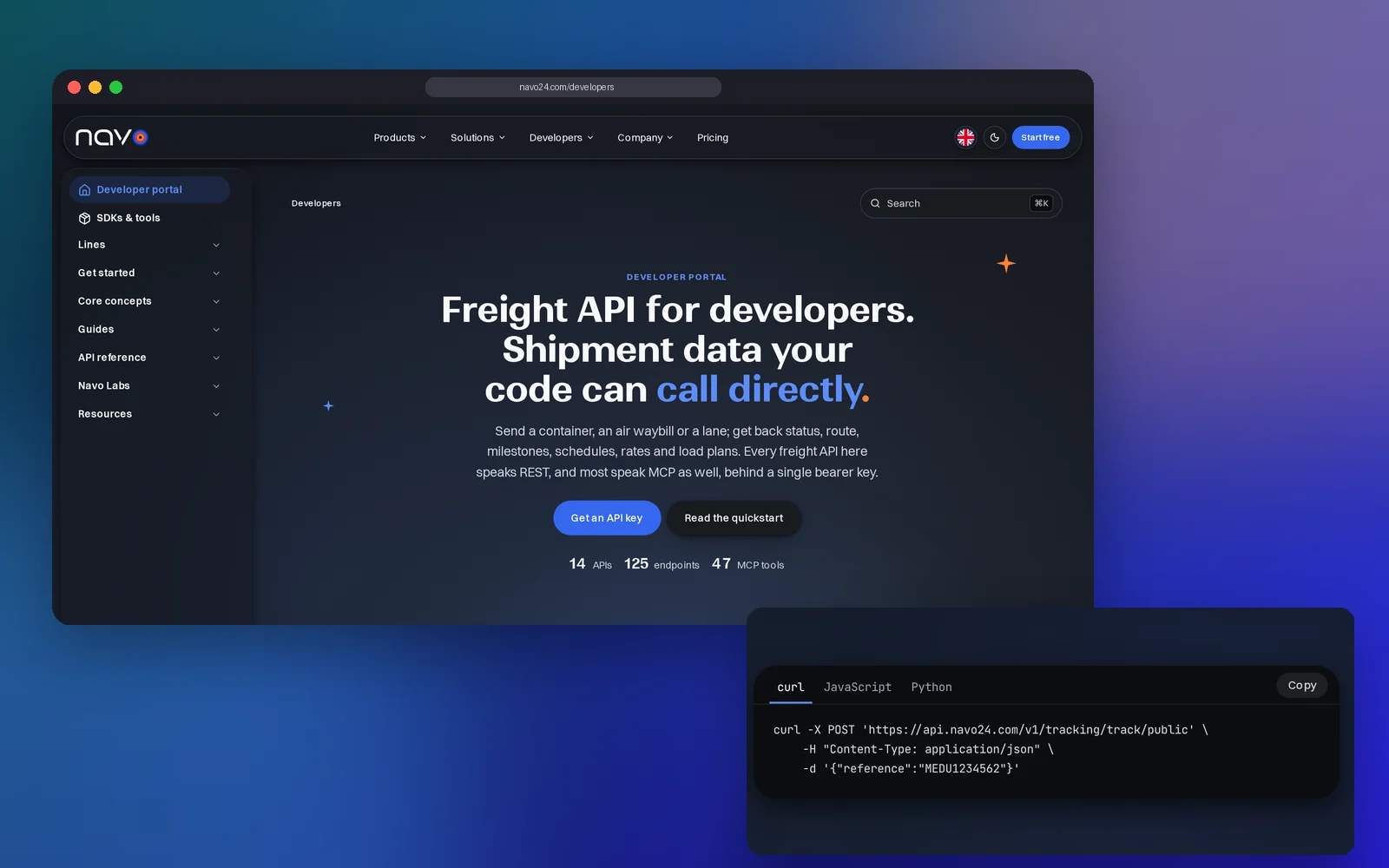
Navo24 developer portal with a curl request to the tracking API

Built for the stacks freight teams already run on

Overview

A TMS or marketplace sees one shipment; the carrier sees a booking, a bill of lading, a container number and a string of events. An FCL box carries an ISO 6346 identifier and moves from depot to shipper, through the terminal gate, onto a vessel with a UN/LOCODE port rotation, often via a transshipment hub, then by rail or truck to the consignee. Air freight adds an 11-digit air waybill and airline-specific status codes. Every party publishes its own events, in its own format, on its own schedule.

What goes wrong today

01

Portal connectors break on every redesign

A carrier changes its portal markup or adds a login step, and a hand-built connector returns stale data without raising an error. Multiply that by hundreds of carriers and maintenance becomes a full-time team.

02

Status vocabularies never line up

One line reports Gate in, another Received at CY, another Container loaded, all describing similar moments. Without mapping to a common model such as DCSA event types, your timeline and your alerts disagree with the carrier.

03

Identifiers point at different things

A booking number, a bill of lading number and an ISO 6346 container number each resolve differently, and the box prefix often names the lessor rather than the line. Wrong matching attaches events to the wrong shipment.

04

Agents answer without a source

A language model asked for an ETA will produce a plausible date if no tool is available. That date has no vessel, no port call and no timestamp behind it, and users cannot tell.

What Navo24 gives you

TrackingMCP

One tracking API across 240+ carriers

Send a container, bill of lading or booking number and receive normalised events, a predicted ETA and free-time alerts. Push updates to your system by webhook instead of polling, or let an agent call the same data through MCP.

  • REST API, webhooks and MCP tools
  • Predicted ETA, not only carrier estimates
  • Demurrage and free-time alerts per box
Open TrackingMCP
SchedulesMCP

Sailing schedules your UI can trust

Query 72,000+ sailings with cut-offs, transshipment legs and carrier on-time reliability. Use it to power booking forms, cut-off reminders and a reasoned view of how late a service usually runs.


  • Port to port sailings and cut-offs
  • Transshipment legs shown explicitly
  • On-time reliability by carrier
Open SchedulesMCP
World Sea Ports

Port facts without a reference build

Look up depth, maximum vessel size, berths and facilities for 2,900+ ports by UN/LOCODE. Use it to validate routings, flag draft limits and enrich every port field in your product.

  • Depths and maximum vessel size
  • Berths and terminal facilities
  • Keyed by UN/LOCODE
Open World Sea Ports
FreightRatesMCP

Indicative FCL rates and history

Add lane-level ocean rate indications and rate history to quoting screens, budgeting tools and agent answers. They are indications for planning, not bookable offers, and your interface should say so.

  • Indicative ocean FCL lane rates
  • Rate history for trend views
  • Same auth as tracking and schedules
Open FreightRatesMCP

How it works with Navo24

  1. Connect and authenticate once

    Get one API key, call the REST endpoints from your backend, or add the MCP server to your agent runtime.

  2. Register shipments by any reference

    Submit container, bill of lading or booking numbers as bookings are created in your TMS, ERP or marketplace.

  3. Receive events by webhook

    Store normalised milestones, ETA changes and free-time alerts, and trigger your own notifications and exceptions.

  4. Serve users and agents together

    Use the same tracking, schedule, port and rate data in your screens and in assistants, each answer tied to a source.

Rules and standards that apply

ISO 6346

Defines the container identifier of owner code, category letter, six-digit serial and check digit, which lets you validate numbers before you query.

DCSA Track and Trace event model

Standard event types for equipment, shipment and transport events give a common vocabulary to map carrier-specific statuses onto.

UN/LOCODE

Five-character location codes identify ports and inland points consistently across schedules, tracking and port reference data.

SOLAS Chapter VI verified gross mass

Packed export containers need a verified weight before loading, so VGM submission deadlines are a milestone your workflow may need to surface.

IATA air waybill numbering

A three-digit airline prefix, seven-digit serial and check digit identify an air shipment, and can be validated before an air tracking request.

Questions

What is the difference between a freight REST API and an MCP server?

A REST API is called by your own code with fixed endpoints and you decide how to present the result. An MCP server exposes the same capabilities as tools that an AI agent can discover and call by itself, so the assistant fetches live data instead of guessing. Navo24 offers both over the same data.

Which identifiers can I use to track an ocean shipment?

Container numbers, bill of lading numbers and booking numbers are the usual references. A container number follows ISO 6346: three owner letters, a category letter, six digits and a check digit. Check the format on your side first to reject typos before a lookup.

Why do two tracking sources show different statuses for the same box?

Carriers and terminals name and time their events differently, and some estimates are typed by hand rather than computed. Mapping events to a common model such as DCSA event types, and showing the source of each ETA, removes most of the disagreement.

Can I book freight through the rates API?

No. FreightRatesMCP returns indicative ocean FCL lane rates and rate history for planning and quoting context. Navo24 is a data and software platform, not a forwarder or carrier, so it does not sell space or handle cargo.

How do I stop an AI assistant inventing ETAs?

Give it a tracking tool and instruct it to answer only from the tool result, quoting the vessel, port call and timestamp. When the tool returns no data, the assistant should say so rather than estimate. MCP tools make this straightforward because the model calls the source directly.