Skip to content
Navo24Navo24
Wind, solar and project cargo

Renewables logistics.

Wind and solar cargo runs from oversized blades and tower sections on project vessels to solar panels in standard containers, and each move depends on port depth and quay limits. Navo24 gives tracking, schedules, rates, load plans and port reference data.

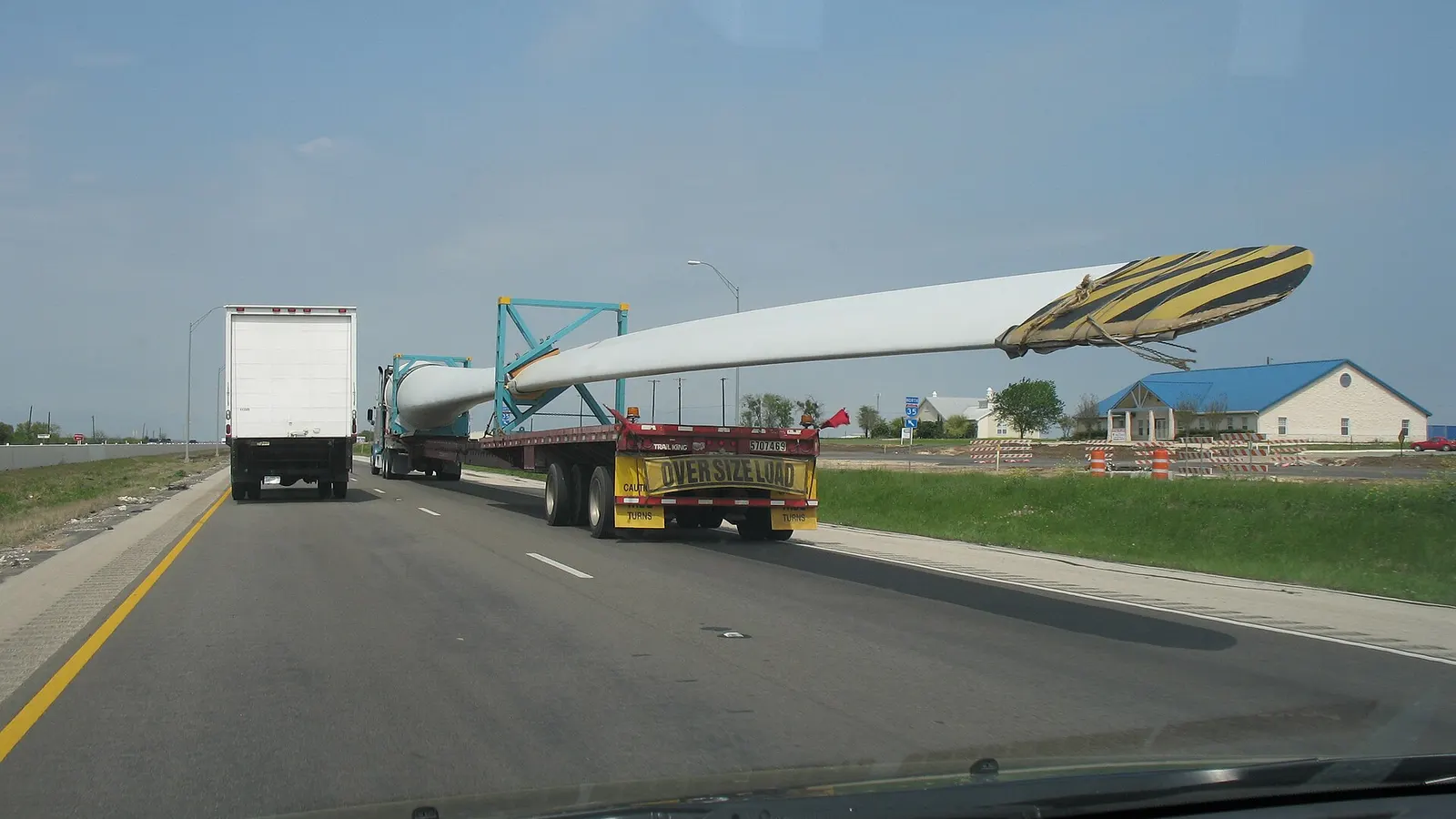
Wind turbine blade on Interstate 35 near Elm Mott, Texas

Overview

Wind and solar cargo moves in two very different ways. Blades, tower sections, nacelles, hubs and offshore foundations travel as breakbulk or project cargo on heavy-lift, multipurpose and general cargo ships, or on ro-ro vessels with roll trailers, and finish on lowboy trailers or self-propelled modular transporters. Onshore blades often exceed 70 m and offshore blades can exceed 100 m. Solar modules go the other way: palletised, loaded into 40 ft high cube containers and shipped on liner services from East Asia.

Most failures start with a mismatch between cargo and infrastructure. A quay that cannot take the point load, a berth with too little depth for the vessel, or a crane that is short on outreach can stop a project shipment. Irregular sailings turn one missed vessel into weeks of delay. For container loads, poor packing is found only at the site. Port reference data, vessel positions and load plans close these gaps early.


What goes wrong today

01

Port depth and quay strength limit options

Nacelles, tower sections and foundation pieces can weigh hundreds of tonnes, and the vessel needs enough water and a quay rated for the point loads. If the load or discharge port is wrong, the plan changes after the vessel is fixed.

02

Irregular project vessel sailings

Breakbulk and heavy-lift vessels often sail on demand or on loose rotations, with few departures per month. A missed vessel or a skipped call can push delivery outside the crane and installation window at the site.

03

Oversize cargo and inland road limits

Blades of 70 m or more and tower sections of about 4 m diameter need route surveys, escorts and permits for the last leg. A port that discharges the piece may still have no workable road, rail or barge exit.

04

Solar modules damaged by packing errors

Glass modules are hit by moisture, shifting pallets and wrong stacking, and the damage appears only at unloading. The container type, pallet layout and bracing must be settled before the doors are sealed.

What Navo24 gives you

World Sea Ports

Check port depth and facilities before fixing

World Sea Ports lists depths, maximum vessel size, berths and facilities for 2,900+ ports, so you can screen load and discharge ports against vessel draught and length. Quay load ratings and crane specifications still need written confirmation from the terminal.

  • Depths and maximum vessel size by port
  • Berths and facilities for project cargo
  • Shortlist ports before asking for terminal data
Open World Sea Ports
Vessel Library

Follow project vessels by name or IMO

Vessel Library shows merchant ships by name, IMO or MMSI with the last known AIS position, which helps when a heavy-lift or multipurpose vessel carries your blades or towers. Compare position and speed with the declared ETA to catch delay early.

  • Search by vessel name, IMO or MMSI
  • Last known AIS position
  • Compare position against the declared ETA
Open Vessel Library
SchedulesMCP

Plan solar container moves on real sailings

SchedulesMCP covers 72,000+ container sailings with cut-offs, transshipment and carrier on-time reliability. Use it for module shipments in 40 ft boxes, and pick services that still sail reliably against your delivery date.

  • Cut-offs and transshipment points
  • Carrier on-time reliability
  • Container services only, not project charters
Open SchedulesMCP
LoadingMCP

Plan pallets and crates before sealing

LoadingMCP builds 3D load plans for pallets, crates and cartons in containers and trucks. For solar modules it shows how many pallets fit, the weight split and how the floor loads before the box is sealed.

  • 3D plans for pallets and crates
  • Weight distribution per container
  • Container type chosen before packing
Open LoadingMCP

How it works with Navo24

  1. Screen ports and vessel limits

    Check depth, maximum vessel size and facilities at candidate load and discharge ports against the piece dimensions and weights.

  2. Match cargo to services

    Compare container sailings for modules and confirm the vessel, owner and rotation for breakbulk before the booking is final.

  3. Plan the load and packing

    Build the pallet and crate layout for each container, check weights and issue the verified gross mass before the cut-off.

  4. Track to the installation window

    Follow the container or vessel to discharge, compare ETA with the site schedule and warn the site team if the call changes.

Rules and standards that apply

SOLAS Chapter VI, verified gross mass (VGM)

Every packed container, including module boxes, needs a signed VGM before loading, or the terminal will not load it.

IMO/ILO/UNECE CTU Code

Sets out how cargo should be packed, blocked and secured in containers, which matters for glass modules that shift or take on moisture.

IMO CSS Code and the Cargo Securing Manual

Breakbulk and project cargo on ships must be lashed according to the vessel Cargo Securing Manual and the CSS Code principles.

Convention for Safe Containers (CSC)

The CSC plate shows the maximum gross weight and structural approval of a container, so overloaded module boxes can be rejected.

Incoterms 2020 (FOB, FCA, DAP, DPU)

The chosen rule decides where risk passes for blades, towers or modules, and who arranges loading, lashing and discharge at the port.

Questions

How are wind turbine blades shipped?

Blades travel as breakbulk or project cargo, usually on heavy-lift or multipurpose vessels, in dedicated frames or root and tip fixtures, or on ro-ro ships with roll trailers. They then go by special trailer to the site. Blade length, often 60 to over 100 m, drives port, vessel and road route choices.

How many solar panels fit in a 40 ft container?

A 40 ft high cube container commonly holds several hundred modules, often 600 to 700 or more, depending on module size and pallet layout. The container payload and pallet height decide the limit. A 3D load plan gives the number for your exact module dimensions.

What port depth is needed for a heavy-lift vessel?

It depends on the vessel draught, which varies by size and load, so there is no single figure. Check the depth alongside the berth and in the approach channel against the vessel declared draught, and allow for tide. World Sea Ports gives depths and maximum vessel size as a first check.

Is wind turbine cargo classed as out of gauge?

Blades, tower sections and nacelles usually exceed the dimensions of standard containers and ship as breakbulk or on flat racks, so they are treated as out of gauge or project cargo. Surcharges and stowage rules then depend on the carrier or vessel operator. Confirm dimensions and weights in writing at booking.

Does Navo24 move or insure renewable energy cargo?

No. Navo24 is a data and software platform and does not move, store, insure or handle cargo. It provides tracking, schedules, rates, load plans and port reference data to the people who plan these shipments.