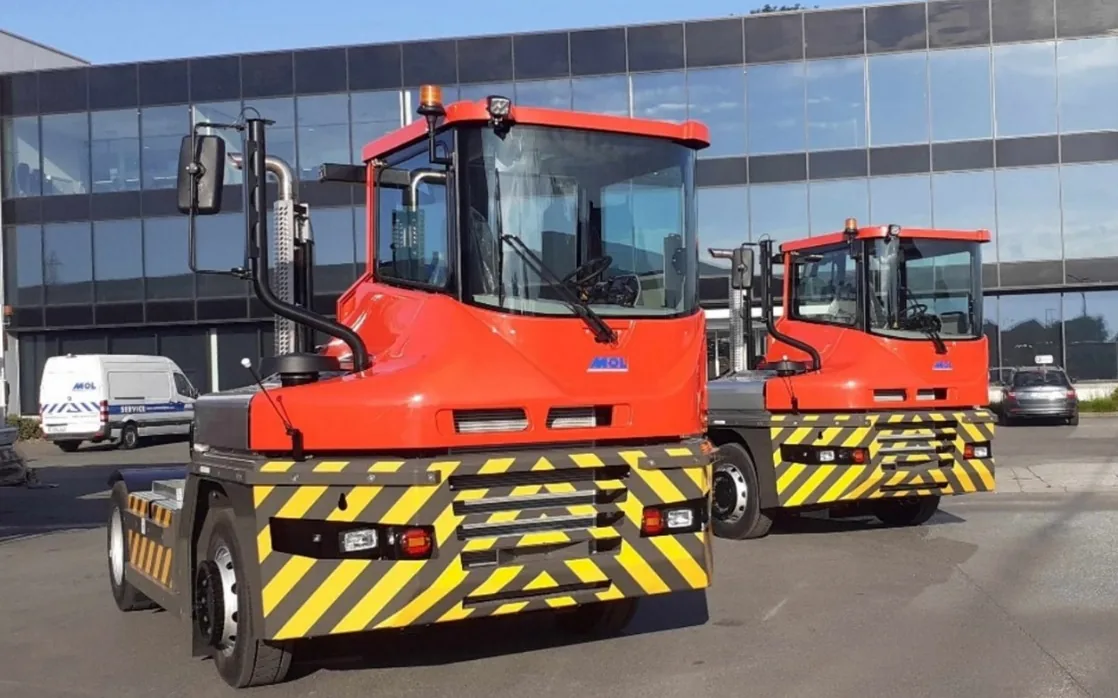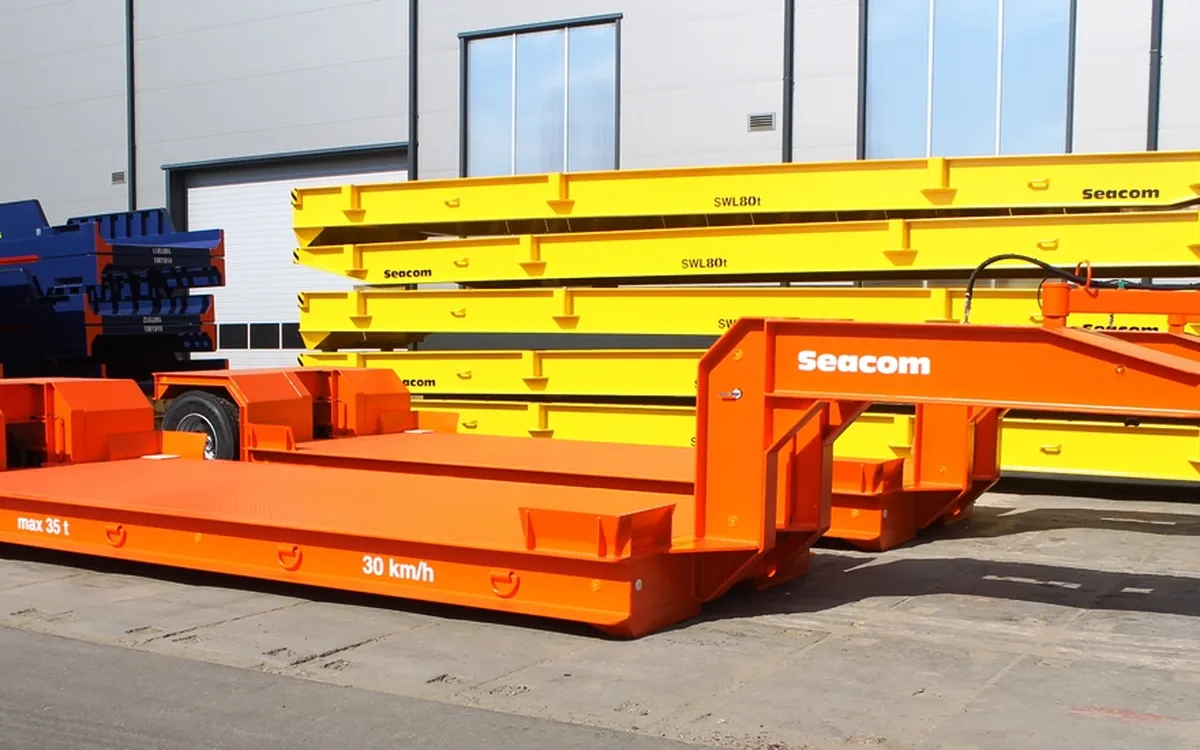
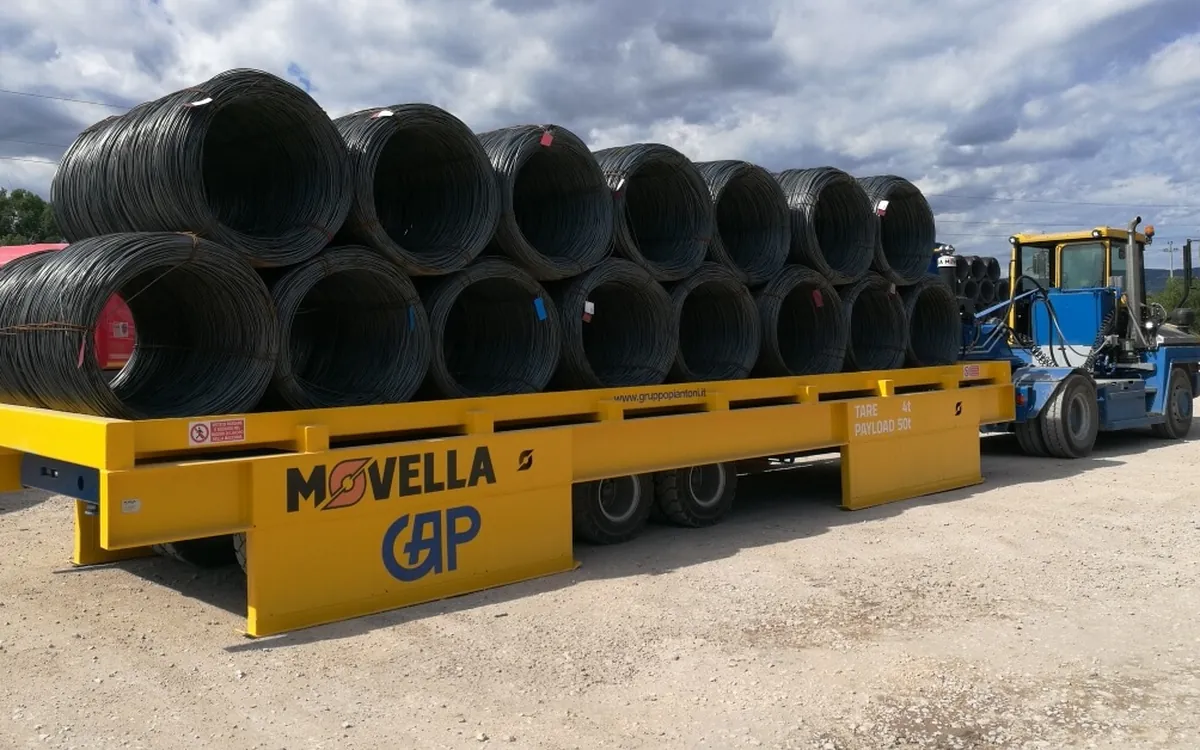
Low platform on small solid tyres that a tractor tows on and off the ship through a gooseneck. Carries cargo that cannot roll on its own: steel, machinery, stacked containers.
What a roll trailer is
A roll trailer looks like a flat rack container with a set of wheels at the rear and no front axle. The front end rests on the ground or on a gooseneck. It lets static cargo, from steel to machinery to stacked containers, be handled as RoRo cargo: rolled on, lashed and rolled off.
MAFI Transport-Systeme developed the system of tractor, gooseneck and cargo trailer in the 1960s. Wikipedia notes that the brand name became generic, so a MAFI trailer today can be built by any maker.
How it works
A gooseneck coupled to the tractor's fifth wheel slides under the front of the trailer and lifts it. The tractor then tows the trailer up the ramp and stows it on deck, where it is lashed for the voyage. The gooseneck is only fitted when needed, so the same tractor can still move ordinary semi-trailers.
MAFI lists simple one-man operation and automatic coupling, and says the system triples the transport capacity of the tractor. Lighter roll trailers can also be moved by forklift with a forklift gooseneck (MAFI type GSH), which handles payloads up to 50 t.
Sizes and key figures
Standard platforms follow container lengths of 20, 30 and 40 ft, and custom sizes are built to order. Payload depends on the design; MAFI states systems for up to 250 t, with the gooseneck selected to match the tractor's fifth wheel capacity.
The deck can be timber, steel or an open skeleton frame, with twistlocks, stanchions, lashing rings, corner guides or locating pins. Trailers come with solid rubber tyres as standard and super elastic tyres as an option. Coil beds turn a trailer into a steel coil carrier.
Where it is used and what cargo
Roll trailers work on deep-sea RoRo and con-ro vessels and in short-sea ferry trades. They carry static cargo that cannot drive aboard: transformers, boilers, machinery, steel coils and bundles, timber, boats, project cargo and stacked containers. Shippers book the cargo as RoRo, and the line supplies the trailer.
Wikipedia notes that roll trailers are offered to shippers by the shipping lines, and that manufacturers lease extra units to lines at peak times for a daily hire fee. After a short free time in port, the line charges demurrage so the consignee clears the trailer quickly. Empty trailers are stacked on top of each other and lashed for repositioning. Freight rates for cargo through these terminals can be compared at rates.navo24.com.
Industrial use and trends
The same platforms are used in steelworks, paper mills and logistics centres as mobile storage: load once, park, and tow when needed. MAFI also builds container chassis for terminal use, up to 45 ft long with payloads up to 70 t. The tractors that pull roll trailers are moving to electric drive, which does not change the trailer itself but changes the duty cycle a terminal can plan.
How to choose: pros and limits
Match the trailer to the heaviest load per square metre, not just total weight, and to the deck strength and ramp gradients of the ships it will use. Pick the deck surface and lashing points for the cargo, and the gooseneck for the tractor. Pros: fast loading of static cargo, no cranes needed on the ship, and mobile storage on the quay. Limits: low ground clearance, solid tyres for low speeds only, and demurrage costs if the trailer waits too long.
Variants
Questions shippers ask
Why is a roll trailer called a MAFI?
MAFI Transport-Systeme introduced the tractor, gooseneck and trailer system in the 1960s, and the name became generic.
How much can a roll trailer carry?
It depends on the build. MAFI states roll trailer systems for payloads up to 250 t.
Who supplies the roll trailer?
Usually the RoRo shipping line, from its own fleet or leased units. Demurrage applies after the free time in port.
Can a forklift move a roll trailer?
Yes, with a forklift gooseneck. MAFI's GSH type moves payloads up to 50 t.