




















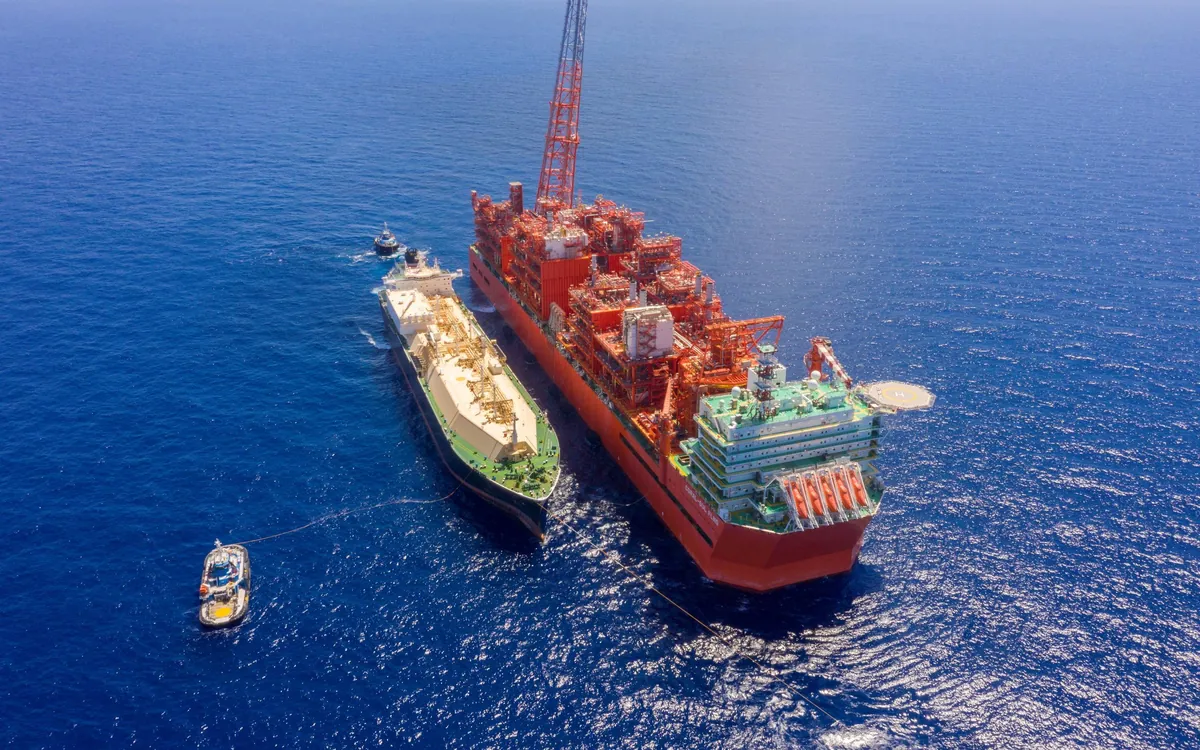
Loading arms on a floating LNG plant that reach across to an LNG carrier moored alongside. A tensioned targeting line guides the arm onto the manifold while both hulls move.
What it is
A floating LNG (FLNG) unit is moored over a gas field. It processes and liquefies the gas, stores the LNG in its hull and offloads it to LNG carriers. Without a reliable offshore transfer system, the gas would need a pipeline to an LNG plant on land.
Transferring LNG offshore is harder than at a jetty, because winds, waves and currents move both vessels. Technip Energies supplies side-by-side arms for these units and a tandem system for rougher conditions.
How side-by-side transfer works
In side-by-side mode the LNG carrier moors along the FLNG unit. Loading arms on the FLNG reach across to the carrier's manifold. Technip Energies uses a targeting system to make connection repeatable and safe: a fibre rope stretched at constant tension between the arm and the carrier guides the arm towards the manifold as both hulls move.
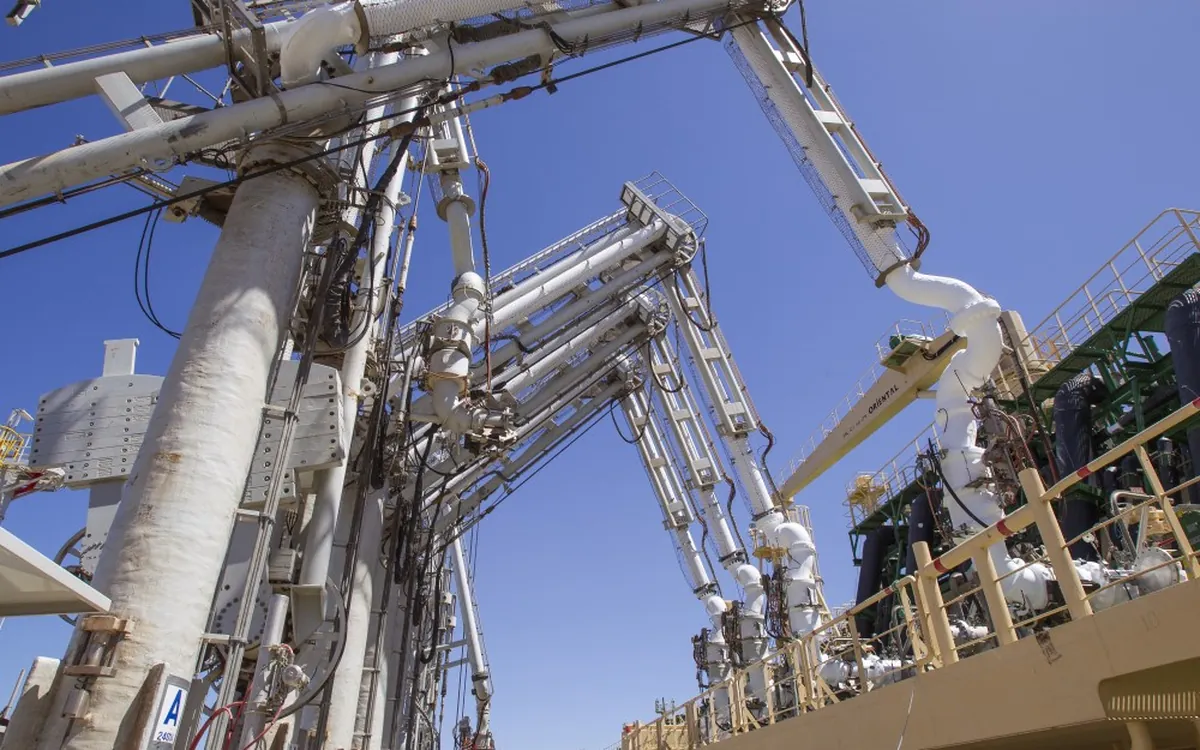
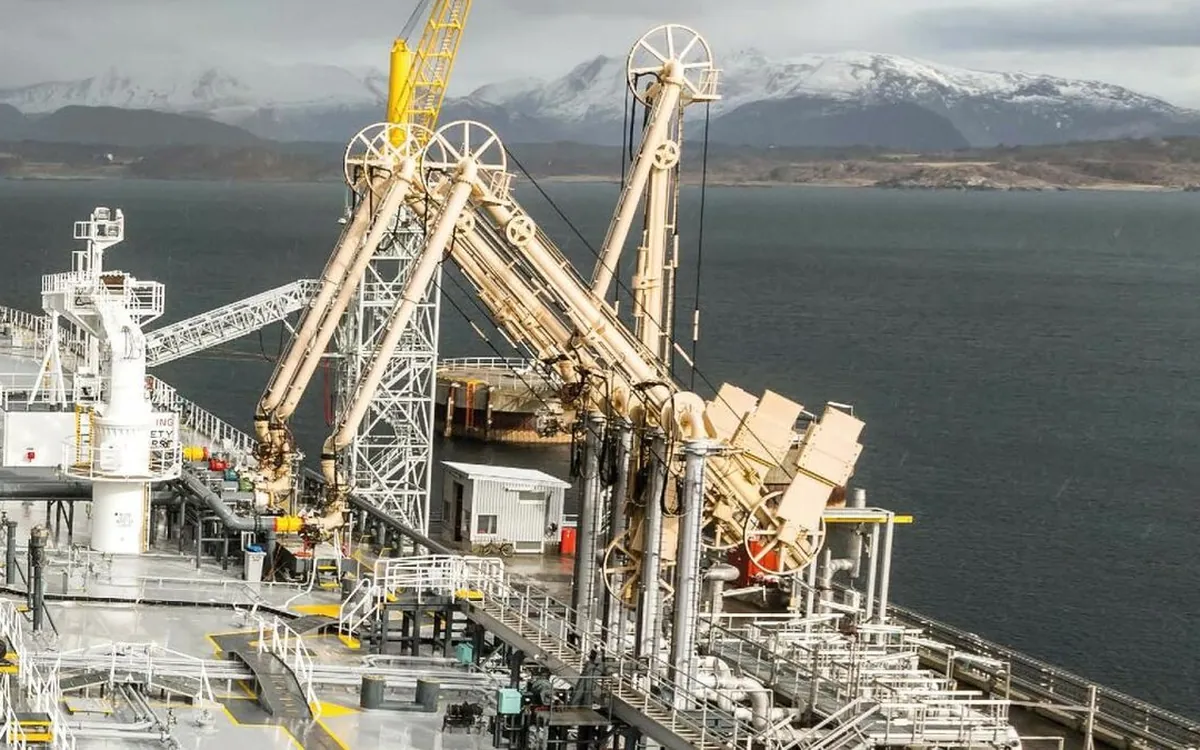
The arms use the same key components as onshore LNG arms, including swivel joints, the emergency release system (ERS) and the quick connect/disconnect coupler (QC/DC).
Connecting two moving hulls is harder than connecting a ship to a jetty, because both the FLNG unit and the carrier roll and heave, each in its own way. The arm has to follow that relative motion for the whole transfer, and the ERS has to release cleanly if the motion grows beyond the design limits.
Key figures and sea states
Technip Energies gives side-by-side transfer up to a significant wave height (Hs) of 2.5 m. Its Parallel Loading System (PLS), which combines side-by-side and tandem features and accepts standard LNG carriers, works up to Hs 4 m. The tandem ATOL (Articulated Tandem Offshore Loader) is fully rigid and works up to Hs 5.5 m, with flow rates up to 16,000 m³/h of LNG through 20" full-bore product lines.
On Shell's Prelude FLNG off Western Australia, Technip Energies supplied seven 16" arms: four for LNG and three for LPG. Prelude is 488 m long and was built for gas fields about 200 km offshore. Golar Hilli, the first converted floating liquefaction vessel, received four 16" LNG arms, and the brochure also lists offshore arms for Petronas' Satu and Dua FLNGs.
The brochure's glossary names its offshore systems: ATOL (Articulated Tandem Offshore Loader), ARCOS (Articulated Rigid Catenary Offloading System), ALLS (Amplitude LNG Loading System) and OLAF (Offshore Loading Arm Footless).
Where it is used
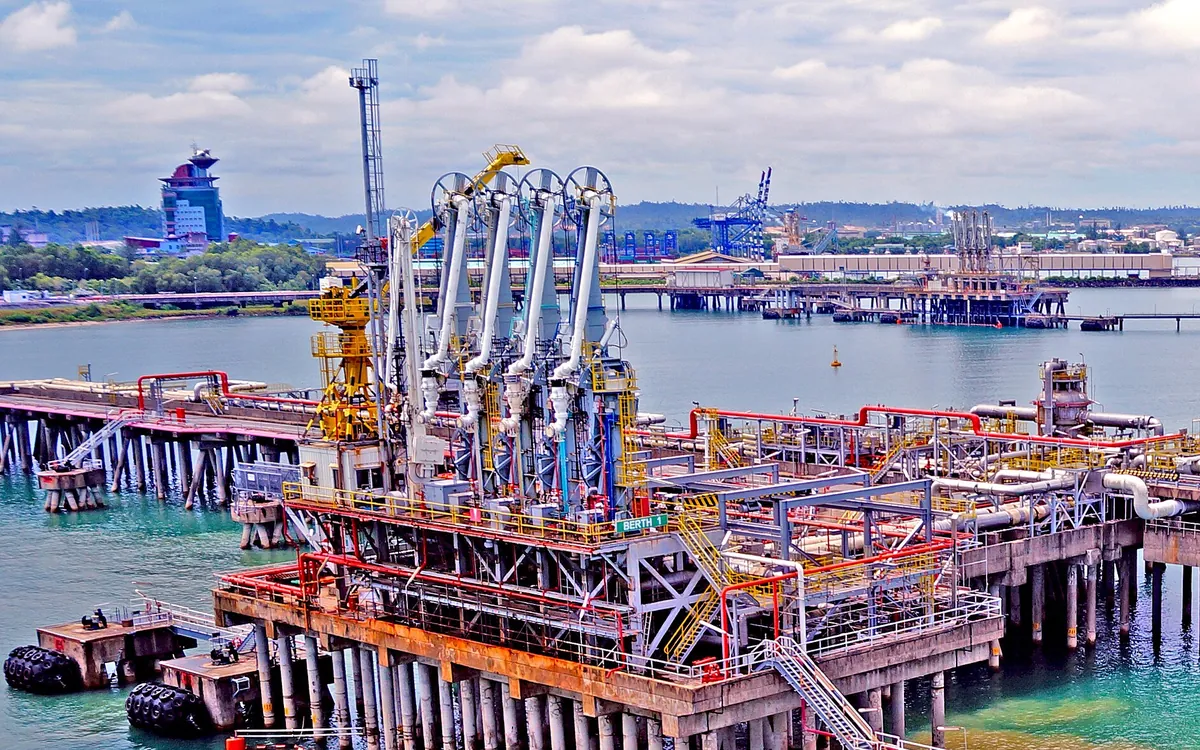
The main users are FLNG units, which offload LNG and other liquid by-products such as LPG and condensate to export carriers. The same technology serves FSRUs that receive LNG from carriers alongside, and ship-to-ship LNG transfer near the shore.
Technip Energies' ARCOS, a rigid catenary system of three articulated 16" stainless steel pipe assemblies, is offered for nearshore ship-to-ship transfer at FSRUs. The maker states it is at least 30% faster than flexible hose solutions. Freight rates for cargo through these terminals can be compared at rates.navo24.com.
Prelude was designed to produce 5.3 million tonnes of liquids a year: 3.6 million tonnes of LNG, 1.3 million tonnes of condensate and 400,000 tonnes of LPG, all offloaded at sea. Petronas' PFLNG Satu, off Sarawak in Malaysia, loaded its first cargo onto the 150,200 m³ LNG carrier Seri Camellia on 3 April 2017.
Trends
Floating liquefaction is growing as a way to develop remote or smaller gas fields. Electric drives instead of hydraulics, and remote inspection with drones, reduce maintenance offshore.
How to choose, strengths and limits
Choose the transfer mode from the site's sea states: side-by-side for calmer waters, PLS or tandem for exposed sites. Arm size and number follow from the carrier size and offloading time.
Rigid arms give a high flow rate and a proven connection. They need a dedicated design and integration with the FLNG hull and mooring, and side-by-side transfer stops when the waves exceed the limit.
Variants
Questions shippers ask
How is LNG transferred offshore?
By rigid loading arms reaching from the FLNG to a carrier moored alongside, or through a tandem system to a carrier moored behind it.
What wave height can offshore LNG arms work in?
Technip Energies gives Hs 2.5 m for side-by-side arms, Hs 4 m for its Parallel Loading System and Hs 5.5 m for the tandem ATOL.
What flow rate can offshore LNG transfer reach?
Technip Energies' ATOL tandem system reaches up to 16,000 m³/h of LNG through 20" full-bore lines.
Which FLNG units use offshore loading arms?
Shell's Prelude, with four LNG and three LPG arms, Golar Hilli, and Petronas' Satu and Dua FLNGs.