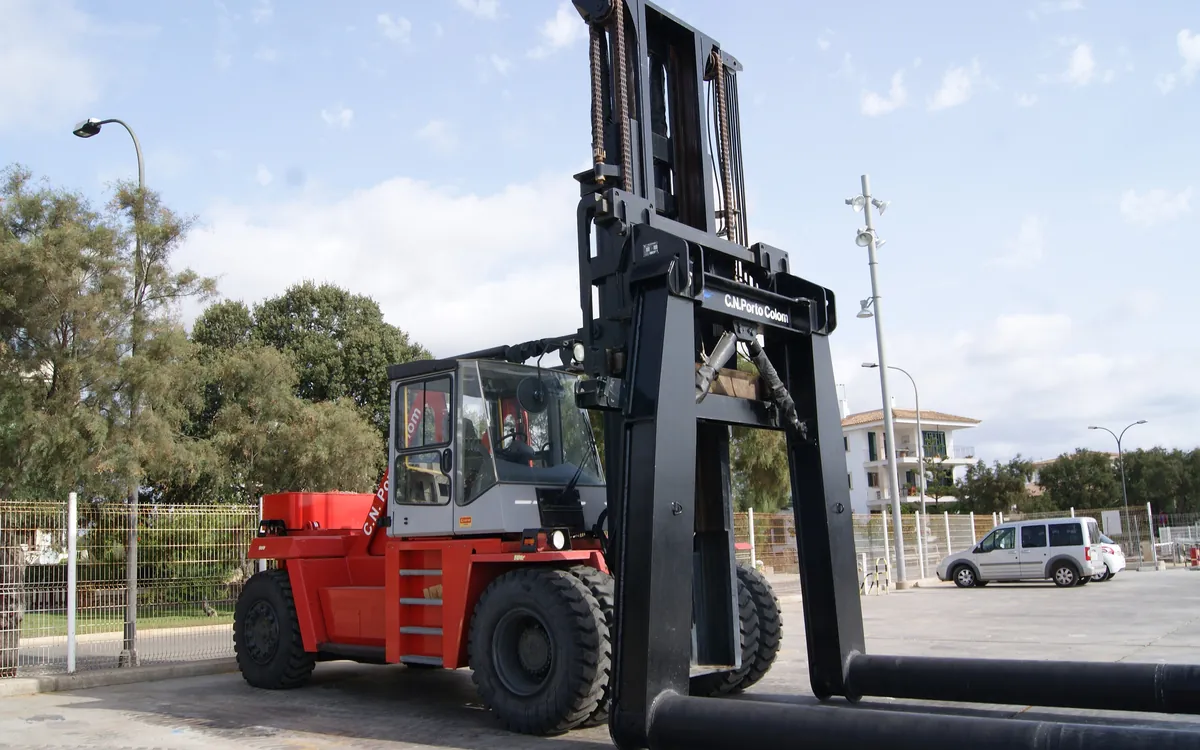
Counterbalanced forklift for steel, timber, paper rolls and machinery, usually with sideshift and fork positioning. The workhorse between the hook and the shed.
What a heavy forklift is
A counterbalanced forklift carries its load on forks in front of the front axle and balances it with weight at the back. Heavy port models use the same principle on a far larger scale, with service weights of 28.5 to 41.5 t on the Kalmar DCG range. They work beside cranes at breakbulk berths, feed sheds and load road and rail vehicles.
Most port units carry integrated sideshift and fork positioning, so the driver can line up the forks with a coil, a steel bundle or a machine skid without moving the truck.
How it works
A diesel engine drives the wheels through a transmission and powers hydraulic pumps for the mast, tilt, sideshift and fork positioning. The mast lifts the carriage, and attachments replace the forks for special cargo. Rated capacity applies at a stated load centre, the distance from the fork face to the load's centre of gravity, and drops when the load sits further out or higher up.
Kalmar's EGO cab sits high for visibility over the load. The cab can be tilted for service access, and the driver changes drive modes from a display.
Sizes and key figures
The Kalmar DCG180-330 family covers 18, 20, 22, 25, 28, 30 and 33 t at a 1,200 mm load centre. Full capacity is available up to 7,000 mm lift height with duplex freelift masts and integrated sideshift and fork positioning. Wheelbase runs from 4,000 to 4,750 mm.
Engines are rated 168 kW at 2,200 rpm and meet EU Stage V and US EPA Tier 4 final. Kalmar lists an unloaded lifting speed of up to 0.39 m/s.
Where it is used and what cargo
Heavy forklifts handle steel coils, plates and bundles of bar or pipe, packaged timber and sawn goods, paper reels, bagged cargo on large slings, machinery on skids and empty containers in smaller ports. They also load and unload roll trailers and position cargo under a harbour crane's hook.
Because they are self-contained, they suit terminals where cargo arrives on varied vehicles and has to be stacked in a shed or on open storage. Freight rates for cargo through these terminals can be compared at rates.navo24.com.
Emissions and electrification
Diesel remains the main power for 18 to 33 t trucks in ports. Kalmar's Economy drive mode, according to the maker, cuts fuel use by up to 15%. Electric heavy forklifts are now offered by several makers and are spreading where charging is available, mainly for shed work and steel handling with short, repeated cycles.
How to choose: pros and limits
Choose capacity at the real load centre: a 25 t coil on long forks may need a larger truck than its weight suggests. Check lift height for stacking, attachments (coil ram, paper roll clamp, fork positioner), turning space in the shed and floor or quay bearing capacity, because axle loads under full load are high. Pros: flexible, quick to deploy, no fixed infrastructure. Limits: high ground loads, limited stacking height compared with reach stackers and cranes, and capacity that drops as the load moves forward.
Variants
Questions shippers ask
How much can a port forklift lift?
Heavy port forklifts range widely; Kalmar's DCG range lifts 18 to 33 t at a 1,200 mm load centre.
What is a load centre?
The distance from the fork face to the load's centre of gravity. Rated capacity applies only at that distance or closer.
How high can a heavy forklift lift at full capacity?
On the Kalmar DCG180-330, full capacity is available up to 7,000 mm lift height with the specified masts.
Are heavy forklifts available electric?
Yes, several makers now offer electric heavy forklifts, though diesel is still most common in ports.