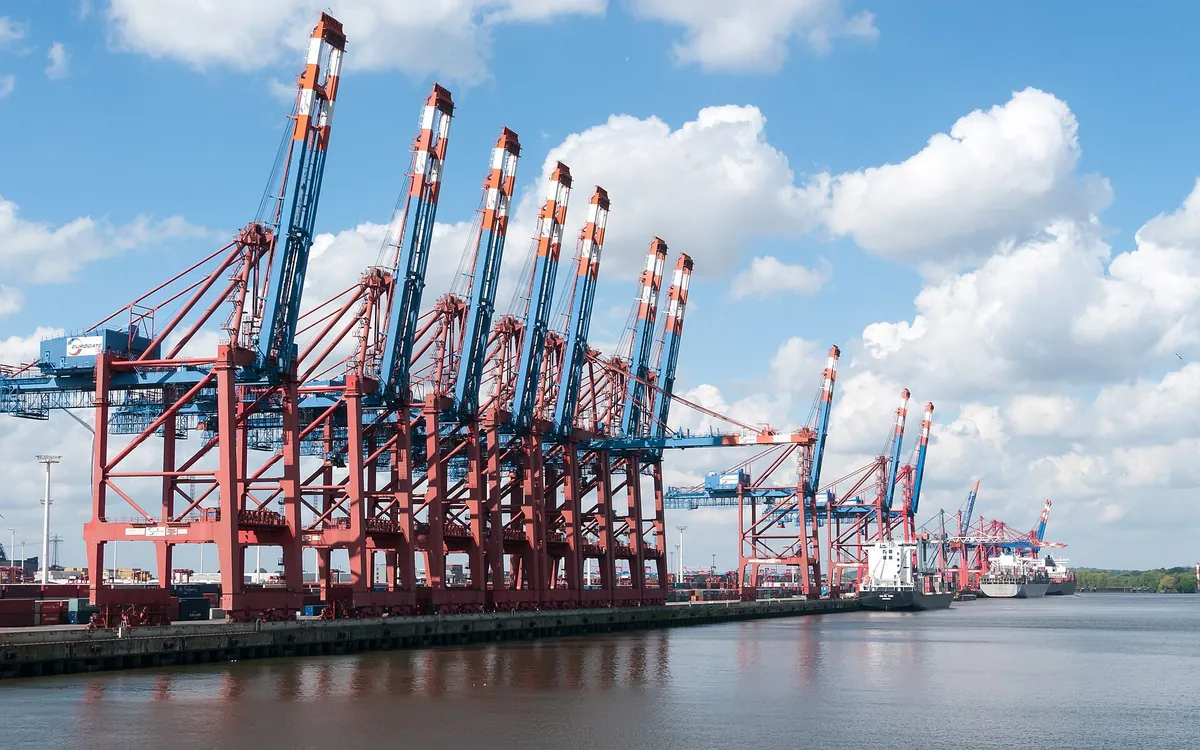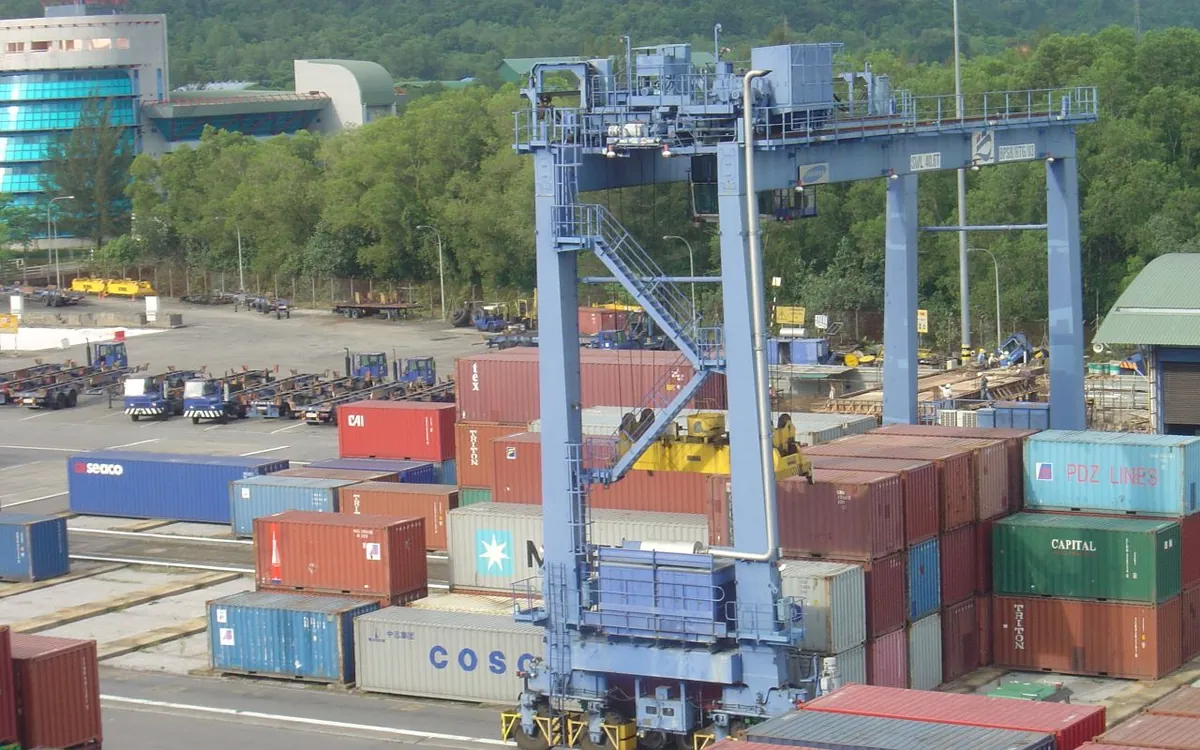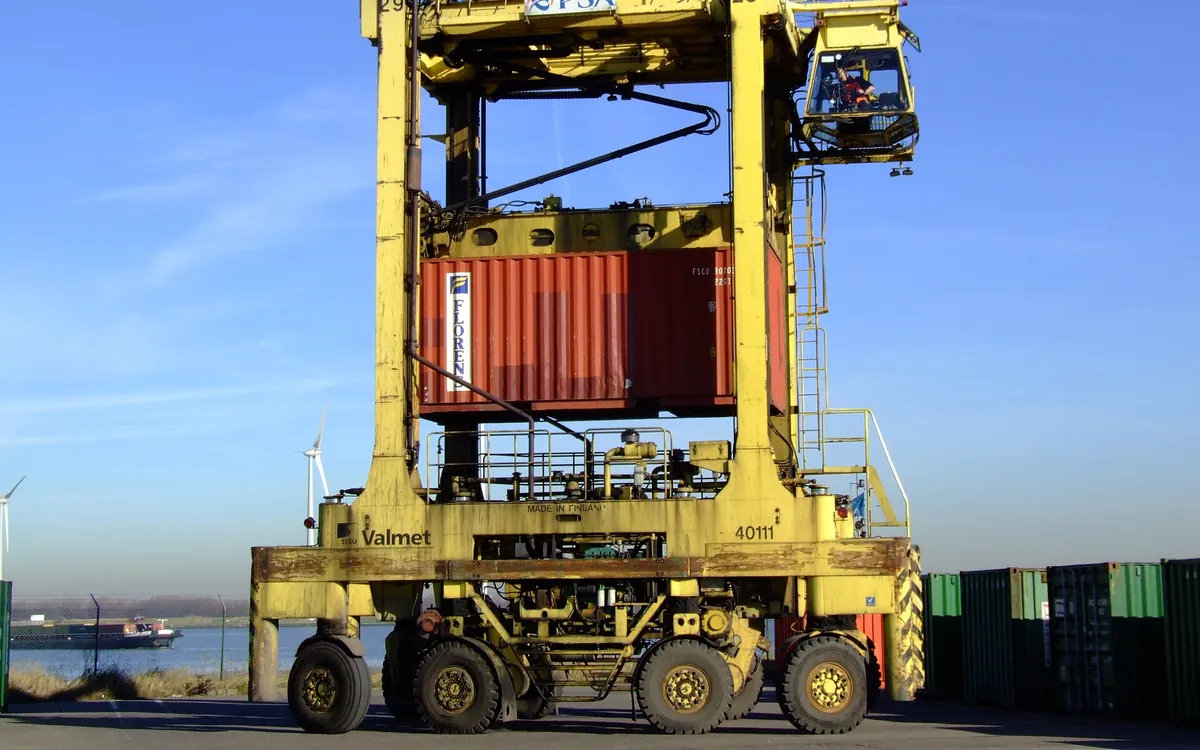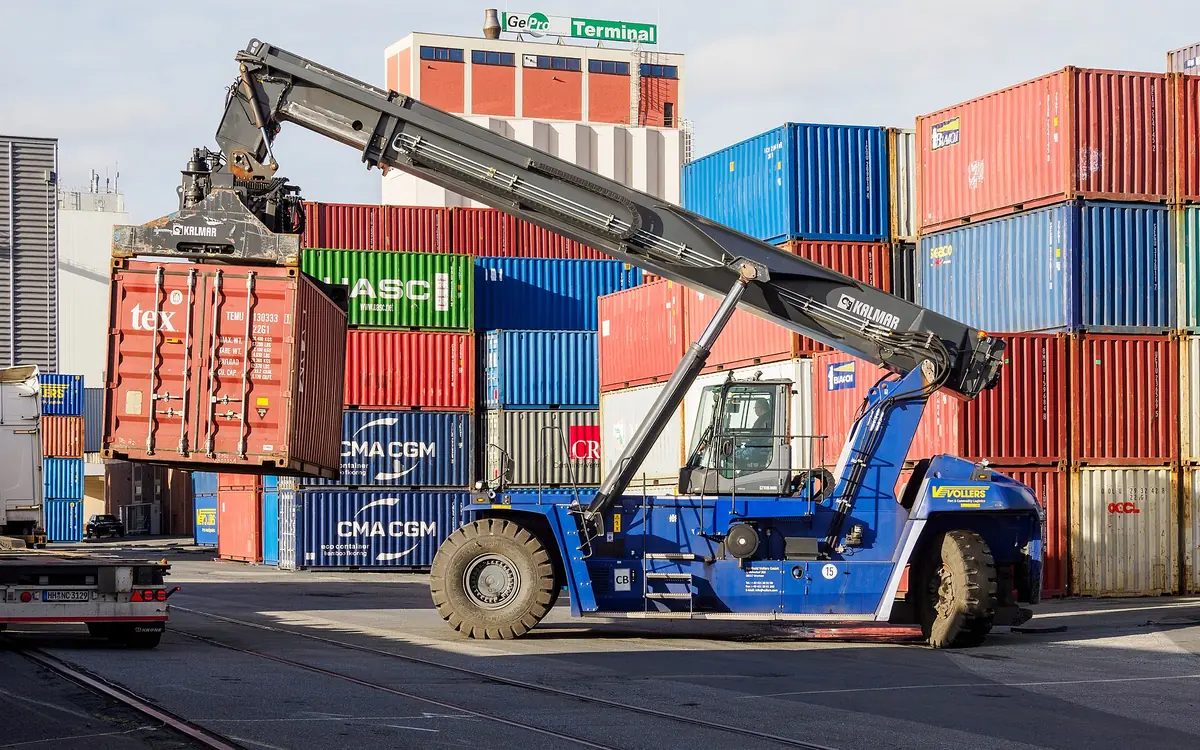





















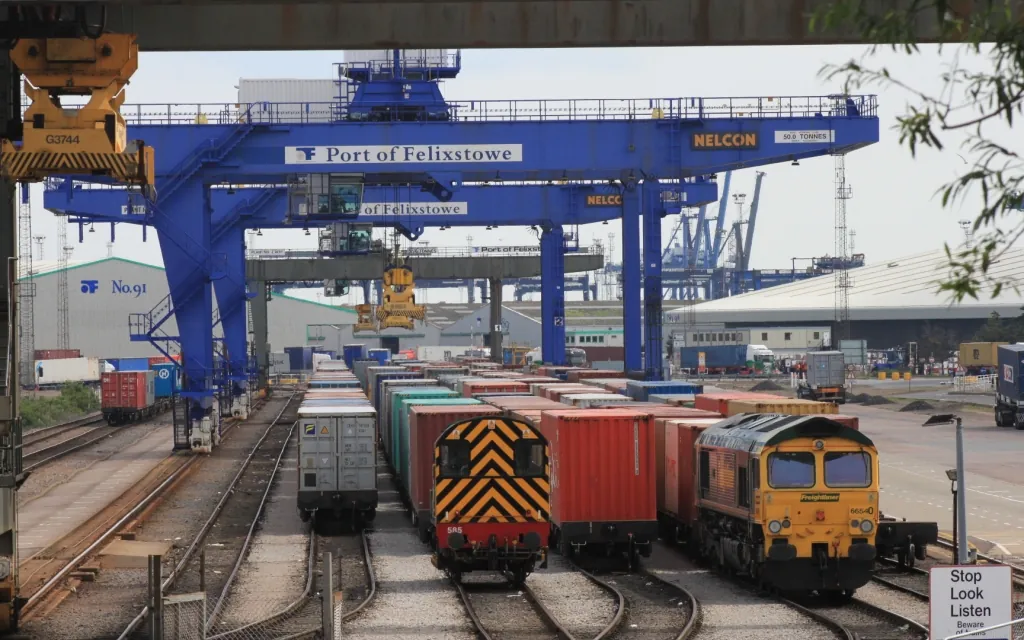
Gantry on rails over a fixed block or over rail tracks. Wider spans and cantilevers than an RTG; automated versions (ASC, ARMG) run most new yards.
What an RMG is
An RMG is a gantry crane whose legs travel on steel rails laid along the ground. The span between the rails covers several container rows and sometimes truck lanes or rail tracks, and cantilevers can extend beyond the legs on one or both sides.
Being tied to rails, the crane serves one block or one rail terminal for its whole life. In return it gets mains power, precise positioning and a stable path, which make it the natural choice for automated stacking.
How it works
The trolley traverses the double-girder bridge and carries the hoist, headblock and spreader. On Konecranes intermodal cranes the trolley can also slew, turning the box by up to 310 degrees, so a container can be turned to face the right way on a wagon or truck.
Power comes through a cable reel fed from the middle or end of the runway. Anti-collision lasers keep neighbouring cranes apart, storm tie-downs hold the crane in high wind, and the spreader can weigh containers to support SOLAS verified gross mass rules.
Visibility is handled by cameras: Konecranes fits a pan-tilt-zoom camera on the trolley, four fixed cameras on the spreader and four on the bogies, and anti-collision lasers sit in the bogies. Spreader attachments such as flippers can be added for rail work.
Sizes and key figures
Konecranes gives a maximum span of 48 m, cantilevers up to 2 x 18 m and lift height up to 19 m (1-over-5). Standard capacity is 40 to 50 t, up to 45 t with grapple arms for trailers, and up to 65 t on heavy-duty cranes for twin lifts.
Hoisting runs at 30 to 45 m/min loaded and 60 to 90 m/min empty. Trolley and gantry travel each reach 120 to 150 m/min, and the trolley slews at 1.6 to 2 rpm.
Where it is used
Two layouts dominate. In intermodal rail terminals the crane spans several tracks plus a road lane and transfers boxes and swap bodies between trains, trucks and a buffer stack. In port yards, automated stacking cranes work blocks laid out end-on to the quay, with transfer areas at each end for terminal vehicles on the waterside and road trucks on the landside.
They handle the same cargo as other yard cranes: full and empty containers, reefers and, with grapple arms, intermodal trailers. Freight rates for cargo through these terminals can be compared at rates.navo24.com.
Because the trolley can slew, an intermodal RMG can turn a container so its doors face the right way before it is set on a wagon or a truck, which saves a separate handling step in the terminal.
Automation and energy
RMGs run on grid power, so they have no exhaust emissions at the point of use. On automated cranes the operator moves from the cab to a remote station and takes control only for tasks the system cannot complete alone, typically at the truck interface.
Konecranes alone reports more than 600 ASCs operating worldwide, built since 2006, which shows how standard automated rail-mounted yards have become.
How to choose, pros and limits
The RMG suits high-volume yards where the layout is fixed for decades. It gives dense stacking, low energy cost per move, reliable automation and wide spans that a tyre-mounted crane cannot match.
The limits are the civil works for rails and foundations and the loss of flexibility: an RMG cannot be moved to another block when volumes shift. In smaller or changing yards an RTG or straddle carrier system is often cheaper.
Variants
Questions shippers ask
What is an ASC?
An automated stacking crane: a rail-mounted gantry crane that stacks containers without an operator in the cab, with remote staff handling exceptions.
How wide can an RMG be?
Konecranes builds spans up to 48 m with cantilevers up to 18 m on each side.
Why do automated terminals prefer RMGs to RTGs?
Rails give a fixed, precise path and grid power, which simplifies automation and removes diesel emissions.