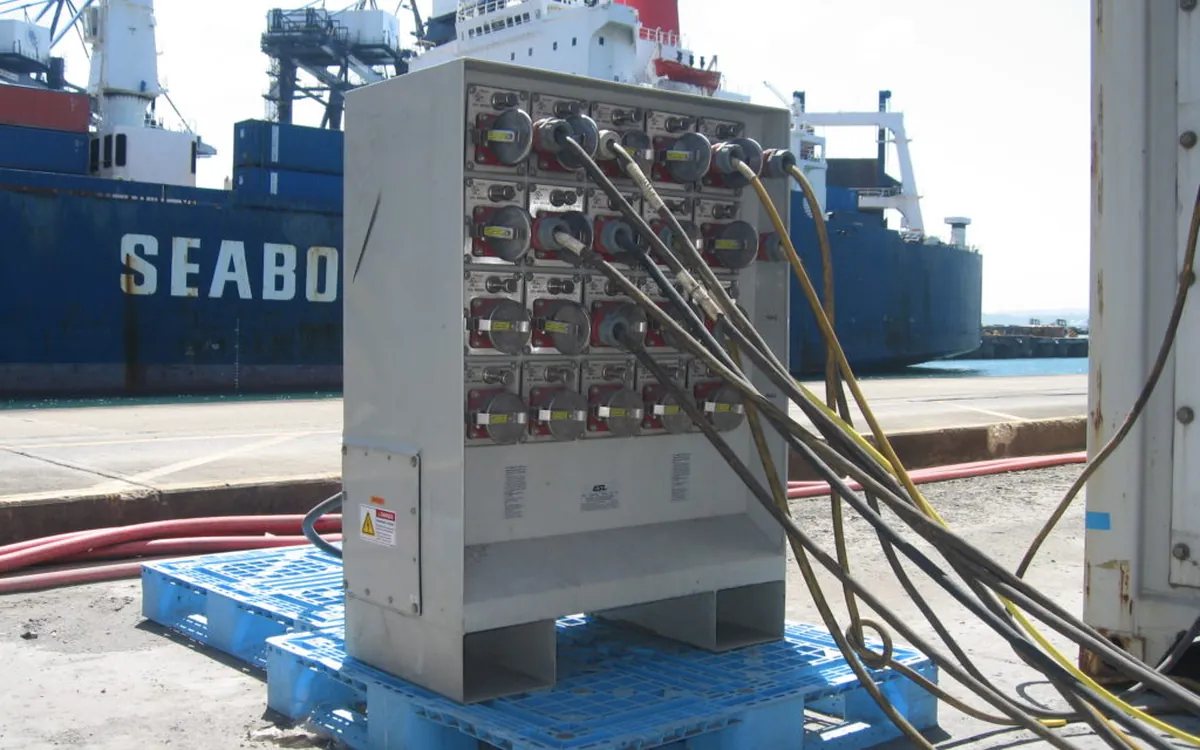
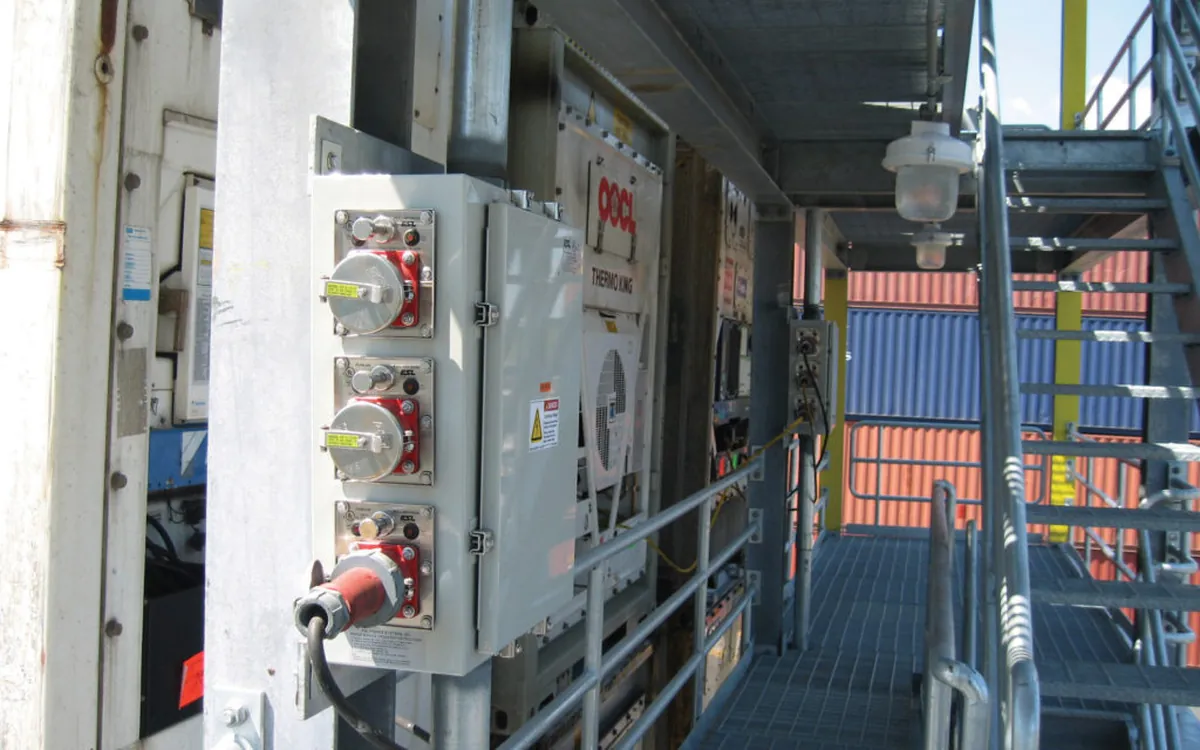
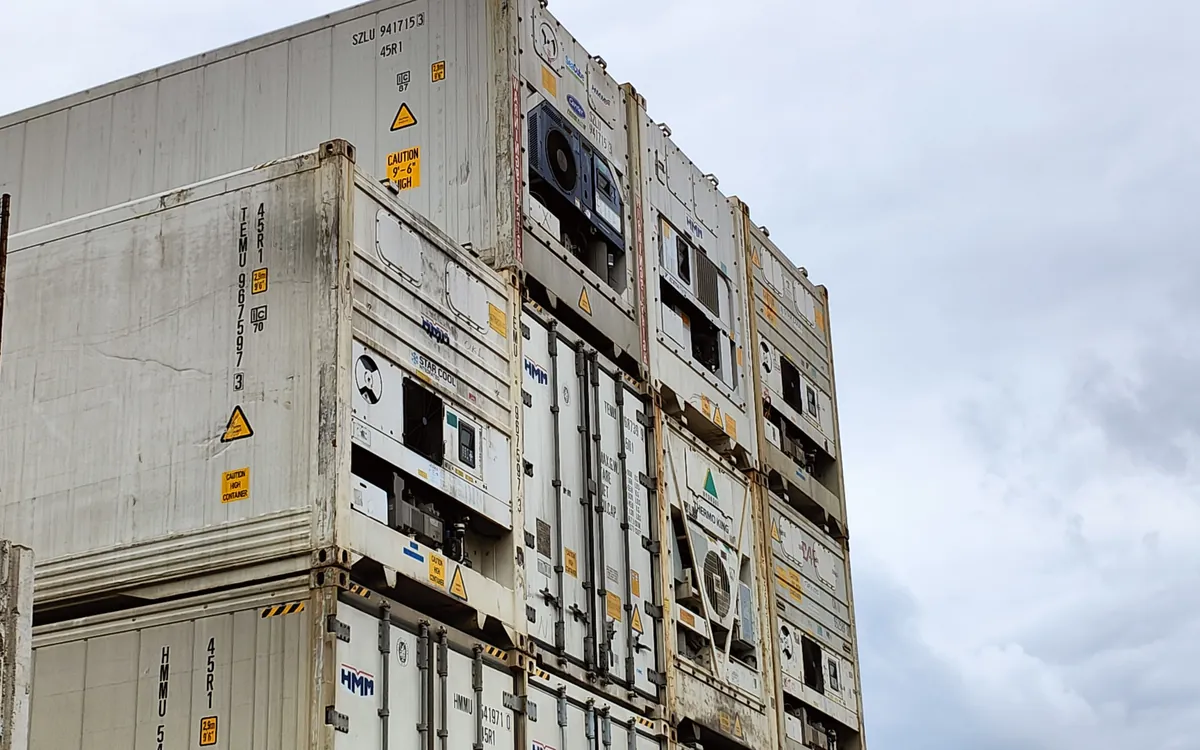
Safety-interlocked power sockets that feed refrigerated containers in the yard. Mounted in gangs on reefer racks, pedestals, poles or bollards; a plug cannot be pulled while the socket is live.
What a reefer outlet is
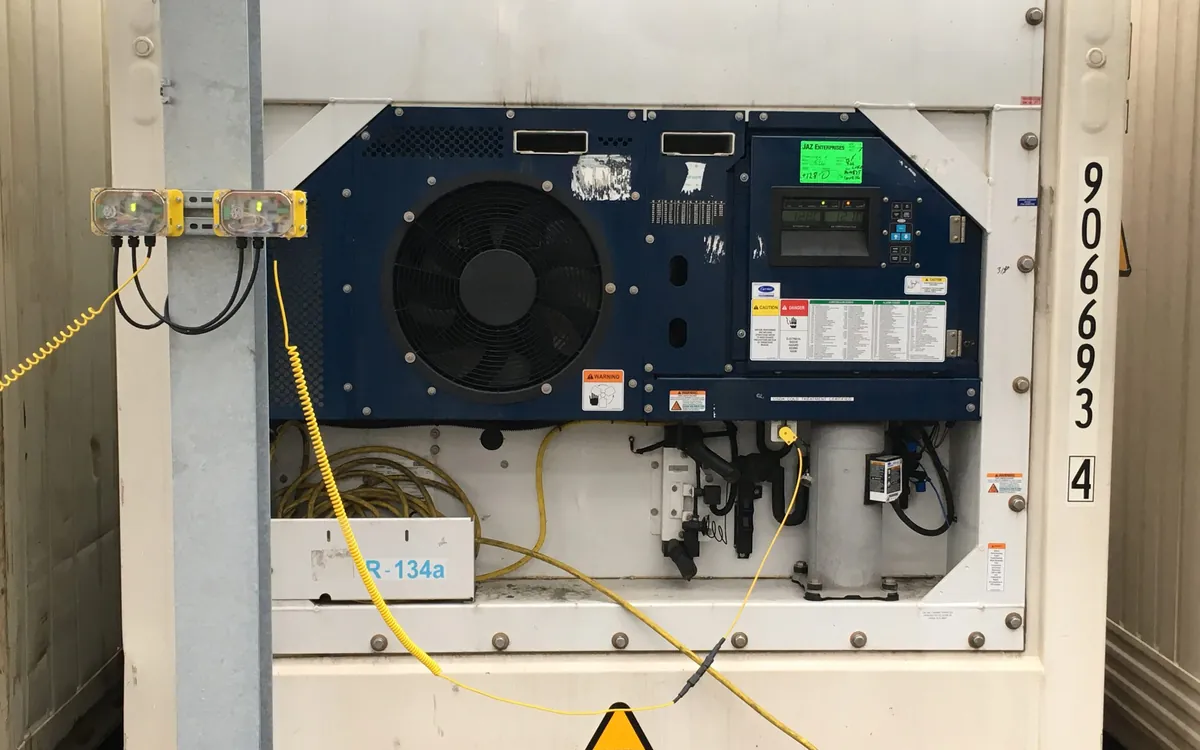
A refrigerated container carries its own refrigeration machinery but no power source. Wikipedia describes reefers as relying on external power from reefer points on land, on a ship or on the quay, and on a diesel generator set when they travel by road or rail. In the yard, the reefer outlet is that power point.
Terminals call the hardware a reefer outlet assembly (ROA), a reefer plug, a reefer socket or simply a reefer point. One assembly usually holds several outlets, each feeding one container through the cable that hangs from the reefer unit.
How the interlock works
The key safety feature is the interlock. ESL Power Systems builds its outlets so the circuit is dead while the male plug is pushed in or pulled out, which stops anyone making or breaking the connection under load. On the standard ESL module the interlock is actuated by the ground pin, and the socket works as a manual disconnect as well.
Each outlet has its own moulded case circuit breaker listed to UL 489 for branch circuit protection. Options include a shunt trip, bell alarm, auxiliary contacts, plug sensing and LED lamps for power on, power available and trip. ESL also makes rear actuated modules, which move the switching point away from the socket face.
Ratings, plugs and standards
The receptacles follow IEC 60309-1 and -2, the international standard for industrial plugs and sockets. IEC 60309 colour codes connectors by voltage, and red marks the 380 to 480 V range used by reefers. Keying and the position of the earth pin stop a plug for one voltage being pushed into a socket for another.
A typical ESL port module is coded R32-480-30-35: a 32 A receptacle at 480 V AC with a 30 A breaker of 35 kA interrupting capacity, and 65 kA versions are available. Housings are stainless steel or polyamide with a Rynite insert and an O-ring seal, because the outlets live outdoors in salt air and get knocked by cables and equipment.
Mounting and layouts in the yard
Most container terminals run dedicated reefer blocks where steel racks or gantries carry the outlets above the stack, so workers can reach plugs on the second and third tier from a walkway. ESL lists rack, pedestal, bunker and pole mounted assemblies, from a single gang up to a 24-gang bollard, in Type 4X stainless enclosures that are seam welded and powder coated.
When a terminal runs out of fixed points it can use portable distribution trees or power packs. A power pack is a containerised diesel generator set that feeds several reefers where no permanent outlets exist. The same family of hardware covers reefer sharing units on ships, rail terminals, disconnect cabinets for electric RTG cranes and connection boxes for RMG cranes.
Cargo and operations
Reefer points carry the cold chain through the port: fruit and vegetables, meat, fish, dairy and pharmaceuticals. According to Wikipedia, a reefer can hold a set temperature anywhere between minus 65 °C and 40 °C, so the same plug serves deep frozen tuna and chilled bananas.
Every plug-in and unplug is a manual job and a safety risk, which is why terminals log the time a reefer was disconnected and pair outlets with remote reefer monitoring. Plug testers, cord converters and extension cords form part of the routine kit. Freight rates for cargo through these terminals can be compared at rates.navo24.com.
Trends: metering and remote control
Terminals increasingly meter power per outlet so they can bill shipping lines for electricity used and spot faulty units. ESL offers integrated power metering for this. Electrically interlocked modules and plug sensing let a terminal operating system see which socket is occupied and whether it is live.
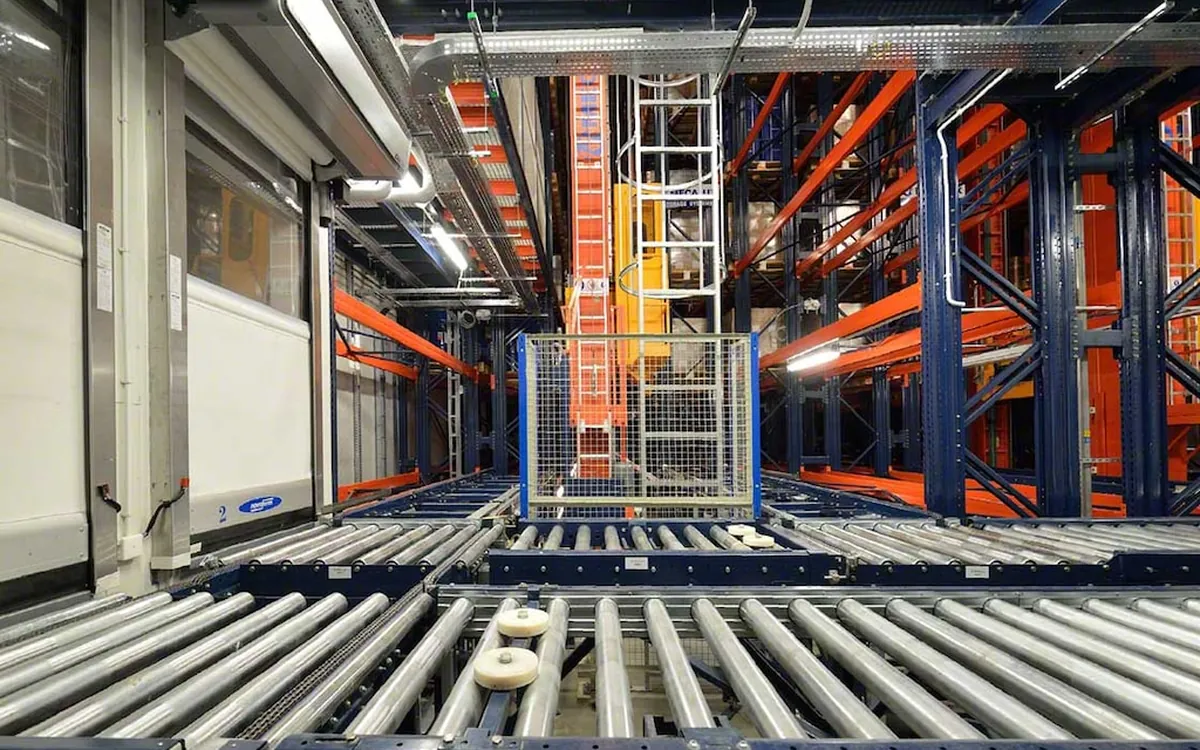
Automated stacks raise a separate question: a crane can land a reefer, but plugging it in is still done by people in most yards. That keeps reefer blocks one of the last manual zones in an automated terminal.
How to choose
Match the outlet to the reefer fleet and the local grid: voltage, frequency and the IEC 60309 configuration of the plugs that arrive on the boxes. Check the breaker interrupting capacity against the fault level of the yard supply, choose stainless housings for exposed quays, and plan enough gangs for peak season. Modular outlets that swap out without rewiring cut downtime when a socket is damaged.
Variants
Questions shippers ask
What plug does a reefer container use?
A red IEC 60309 industrial plug. Port outlets are commonly rated 32 A at 380 to 480 V AC.
Why are reefer outlets interlocked?
So the socket is dead while the plug is inserted or removed. Pulling a live plug under load can arc and injure the worker.
What happens when a terminal runs out of reefer points?
It can use portable outlet trees or a power pack, a diesel generator in a container that feeds several reefers.
Who pays for reefer electricity in a port?
Terminals normally charge the shipping line or cargo owner a daily reefer plug-in fee. Per-outlet metering makes the charge traceable.