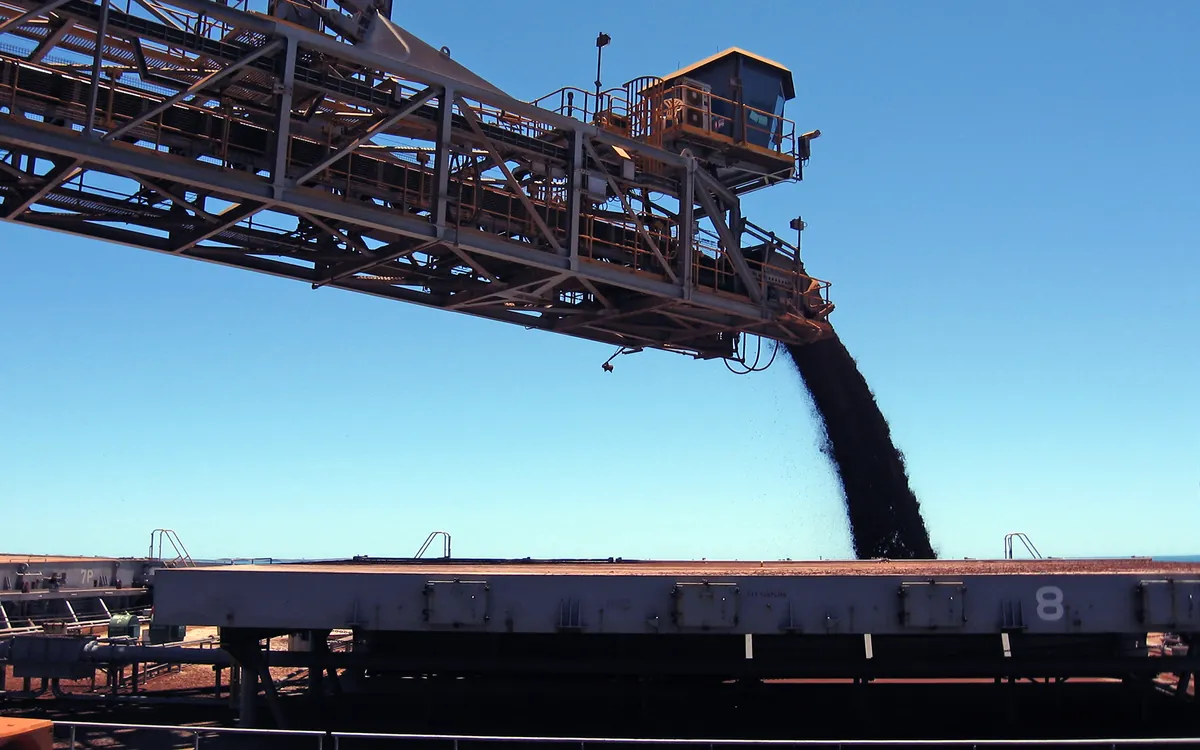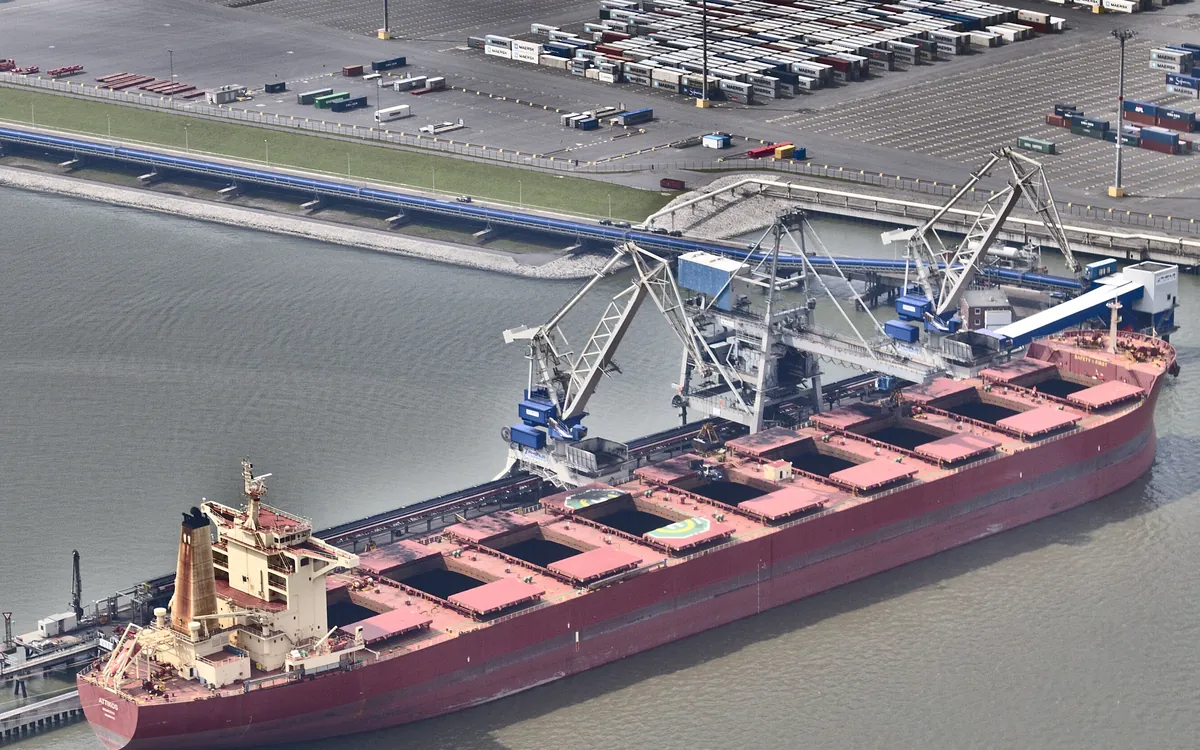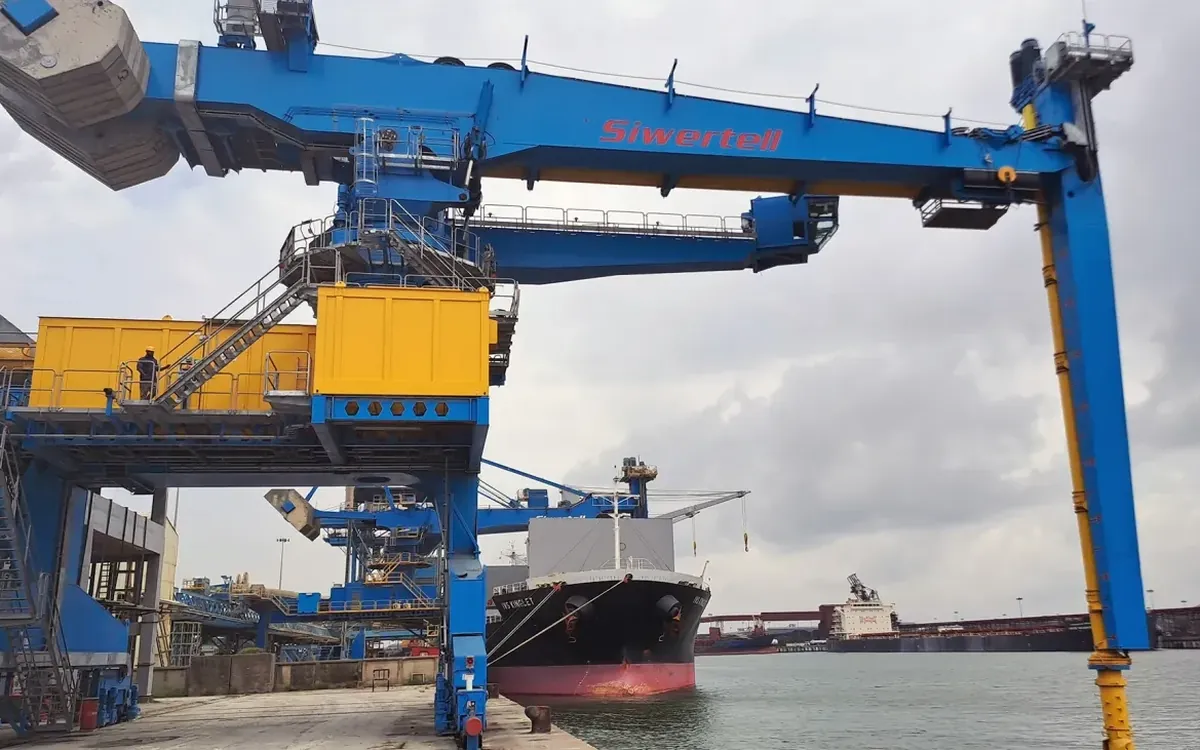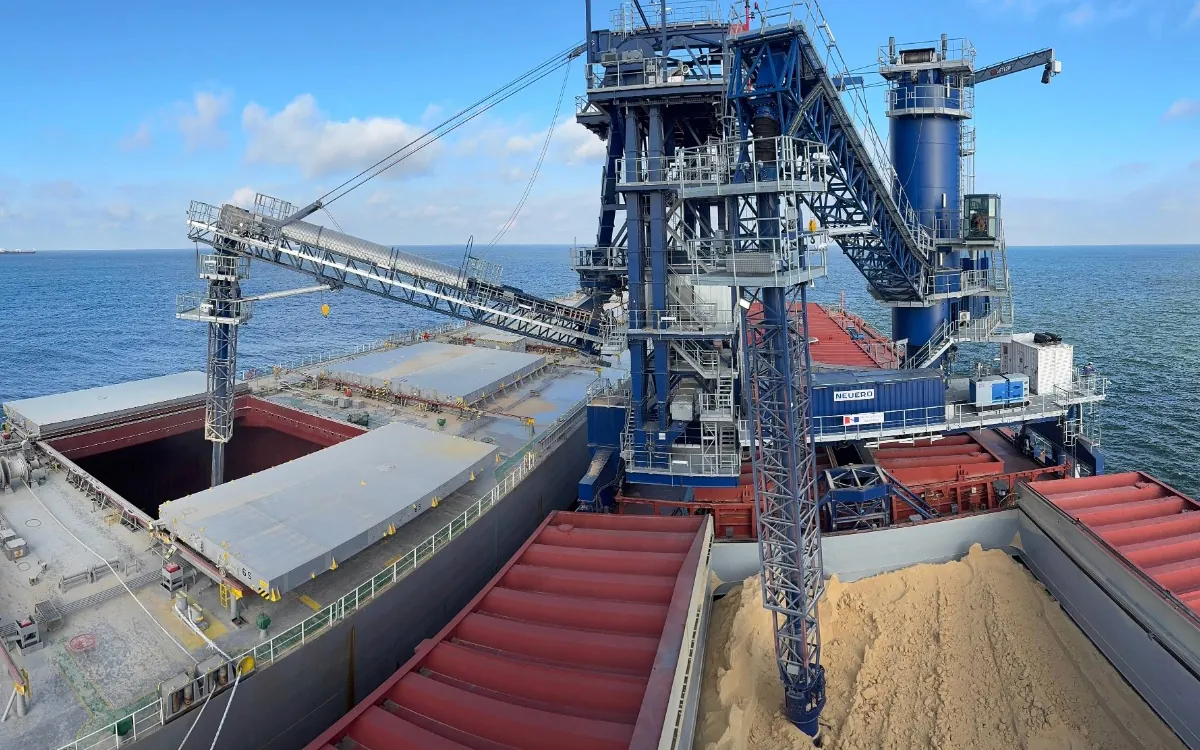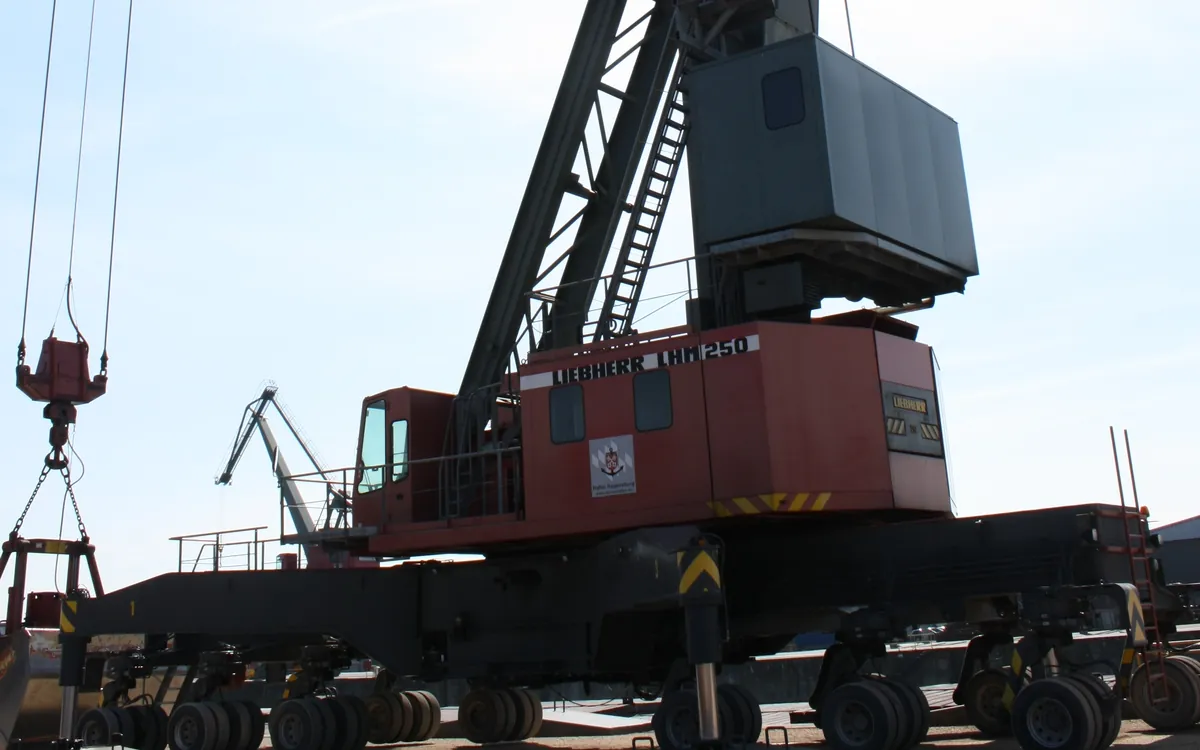





















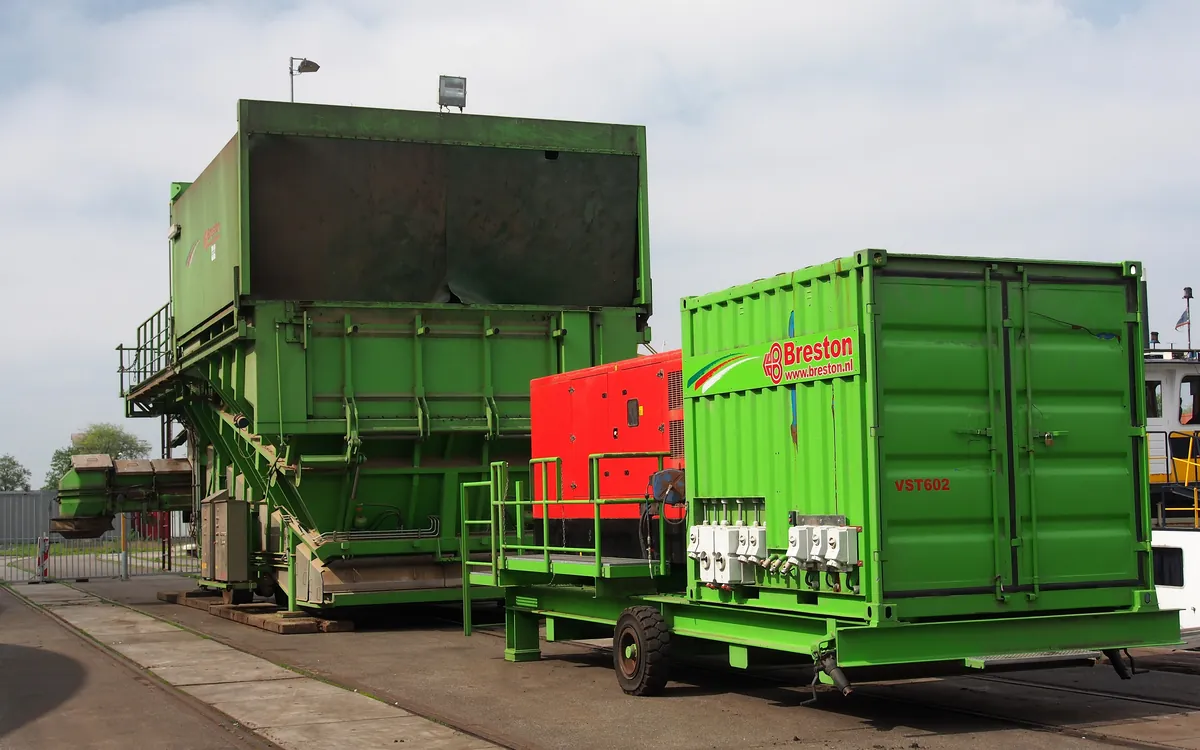
Receiving hopper the grab discharges into, with flaps, seals and filters that keep the dust in. It feeds a conveyor or trucks and can be moved off the quay when not in use.
What an eco hopper is
When a crane discharges a bulk carrier with a grab, the cargo has to land somewhere. Dropping it straight onto the quay is slow to clear and raises dust. A port hopper gives the grab a target and meters the cargo into the next step of the chain.
An eco hopper is a hopper designed for dust control. AUMUND's SAMSON Eco Hopper is the example used here. It is built to suit the flow properties of almost any dry bulk material and can work on non-dedicated quays.
AUMUND describes the SAMSON Eco Hopper as a cost-effective, environmentally friendly import hopper for dry bulk. It sits on the quay between the ship and the rest of the terminal, so the crane can keep a short, steady cycle while the conveyor or trucks take the cargo away at their own pace.
How it works
The grab opens over a grill at the top of the hopper. The grill takes the impact and holds back oversize lumps, and a top shroud contains the burst of material and air. Flexible flaps close over the opening as the cargo falls, and dust seals plus a filter unit with an air compressor capture what is left in the displaced air.
The cargo leaves through the bottom. Depending on the site it goes to a belt conveyor, straight into trucks, through a telescopic chute, or onto an AUMUND SAMSON Material Feeder for onward handling. Level detectors and strain gauges watch the fill level and load, and the structure is designed to withstand being filled to the top of the skirt.
Capacity and sizes
AUMUND states intake rates of up to 5,000 t/h, subject to the performance of the grab crane. In practice the crane sets the rate: the hopper must be large enough to take a full grab and empty it before the next cycle.
A terminal can raise throughput by adding hoppers, one per crane, as long as conveyors and truck loading downstream can take the extra flow.
The maker says the hoppers are designed around the characteristics and flow properties of the material they will handle. In practice this means the slope of the walls, the size of the outlet and the type of feeder are chosen per cargo, so a hopper for free-flowing grain is not the same as one for damp coal or sticky clinker.
Where it is used and what cargo
Eco hoppers sit under mobile harbour cranes and other grab cranes at import berths for coal, ores, fertilisers, grain, clinker, petcoke and similar dry bulk. They are common where a port is close to housing, or where the cargo is dusty or sensitive to contamination.
Travel options include rails, static installation, pneumatic tyres, or a powered or towable chassis. A tyred hopper can follow the crane from hatch to hatch and then leave the quay so the berth can take containers or general cargo. Freight rates for cargo through these terminals can be compared at rates.navo24.com.
Mobile versions suit multipurpose quays where bulk ships call only some of the time. When no bulk ship is alongside, the hopper can be moved out of the way so the berth can serve containers, project cargo or general cargo.
Dust control and environment
Dust from grab discharge is visible, it settles on neighbouring areas and it can be a fire or explosion risk with some cargoes. The flex flaps and seals cut the escape of dust at the moment of impact, and the filter recovers fine material. Because the hopper feeds a closed conveyor or a truck directly, the quay stays cleaner and there is less product loss.
Electric drives for travel and filters, and onward handling by conveyor instead of trucks, further reduce local emissions at the berth.
How to choose, strengths and limits
Match the hopper opening and volume to the largest grab, and the outflow to the downstream system. Decide how it moves: rails for a fixed bulk berth, tyres for a shared quay. Choose the discharge option (conveyor, truck, chute or feeder) from how the cargo leaves the port.
The strengths are dust control, flexibility and the ability to raise throughput step by step. The limits are that the rate depends entirely on the crane, and that very sticky or wet materials need hopper geometry and flow aids designed for them.
Variants
Questions shippers ask
What is an eco hopper used for?
It receives bulk cargo from a grab crane on the quay and passes it to a conveyor, trucks or a chute while keeping dust contained.
How much can a port hopper take per hour?
AUMUND quotes up to 5,000 t/h for its SAMSON Eco Hoppers, but the real rate is set by the grab crane that feeds it.
Can a hopper be moved off the quay?
Yes. Tyre-mounted and towable versions can be moved off the berth when it is needed for other cargo.