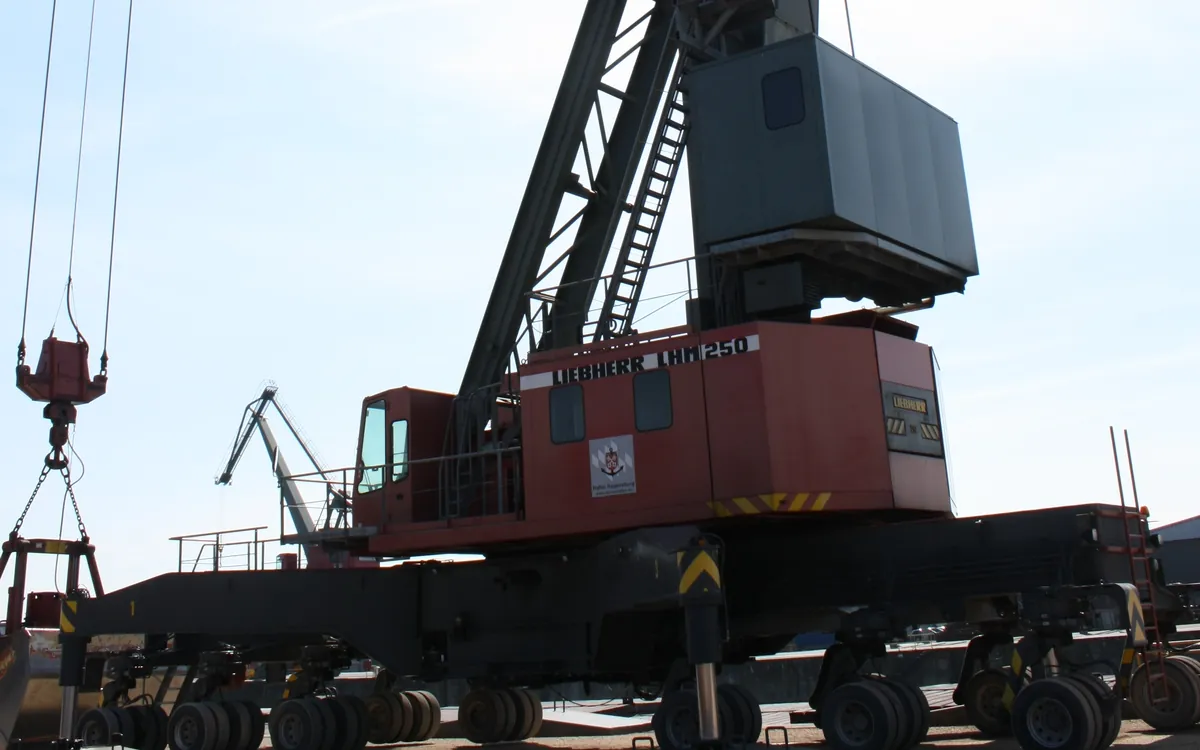
Rubber-tyred crane with a tower and lattice boom that drives along the quay and works a four-rope grab. Handles bulk without rail tracks, then switches to hook or spreader for other cargo.
What a mobile harbour crane is
A mobile harbour crane (MHC) sits on a wheeled undercarriage instead of quay rails. For work it stands on four outriggers with pads, and between jobs it drives to the next hatch or berth. The operator sits in a cabin high on the tower to see into the hold.
The Liebherr LHM 550 used as the reference here has a cruciform slewing support, modular axles with hydraulic load distribution, standard trailer tyres and individually steerable wheel sets. It can turn on the spot and drive curves of any radius.
How grab operation works
For bulk the crane works a grab. A four-rope grab hangs on two pairs of ropes: one pair holds it, the other closes the shells. A motor grab closes with its own drive and hangs on the hook. The crane lowers the open grab into the hold, closes it in the cargo, hoists, slews to the quay and opens it over a hopper or onto a stockpile.
On the LHM 550 the hoist runs at up to 120 m/min, the slew at up to 1.6 rpm and the luffing at up to 55 m/min. Liebherr's Pactronic system stores energy and adds it during peak demand, which shortens cycles. Assistance options such as SmartGrip, anti-sway, Teach-In and Sycratronic help hold a steady rate over a shift.
Key figures of a large MHC
The LHM 550 handles four-rope grabs of up to 63 t in class A7, and four-rope or motor grabs of up to 52 t in the heavier A8 duty class. Liebherr quotes bulk turnover of up to 1,500 t/h as standard and up to 2,000 t/h with Pactronic.
Outreach runs from 11 to 54 m, with the bulk version usually on a 48 m boom. The boom fulcrum is at 17.8 m and the tower cabin eye level at 24.3 m. With the hook, the crane lifts up to 154 t for heavy cargo. Liebherr rates it for Capesize bulk carriers and New Panamax container ships.
The bulk version weighs about 400 t. Spread over a 13.5 x 13.5 m propping base and pads of 9.9 m² each, the quay load stays around 1.7 t/m², with a maximum of 5.8 t per tyre while driving.
Where it is used and what cargo
MHCs work at multipurpose and smaller bulk terminals where traffic is too mixed or too low for dedicated rail-mounted unloaders. Typical bulk cargo includes coal, ores, fertilisers, grain, scrap and aggregates. The same crane then handles steel, project cargo or containers on the next call.
When a grab crane discharges onto the quay, a dust-controlled hopper usually sits under the boom to feed trucks or a conveyor. Freight rates for cargo through these terminals can be compared at rates.navo24.com.
Electric drive and emissions
MHCs traditionally run on an on-board diesel engine. Liebherr offers the LHM 550 with electric drive from high or low voltage shore supply, biodegradable hydraulic oil and HVO 100 renewable diesel. Pactronic recovers energy as well as boosting performance.
Remote and digital options include radio remote control, video monitoring, collision alerts, a vertical line finder and the LiDAT app for fleet data.
How to choose, strengths and limits
Size the crane from the largest ship and its beam (outreach), the grab size and density of the cargo (grab capacity and duty class), and the quay's allowable load. Check the A-class: bulk work is a heavy duty cycle, so a crane rated A8 for its grab load will last longer than one pushed at its A7 limit.
The strengths are flexibility and low infrastructure cost, since no rails are needed. The limits are rate and energy per tonne compared with a dedicated grab unloader or a continuous unloader. Very high-volume ore or coal berths usually use rail-mounted equipment instead.
Variants
Questions shippers ask
How much bulk can a mobile harbour crane handle per hour?
Liebherr quotes up to 1,500 t/h for the LHM 550 as standard and up to 2,000 t/h with its Pactronic hybrid drive. Real rates depend on grab size, cargo density and hatch geometry.
What is the difference between a four-rope grab and a motor grab?
A four-rope grab is opened and closed by the crane's hoisting ropes. A motor grab has its own closing drive and hangs on the hook, so it can be fitted without changing the reeving.
What do A7 and A8 mean?
They are crane duty classes. A8 is the heavier class for intensive, continuous work. The LHM 550 handles grabs of up to 52 t in A8 and up to 63 t in A7.
Can mobile harbour cranes run electrically?
Yes. The LHM 550 is available with electric drive from high or low voltage shore power, and with HVO 100 fuel and biodegradable hydraulics for the diesel version.