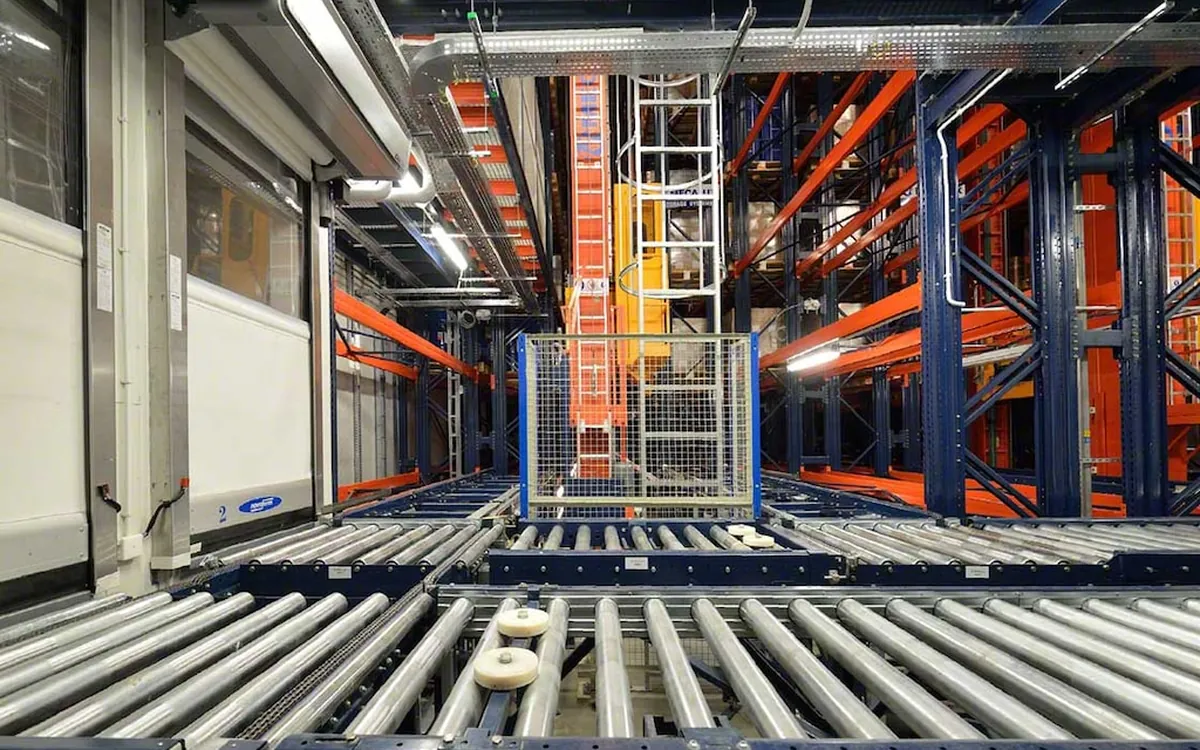
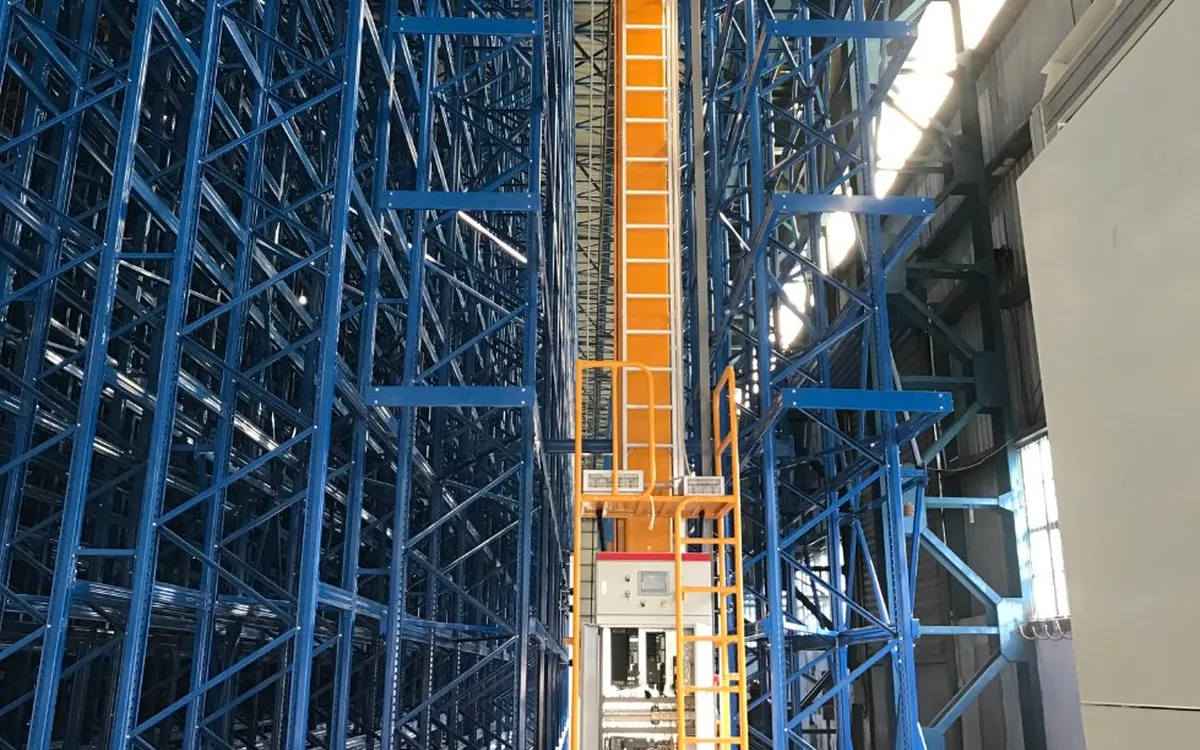
Automated crane that runs in the aisle of a high-bay pallet warehouse and stores and retrieves pallets, so nobody has to work inside the freezer.
What a stacker crane is
An automated storage and retrieval system (AS/RS) is a set of computer-controlled machines that place and retrieve loads from fixed storage positions. Wikipedia lists the conditions where it pays off: high volumes in and out, scarce space, no processing during storage and a need for accuracy because errors are costly. Frozen food in a port cold store ticks all four.
The stacker crane is the unit-load machine in such a system: a mast that travels on a floor rail and a top guide rail, a lifting carriage and a telescopic fork that reaches into the rack.
How it works
Pallets arrive on conveyors at the front of the store. The warehouse management system picks a location, and the crane drives down the aisle while lifting the carriage, so both movements run at once. The fork extends into the rack, sets the pallet down and the crane returns or picks up an outgoing pallet on the way back. One store-and-retrieve trip is a double cycle.
Because the crane is automatic, the racks can be much taller and aisles much narrower than with forklifts. That means less volume to cool per pallet stored, and staff stay in the warmer handling zone instead of working at freezer temperatures.
Sizes and key figures
Swisslog's Vectura pallet crane, an example of the type, is built from 4 m to 45 m high and works from minus 30 °C to 50 °C. It handles one load of up to 3.5 t or a double load of 2.5 t in total, and Swisslog rates throughput at 20 to 45 double cycles per hour depending on rack height and layout. Racks can be single-deep or several pallets deep.
Swisslog says the tapered mast makes the crane up to about 30% lighter than competing designs and, with regenerative drives and cycle optimisation, cuts energy use by up to 20 to 25%. More than 4,000 Vectura cranes are in operation, and modular delivery lets a team install up to five cranes in a day.
Where it is used in ports
Port cold stores sit between reefer ships or reefer containers and the inland distribution chain. Frozen fish, meat, poultry, fruit juice concentrate and chilled fruit are unloaded, stored on pallets and later picked for trucks. A high-bay store with stacker cranes holds many more pallets on the same plot than a conventional cold store, which matters on expensive port land.
The same design is used in import hubs for frozen food, in fruit ripening and storage centres and in pharmaceutical cold chains.
Automation and energy
Stacker cranes are fully electric and run under software control, so the trend is less about fuel and more about energy recovery and uptime. Regenerative drives feed braking energy back when the carriage lowers or the crane decelerates. Lighter masts cut wear on wheels and rails, and Swisslog cites installations running for more than 20 years without major part replacement.
For servicing, controls and the hoist sit at the bottom of the Vectura mast, with access to an emergency cabin for troubleshooting. In a freezer, maintenance access is planned carefully because people can only work in the cold for limited periods.
How to choose: pros and limits
Start with throughput at peak, pallet sizes and weights, building height and storage temperature. Single-deep racks give fast access to every pallet; multi-deep racks store more but suit fewer product lines. Pros: high density, low labour, accurate stock and no staff in the freezer. Limits: high capital cost, a building designed around the system and a single aisle that stops when its crane is down, so most stores install several aisles for redundancy.
Variants
Questions shippers ask
What is a stacker crane?
An automated crane that runs in a warehouse aisle and stores and retrieves pallets or bins at any rack level.
How cold can a stacker crane work?
Crane makers build freezer versions; Swisslog rates the Vectura for minus 30 °C to 50 °C.
How tall can automated high-bay racks be?
Swisslog builds the Vectura for racks from 4 m up to 45 m high.
Why automate a port cold store?
It stores more pallets on scarce land, keeps workers out of the freezer and tracks every pallet accurately.