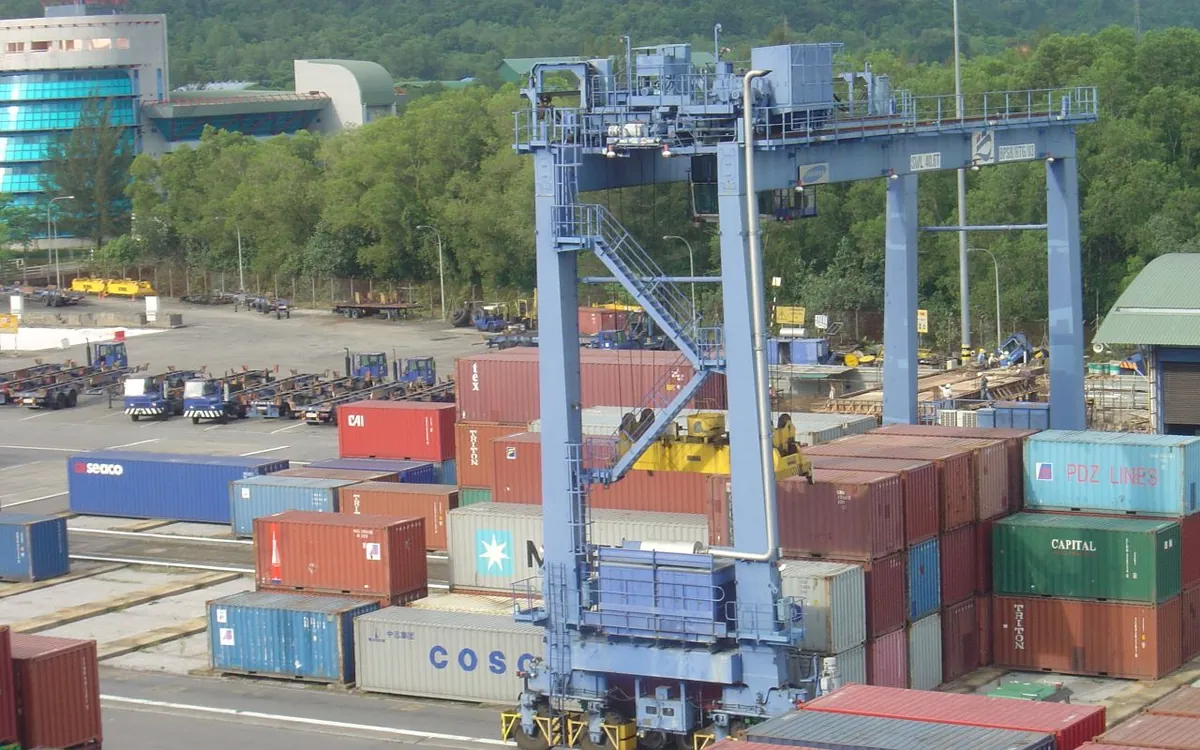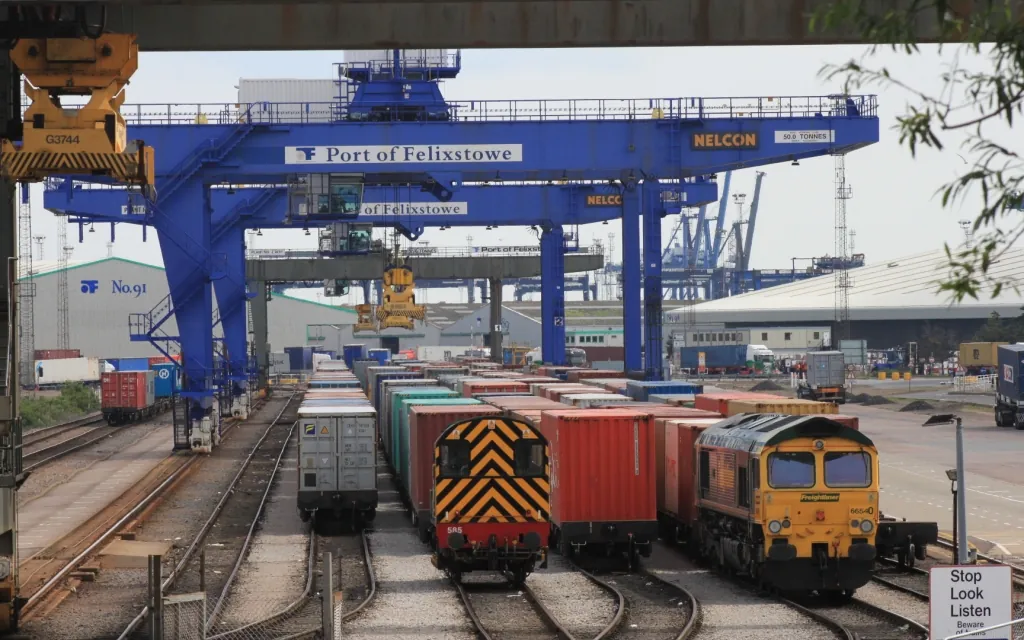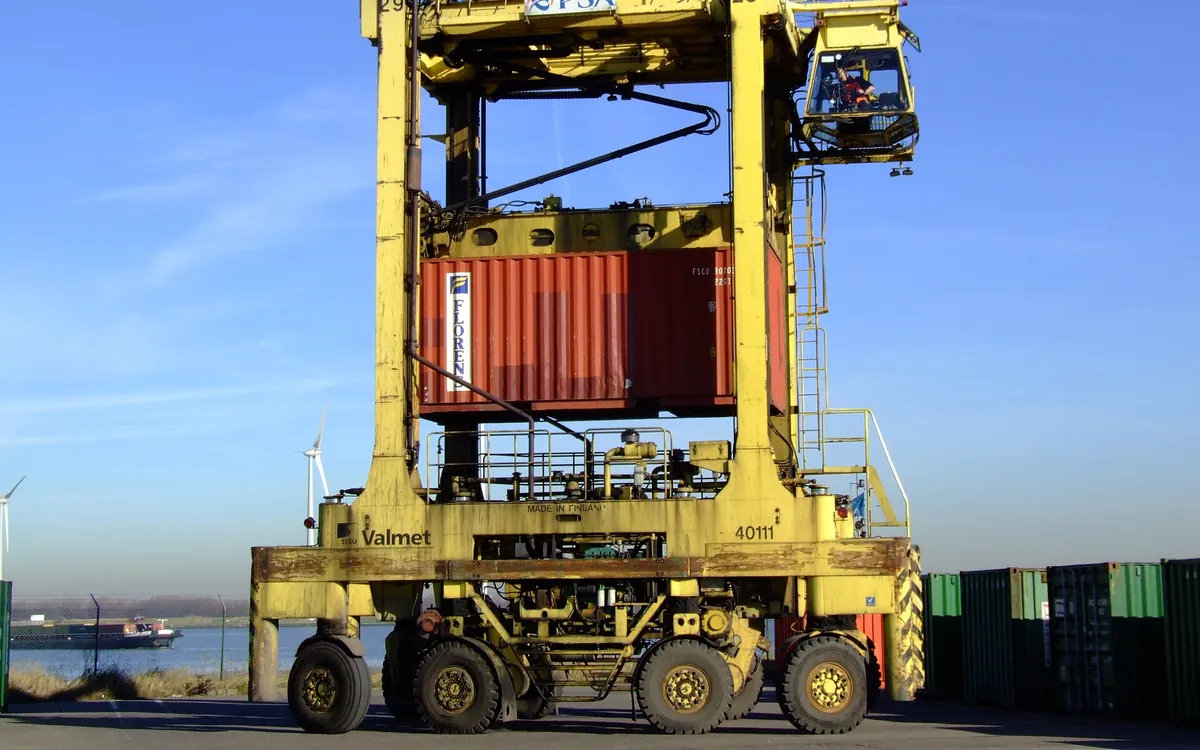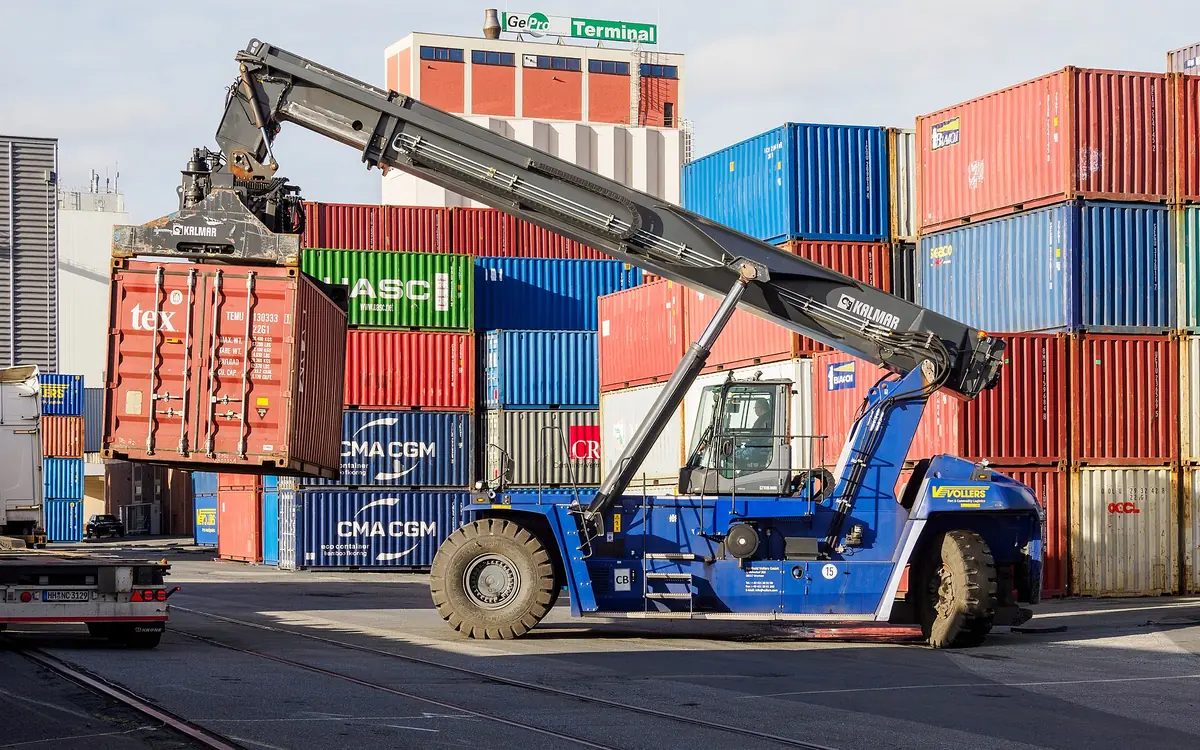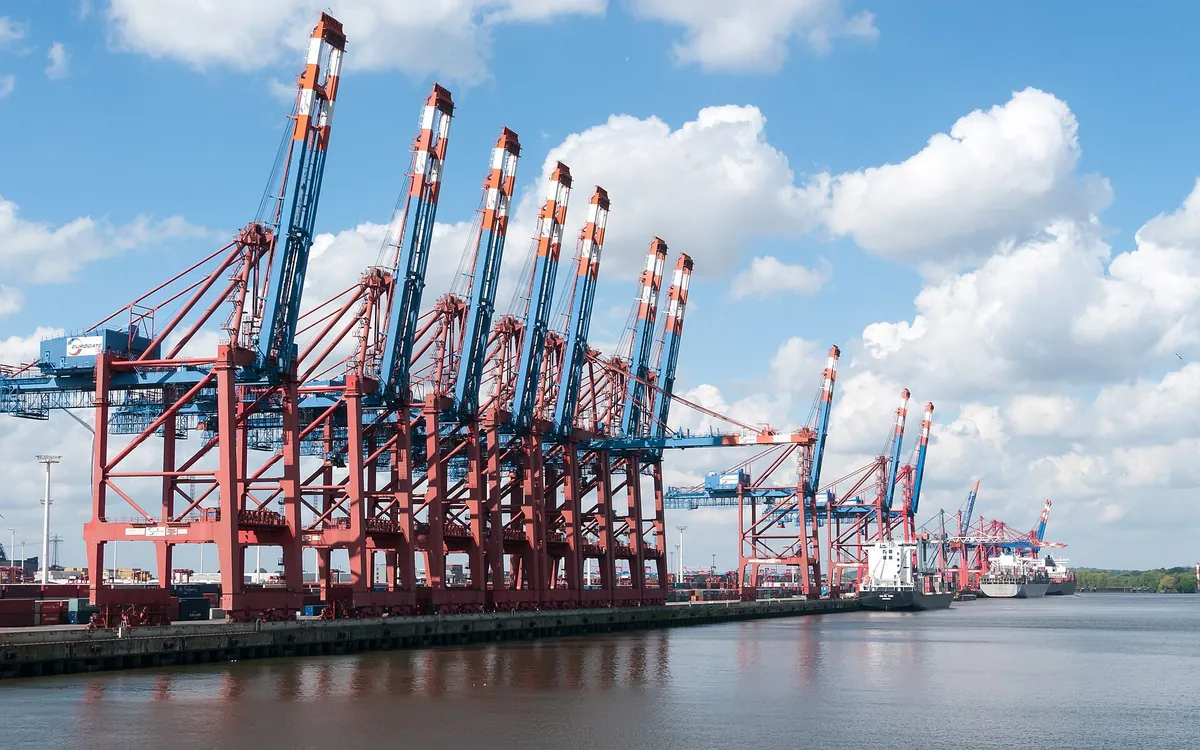
Loads and discharges the ship. Runs on rails along the berth; the trolley travels out over the vessel on the boom. Crane size follows the widest ship it must reach across.
What an STS crane is
An STS crane, also called a quay crane or container gantry crane, is a steel portal frame that travels on rails along the berth. A boom reaches out over the ship and a backreach extends over the landside apron. Instead of a hook it carries a spreader, which lands on top of a container and locks into its four corner castings with twistlocks.
The first quayside container gantry crane was built by Paceco in 1959. Since then the type has grown with the ships: early A-frame cranes ran on rails 12 to 16 m apart, and today the largest units weigh 1,600 to 2,000 tonnes, against roughly 800 to 900 tonnes for a post-Panamax crane.
How it works
The crane has three main motions. The gantry travels along the quay to line up with a bay of the ship, the trolley runs along the boom and backreach, and the hoist raises and lowers the spreader. When the ship is moving in or out, the boom is raised clear of the vessel.
Shore power is usually converted to direct current and then to variable-frequency alternating current for the hoist, trolley, gantry and boom motors. Modern drives feed braking energy back to the grid: Liebherr lists active front-end power regeneration as standard on its STS range.
Some cranes carry a second trolley. The waterside trolley moves boxes between the ship and an intermediate platform, and a landside trolley takes them from the platform to the quay, so the two halves of the cycle run in parallel.
Size classes and key figures
Cranes are named after the widest ship they can work across. In Liebherr's 2026 datasheet a Panamax crane reaches up to 38 m and covers up to 13 containers across the deck, a Post-Panamax up to 45 m and 16 across, a Super Post-Panamax up to 55 m and 19 across, and a Megamax more than 53 m and 20 or more across. Dual-trolley cranes reach 60 to 75 m.
Lift height under the spreader runs from 30 m for Panamax to 45 m and above for Megamax. Safe working load is 40 to 50 t on a single spreader and 65 t in twin-lift mode (two 20 ft boxes end to end), with tandem lifts of 65 to 85 t on the larger classes. Trolley speed rises from 150-180 m/min on Panamax cranes to up to 270 m/min on dual-trolley units, while gantry travel stays at about 45 m/min.
The quay has to carry all this. Liebherr quotes wheel loads of 30-45 t/m for Panamax cranes and 65-120 t/m for Megamax, based on 8 wheels per corner, which is why crane size is decided together with the wharf structure.
Where it is used
STS cranes stand on the berths of deep-sea and feeder container terminals and serve all container cargo: dry boxes, reefers, tank containers and out-of-gauge units on flat racks. Cranes are normally worked in teams on one ship to cut its time at berth, and some terminals build berths with cranes on both sides of the vessel.
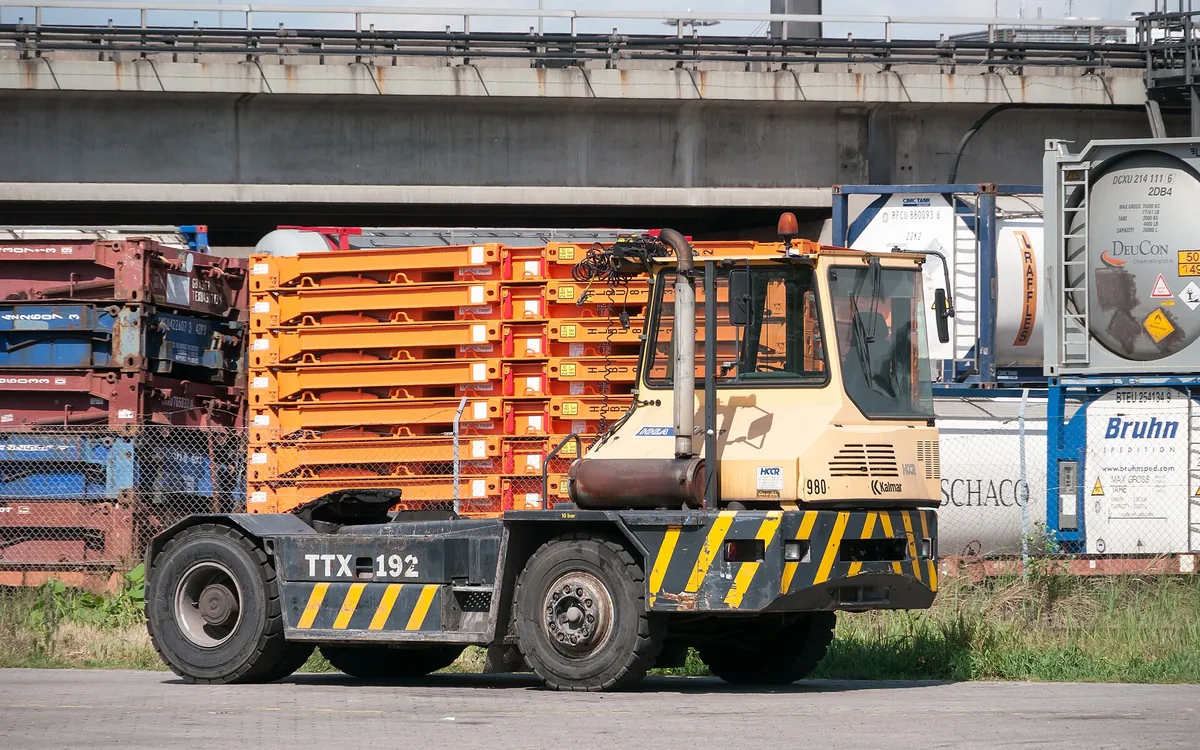
Smaller cranes, often without a moving boom, still serve barges at inland ports. Behind the crane, straddle carriers, terminal tractors or automated vehicles shuttle boxes between the quay and the yard. Freight rates for cargo through these terminals can be compared at rates.navo24.com.
Automation and energy
Because the crane already runs on grid electricity, the focus is on automation and energy recovery rather than fuel. Liebherr uses mechanical anti-sway reeving, liquid-cooled drives and hydraulic-free systems, and states that 85% of the crane mass is recyclable ferrous material.
Lubrication-free and hydraulic-free systems also remove grease and oil from the machine, and LED lighting cuts the power drawn at night.
How to choose and the limits
The design vessel sets outreach and lift height; the quay sets gantry span, rail gauge and the wheel loads the crane may impose. Liebherr's range covers spans of 15 to 35 m (30 to 45 m for dual trolley) and travel wheel gauges of 15 to 19 m.
Special layouts exist for difficult sites. Liebherr builds articulated-boom cranes, narrow-span cranes for confined quays, double-boom cranes that serve both sides of a finger pier, and wide-span cranes.
The limits are cost and civil works: a crane weighing up to 2,000 tonnes needs a strong quay and a long lead time, and it cannot be moved to another berth easily.
Variants
Questions shippers ask
What does Panamax or Megamax mean for an STS crane?
It is the widest ship the crane can reach across. In Liebherr's figures a Panamax crane covers up to 13 containers across the deck and a Megamax crane 20 or more.
How much can an STS crane lift?
Typically 40-50 t under a single spreader, 65 t in twin-lift mode and 65-85 t in tandem lifts, depending on the class.
How heavy is a ship-to-shore crane?
Post-Panamax cranes weigh about 800-900 t; the newest super-post-Panamax units weigh 1,600-2,000 t.
Why do some cranes have two trolleys?
Splitting the cycle at a platform lets the ship side and the quay side work in parallel, which raises output and shortens each move.