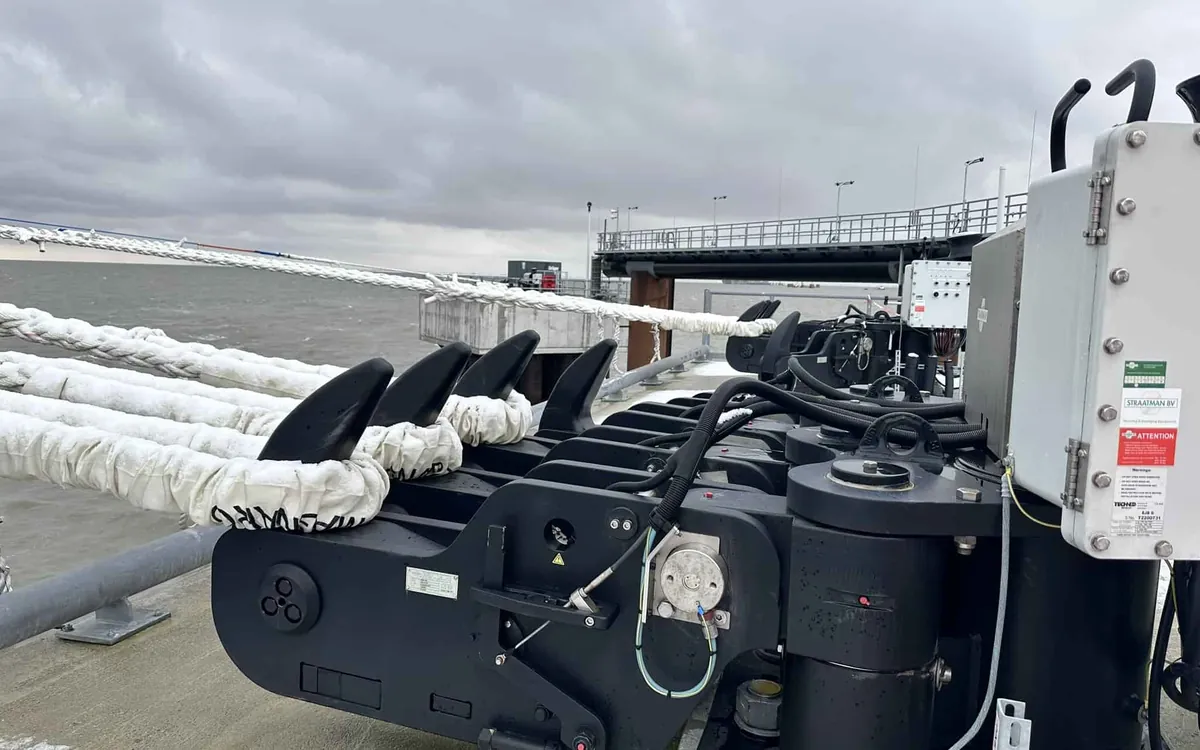





















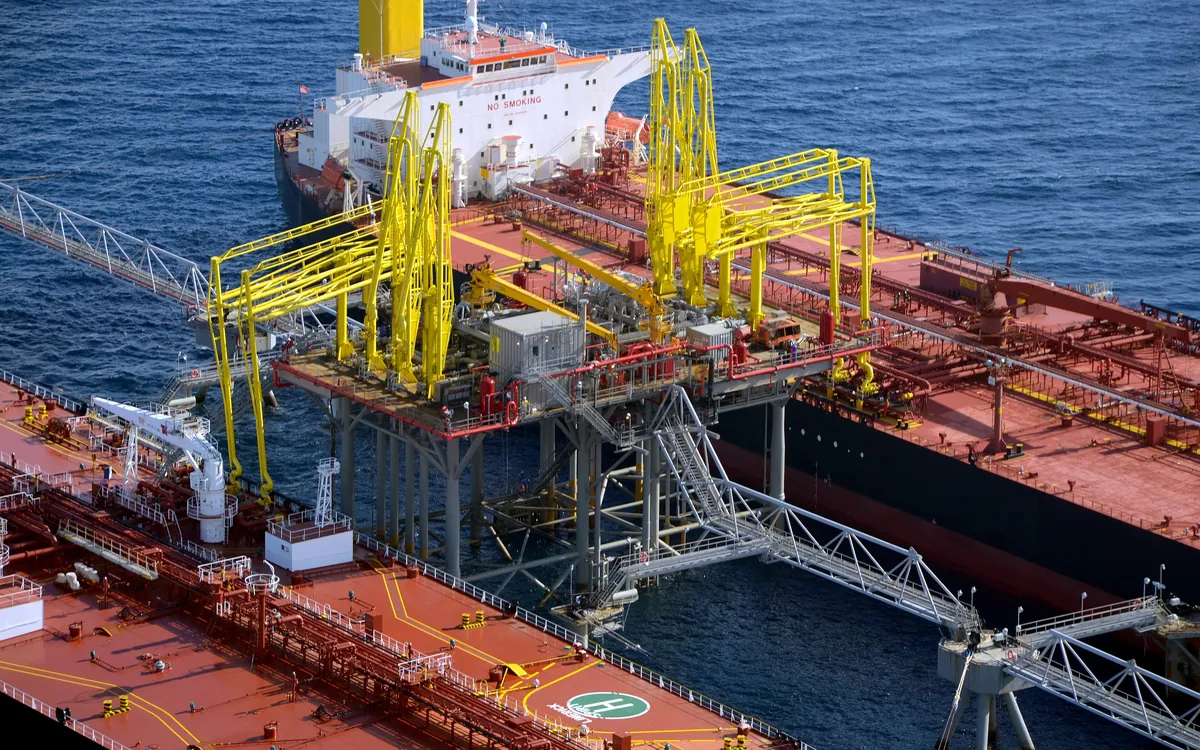
Articulated steel pipe on a riser, balanced by counterweights, that connects the jetty pipeline to the tanker manifold. Swivel joints follow the ship with tide and draft; an emergency release system separates it fast.
What a marine loading arm is
A marine loading arm (MLA), also called a mechanical loading arm, is made of rigid steel pipes linked by swivel joints. It stands on a riser on the jetty head. One end connects to the shore pipeline, the other to the ship's manifold flange.
Compared with cargo hoses, arms suit larger vessels, higher flow rates and higher pressures. Their main drawback is that they are less flexible than a hose, so the berth and the vessel must fit within the arm's working envelope.
How it works
The arm has an inboard section hinged on the riser and an outboard section reaching to the ship. Counterweights balance both, so the arm floats in position and needs little force to move. The common layout is a pantograph with a double counterweight, which keeps the counterweights near the riser.
Arms are moved manually or hydraulically. Once connected, swivel joints let the arm follow the ship as it rises and falls with the tide and with loading. A quick connect/disconnect coupler (QC/DC) clamps the arm to the manifold without bolting. An emergency release system (ERS) of two valves with a coupler between them closes both sides and separates the arm if the ship drifts out of range.
Technip Energies offers options such as heat tracing, insulation, a piggy-back line, a constant position monitoring system and electric drives. Its EasyDrive control moves the presentation flange in straight lines instead of joint by joint, which simplifies connection.
Sizes and key figures
Technip Energies builds petrochemical arms from 6" to 24" diameter with design pressure up to 50 bar (ANSI 300). At the Basra Oil Export Terminal in Iraq it delivered 24" arms and field services as part of the refurbishment of the crude export jetties. For the STAR refinery in Turkey it delivered thirty-four marine loading arms.
Options listed by the maker include a piggy-back line, heat tracing and insulation for heavy or heated products, and a full-bore ERS. The number of arms on a berth depends on the products and rates: crude berths may use several large arms in parallel, while chemical berths often have several smaller arms for different products.
Where it is used and what cargo
Loading arms serve crude oil export terminals, refinery jetties, product import terminals, chemical and LPG berths. Technip Energies lists petroleum, LPG, refined products and chemicals, including sulphuric and nitric acid, chlorine, sulphur, bitumen and ammonia, plus liquid CO2. Arms for hot, corrosive or toxic products are built with heating, linings or special materials.
Cryogenic arms for LNG are a separate family with stainless steel piping and cryogenic swivels. Freight rates for cargo through these terminals can be compared at rates.navo24.com.
Electric arms and emissions
Hydraulic drives are standard, but they carry a risk of oil leaks over water. Technip Energies' e-MLA replaces hydraulics with electric drives and off-the-shelf electrical parts, and the maker claims about 30% lower maintenance costs plus health monitoring for predictive maintenance.
Loading arms also connect vapour return lines, which take displaced vapour from the ship's tanks to a recovery or combustion unit on shore.
Technip Energies also offers electric marine loading arms (e-MLA). They replace the hydraulic drives with electric ones, which removes the risk of hydraulic oil reaching the water, and they are ready for its EasyDrive control. Its Constant Position and Management System (CPMS) is offered as an option for keeping the arm aligned with the manifold.
How to choose, strengths and limits
Arm size follows from the target flow rate and the product. The working envelope must cover the full range of vessels, tides, freeboard and drift at the berth. Design pressure, temperature and material follow from the product, and the ERS must be sized for the worst-case drift.
Arms give a fixed, tested connection with built-in emergency release and need less handling than heavy hoses. They cost more to install, need a solid jetty structure, and cannot reach as far as a hose if ships moor outside the envelope.
Variants
Questions shippers ask
What is the difference between a loading arm and a cargo hose?
A loading arm is rigid steel pipe with swivel joints, mounted on the jetty. It handles larger ships, higher flows and higher pressure. Hoses are more flexible and cheaper but heavier to handle at large sizes.
What sizes do marine loading arms come in?
Technip Energies builds petrochemical arms from 6" to 24" diameter with design pressure up to 50 bar.
What does an emergency release system do?
It closes valves on the arm and ship sides and separates the arm in a controlled way if the ship moves out of range, limiting spillage.
Can loading arms handle liquid CO2?
Yes. Technip Energies lists liquid CO2 among the products its petrochemical arms can be configured for.