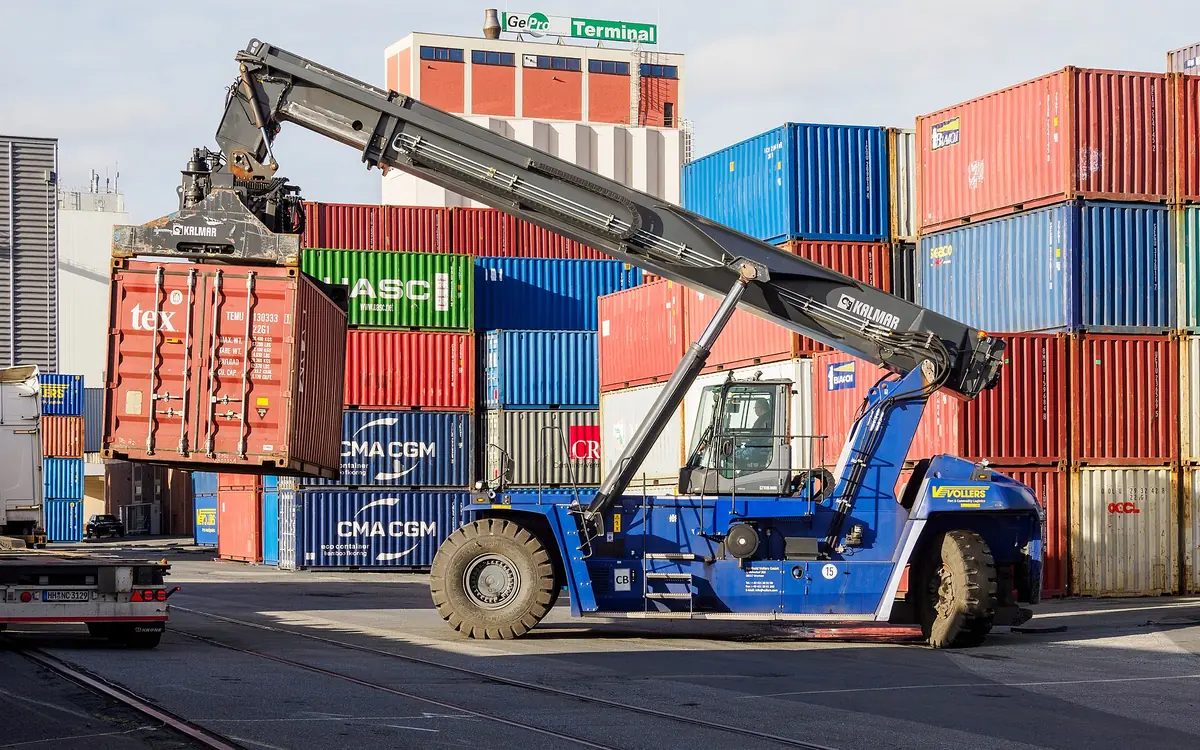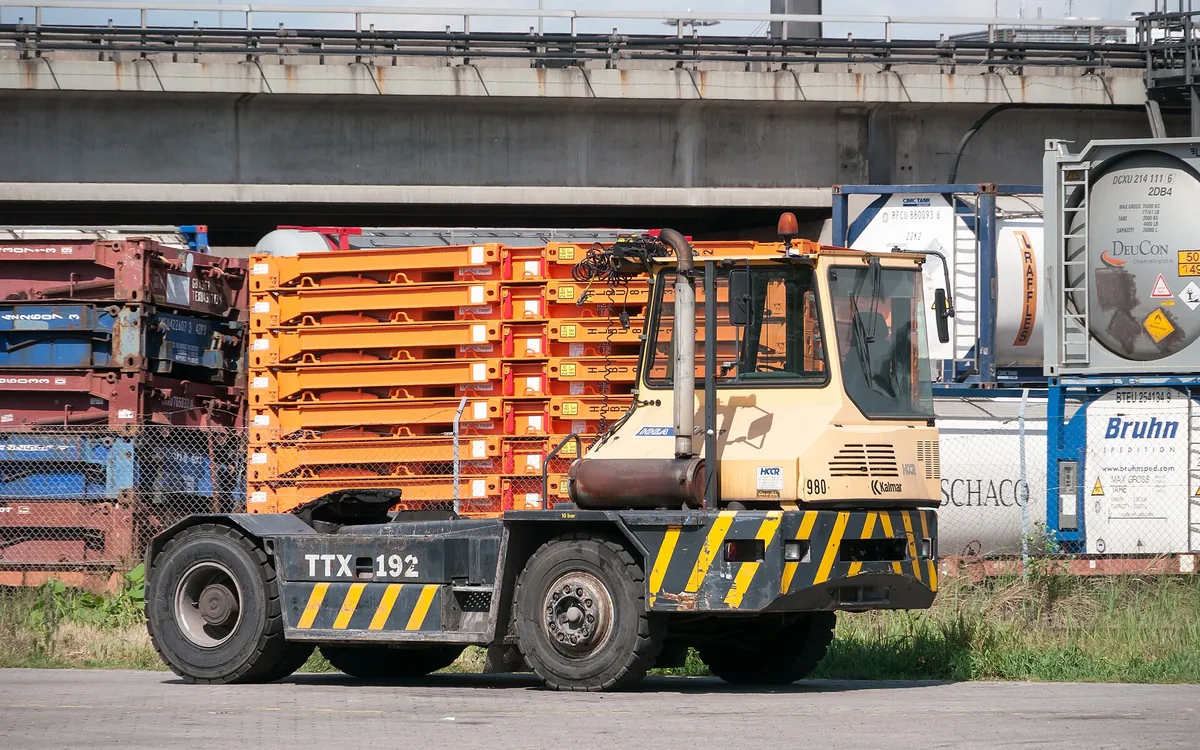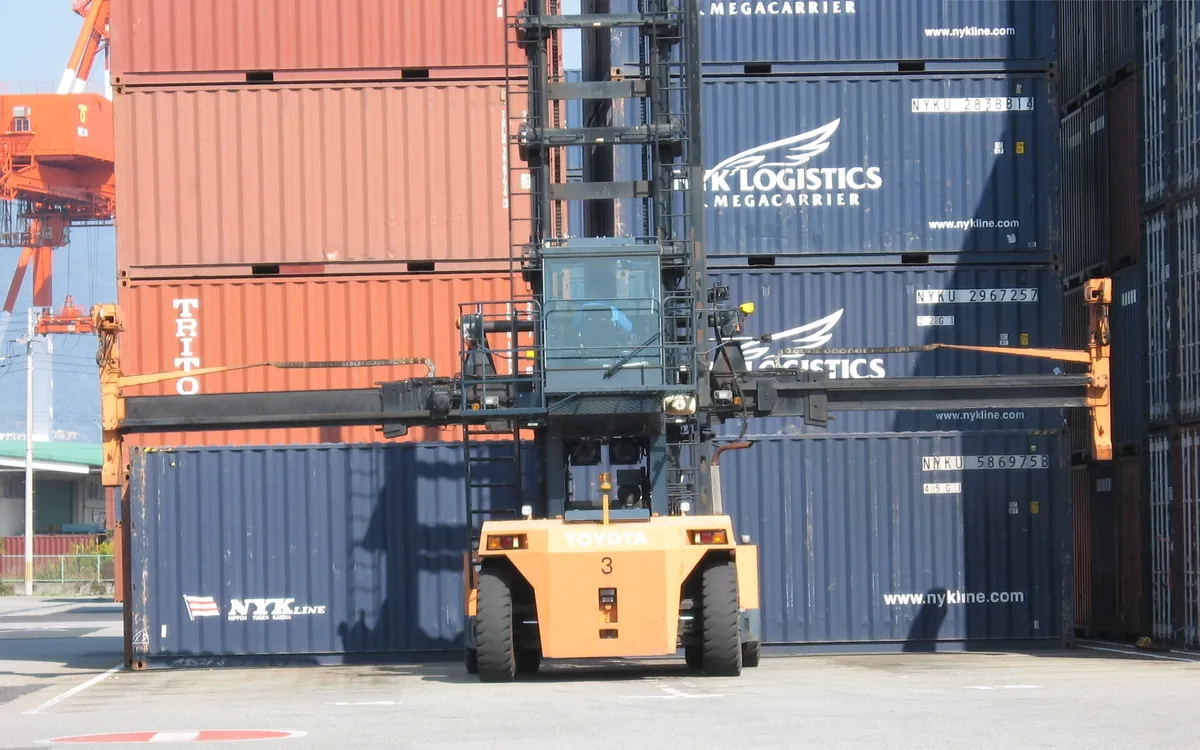
Masted forklift with a side or top spreader for empties only. Light lift, very high stacks.
What it is
An empty container handler (ECH), also called an empty lifter, looks like a large forklift with a tall mast. Instead of forks it carries a spreader that grips the container from the top or the side. It is designed for speed and stacking height, not for heavy weights.
Kalmar's range runs from a 7 t compact electric model to 11 t double stackers.
How it works
The spreader slides up and down a multi-stage mast in front of the cab. Single-stacking machines lift one empty at a time. Double-stacking machines lift two empties one above the other, which is where the 8+1 notation comes from: eight containers high, plus one more carried on top.
Spreaders handle 20 and 40 ft boxes, and 45, 48 and 53 ft containers are picked up in the 40 ft position. Load-sensing hydraulics adjust lifting power to the weight being handled.
Sizes and key figures
Kalmar's single-stacking electric models lift 9 t or 10 t and stack 5 to 8 high. Double-stacking models lift 10 t or 11 t and stack from 5+1 to 8+1. The ECG90-110 has a 5,000 mm wheelbase and a 115 kW traction motor.
At the small end, the ECG70 lifts 7 t and stacks 4 high, aimed at small depots and noise-sensitive sites.
Diesel machines cover the same ground. Kalmar's DCG80-110 comes as a single or double stacker from 8 to 11 t and stacks up to 8 high, and the DCU80-100 is a simpler, lower-cost line.
Where it is used
Empty handlers work in container depots, port empty yards, rail terminals and inland depots. Their job is to store empties densely after discharge, repair and cleaning, and to release them again to truckers and shipping lines.
They also serve the gate and the repair area, and in busy depots they make up most of the fleet. Full containers need a reach stacker or loaded container handler instead. Freight rates for cargo through these terminals can be compared at rates.navo24.com.
Electric models
Empty handling suits battery power: loads are light and work is concentrated in one yard. Kalmar's ECG90-110 runs on lithium-ion batteries of 267 kWh or 400 kWh and accepts CCS1, CCS2 and GB/T chargers up to 350 kW input, with a 90 kW charger suggested for overnight charging and higher power for top-ups during breaks.
Regenerative braking and an efficient electric driveline help reduce operating costs.
Kalmar's charging chart assumes a charge from 20% remaining capacity to full. Depots running long shifts size the battery to the shift and use breaks for top-up charging.
How to choose, pros and limits
Stack height, single or double handling and the container lengths in the depot decide the model. Higher masts increase storage per hectare but need good ground and calm wind conditions, and taller stacks mean more digging when a specific box is wanted.
The main limit is weight: an empty handler must never lift a laden container. Depots that also handle full boxes need at least one reach stacker or loaded handler.
Kalmar's own guidance gives a quick filter: choose the electric ECG90-110 for terminal-class performance with zero emissions at source, and the ECG70 when lower emissions and operating cost matter more than maximum stacking height.
Variants
Questions shippers ask
What does 8+1 mean?
The machine can stack eight empties high and lift a ninth over the top of the stack.
Can an empty container handler lift a full container?
No. Capacity is about 7-11 t, far below a laden container. Use a reach stacker or loaded container handler.
Are empty container handlers available electric?
Yes. Kalmar builds electric models from 7 t to 11 t with battery options up to 400 kWh.