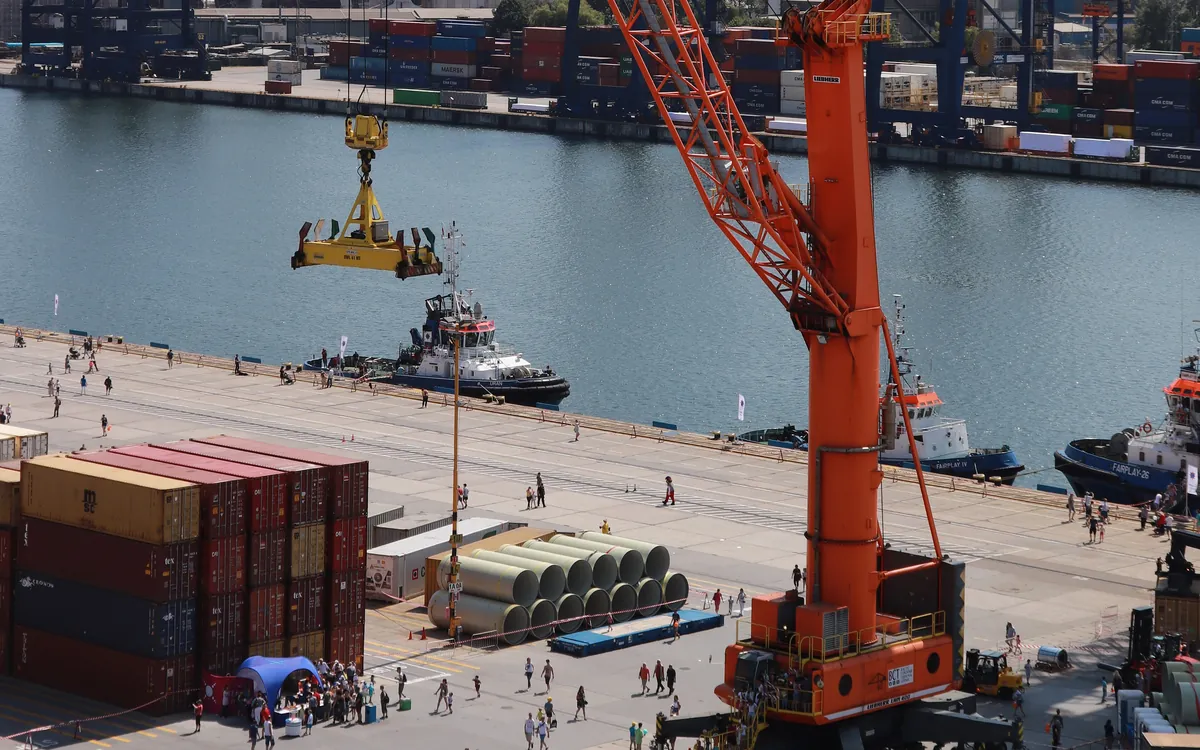





















Slewing crane on a rail-mounted portal, so trucks and trains pass underneath. Common on narrow quays; handles bulk with a grab, general cargo and containers.
What a portal crane is
The crane has two parts: a steel portal that travels on rails along the quay, and a slewing upper structure with tower, boom, hoists and cab. The portal lifts the working parts high enough for road and rail traffic to pass below, which suits narrow quays where there is no room for a crane to sit beside the tracks.
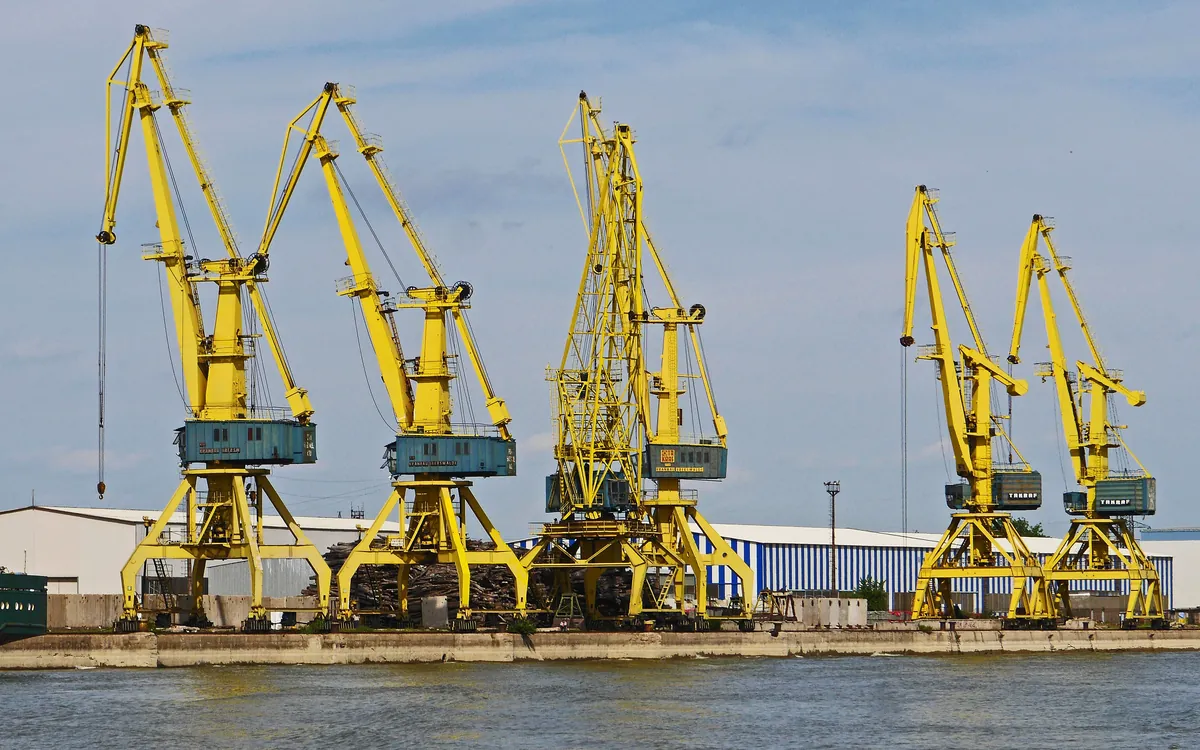
Rows of portal cranes have lined European river and sea ports for decades. Many older units have level-luffing jibs, where the hook stays at the same height as the jib moves in and out. Wikipedia describes the horse-head jib as the usual mechanism for this; modern cranes do the same with electronic control of the hoist winches.
How it works
The crane travels along the berth on its rails to line up with a hatch. It then slews, luffs and hoists to move cargo between ship and quay, truck or rail wagon. Grab cranes use four-rope grabs, with the hoist and closing winches synchronised by the control system.
On Liebherr's LPS series, power comes from the quay at low voltage (400 V) or medium voltage (1 kV to 20 kV), wound on a cable drum fixed to the portal. Lifting, slewing and luffing run in closed hydraulic loops.
Sizes and key figures
The Liebherr LPS 420 lifts up to 124 t and reaches up to 48 m. It weighs 371 t and hoists at up to 120 m/min. The portal is designed per project: rail gauge, portal height, wheel loads and access ladder all match the quay.
Buffers at all four corners of the portal protect against collisions with neighbouring cranes, and a manual storm anchor holds the crane in winds up to 42 m/s. Capacity varies with radius, so the load chart, not the headline figure, sets what can be lifted at the ship's far side.
Where it is used and what cargo
Portal cranes work bulk cargo with grabs (coal, ore, grain, fertiliser, scrap), steel products, timber, project cargo and containers. River ports and short-sea terminals with tracks along the quay edge are typical sites. Because the crane sits on rails, it can work next to a warehouse or silo without blocking the quay road.
Shippers see them at general cargo terminals across Europe, the Baltic and the Black Sea, where many quays were built around rail-mounted cranes.
Electric drive and automation
Most portal cranes are electric, fed through the cable drum or a busbar, so they produce no local exhaust and can recover energy when lowering. Where a crane carries a diesel unit, Liebherr fits engines meeting EU Stage V or EPA Tier 5 final. Four-rope grab control monitors and synchronises the winches, which helps keep bulk output steady.
How to choose: pros and limits
Compared with a mobile harbour crane, a portal crane frees the quay surface for traffic and puts lower point loads into the quay, but it is tied to its rails. Choose by the heaviest lift at the needed outreach, the grab size for bulk, the rail gauge already in place and the power supply. Limits: a fixed track restricts it to one berth line, and rail and power works are part of the investment.
Variants
Questions shippers ask
What is the difference between a portal crane and a mobile harbour crane?
A portal crane runs on rails on a raised portal so traffic can pass beneath. A mobile harbour crane drives on rubber tyres and stands on outriggers.
What can a portal crane lift?
It depends on model and radius. The Liebherr LPS 420 lifts up to 124 t with a 48 m maximum outreach.
Are portal cranes electric?
Most are, fed from the quay through a cable drum. Liebherr's LPS takes 400 V or 1 to 20 kV.