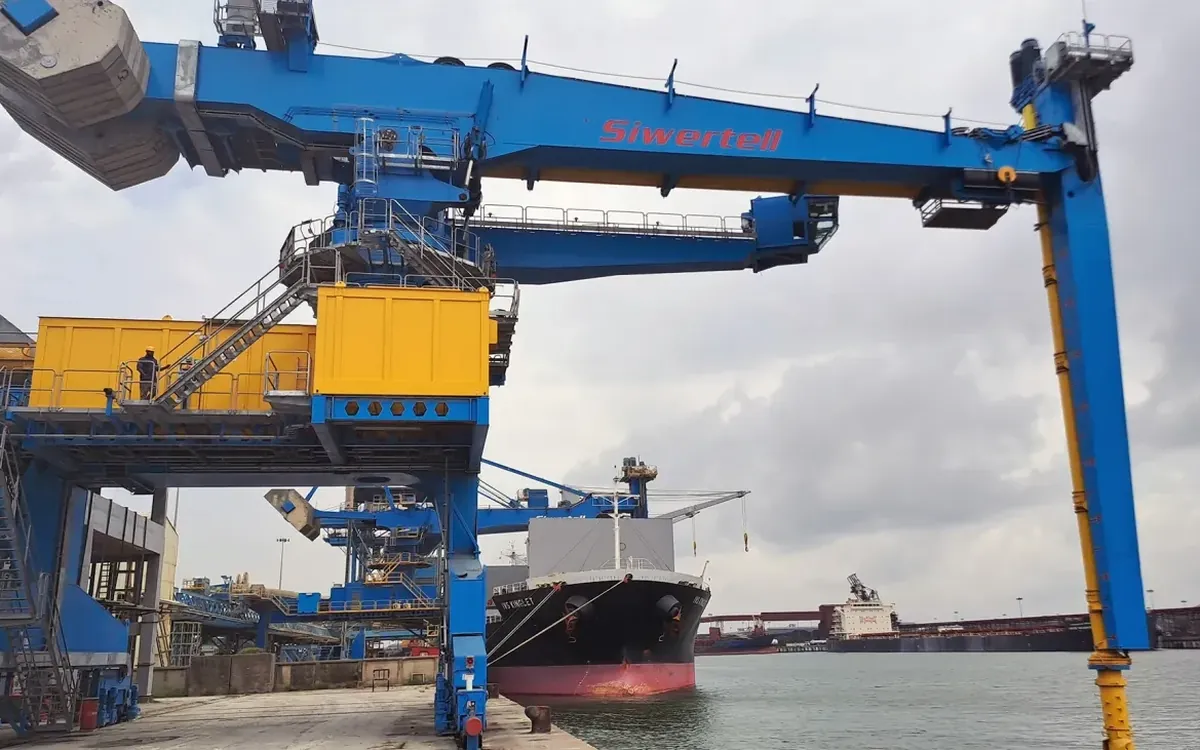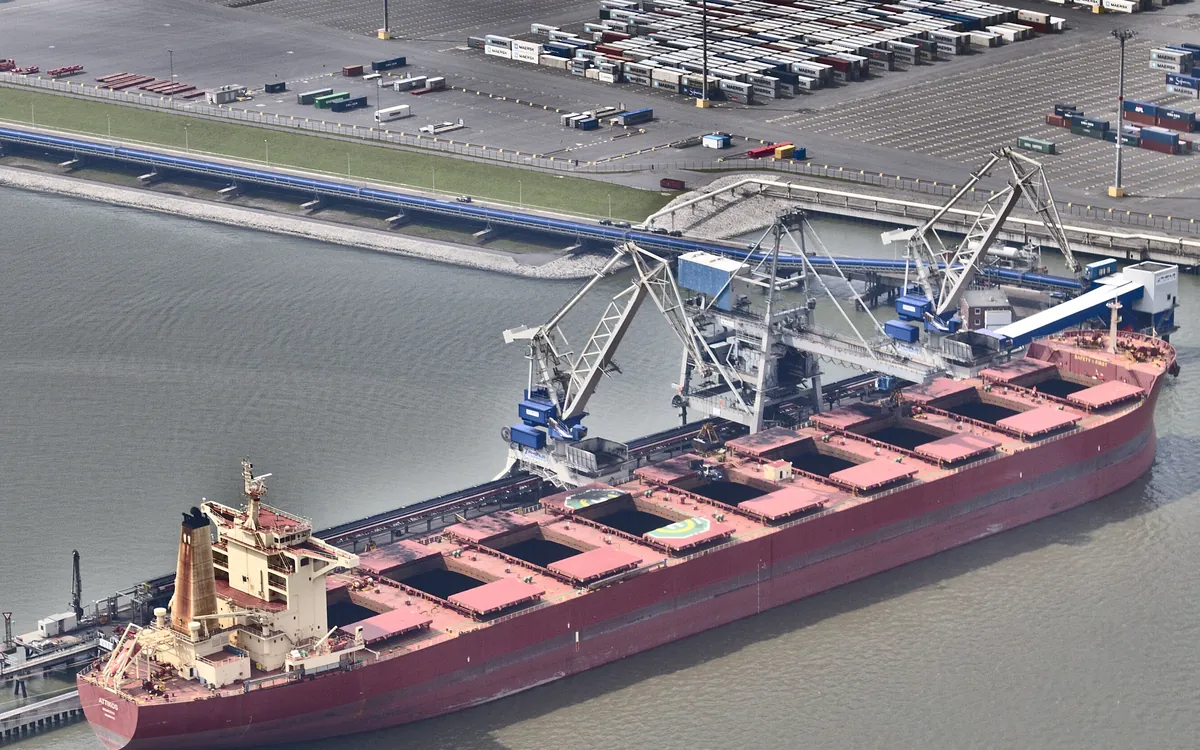
Rail-mounted gantry whose trolley runs a four-rope grab from the hold to a hopper built into the portal. The standard way to discharge coal and ore from large bulk carriers.
What a grab unloader is
The machine looks like a container crane but carries a grab instead of a spreader. A portal frame travels along the berth on rails, a boom reaches over the ship and a trolley runs out to the hatch. A hopper built into the portal receives the cargo and feeds a conveyor to the stockyard.
Grab unloaders cover the full range from barge unloading to the largest ocean-going bulk carriers, and they handle almost any dry bulk material.
How it works
Each cycle has four steps: lower the open grab into the cargo, close it to take a bite, hoist and travel back to the hopper, and open it to discharge. In the four-rope system, two ropes hold the grab and two close it, each with its own winch. Konecranes' Advanced Grab Drive synchronises the four drums electrically and supports automatic unloading modes.
Energy is recovered whenever a motion slows or the load is lowered. Konecranes states that during free digging about 30% of the electrical power intake is fed back to the grid in each cycle.
Sizes and key figures
Konecranes groups its AGD unloaders by ship size. For ships up to 80,000 dwt the grab lifts 20 to 35 t and the unloader discharges 1,000 to 1,500 t/h with 30 to 37 m outreach. For ships up to 160,000 dwt it lifts 35 to 65 t at 1,500 to 2,800 t/h with 37 to 42 m outreach. For larger ships it lifts 50 to 90 t at 2,000 to 3,500 t/h with 40 to 50 m outreach.
Rail spans range from 11 to 30 m and backreach up to 40 m. Hoisting, closing and trolley speeds are 180 m/min and gantry travel 20 to 30 m/min. Real throughput depends on vessel and quay conditions, so rated capacity is higher than the average achieved over a whole ship.
Where it is used and what cargo
Grab unloaders work at import terminals for power stations, steel mills, cement and fertiliser plants and general bulk ports. TAKRAF lists iron ore, bauxite, limestone, phosphate, fertilisers and potash among the materials. With hooks or spreaders, some can also handle general cargo or containers.
Konecranes references include the Port of Koper (iron ore and coal, 32 t grab, 1,500 t/h, 40 m outreach) and Bristol (coal and animal feed, 28 t, 1,200 t/h, 35 m). Freight rates for cargo through these terminals can be compared at rates.navo24.com.
Dust, noise and automation
Open grabs release dust when they discharge, so modern unloaders enclose the hopper and transfer points. At Bristol, for example, dust suppression is used when unloading coal and dust extraction for very dusty animal feed, with transfer points enclosed and the air filtered before release. At Stignaes in Denmark a Konecranes coal unloader (40 t, 1,800 t/h, 44 m outreach) uses noise reduction technology that cuts operating noise by up to 90%.
Automatic and semi-automatic cycles are now standard on many machines, with the operator in the cab or a remote station, and crane management systems log every signal for maintenance.
At Koper the unloader works a scissors-type grab in manual, semi-automatic and automatic modes. The Bristol Port Company runs two grab unloaders alongside two continuous unloaders, a common mix at ports that receive both heavy and dusty cargo.
How to choose, pros and limits
The grab unloader's strengths are versatility and robustness. It handles heavy and abrasive cargo, sticky material and lumps, and copes with many ship types. It is often the default for ore and coal.
Its limits are dust and spillage, heavy cyclic loads on the quay, and lower efficiency than continuous systems. Mitsui Miike gives a cargo handling efficiency of 0.45 to 0.6 for grab unloaders against 0.7 to 0.75 for bucket elevator continuous unloaders. Final clean-up of the hold needs bulldozers or excavators lowered into it.
Variants
Questions shippers ask
How big is the grab on a ship unloader?
From about 20 t for ships up to 80,000 dwt to 90 t for the largest bulk carriers, in Konecranes' range.
How fast does a grab unloader discharge?
Rated capacity runs from 1,000 to 3,500 t/h depending on size; average throughput over a whole ship is lower.
Grab or continuous unloader?
Grabs handle heavy, lumpy and abrasive cargo well; continuous unloaders give steadier output and less dust, especially for cement and grain.