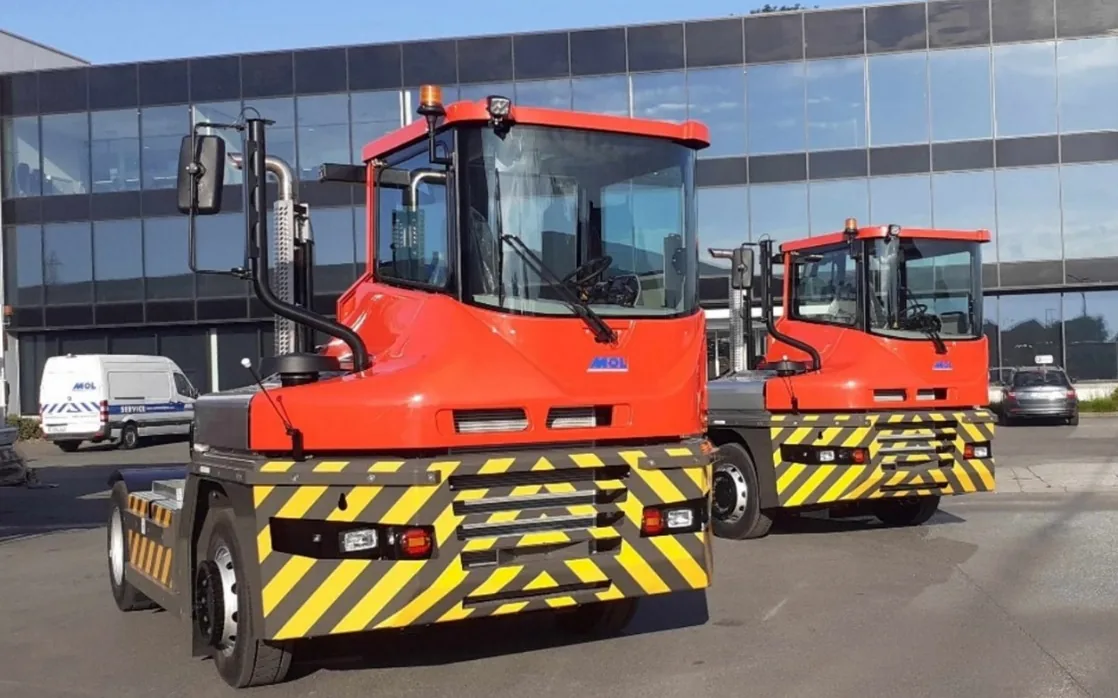
Four-wheel-drive terminal tractor built to pull heavy trailers up steep ship ramps. A 180° swivelling seat lets the driver face either way.
What a RoRo tractor is
Terminal tractors move semi-trailers within yards, warehouses and intermodal terminals. Wikipedia lists their features: a one-person cab offset to one side, a short wheelbase, a low-speed engine with automatic transmission and a hydraulic lifting fifth wheel, so the trailer's legs can stay down during the move. A RoRo tractor adds four-wheel drive and a heavier driveline for ship ramps.
Terberg designs its RT223, RT283 and RT323 for RoRo vessels with steep ramps and for industrial yards. The Ergoturn seat swivels 180°, so the driver can face the trailer when reversing it into a deck lane.
How it works
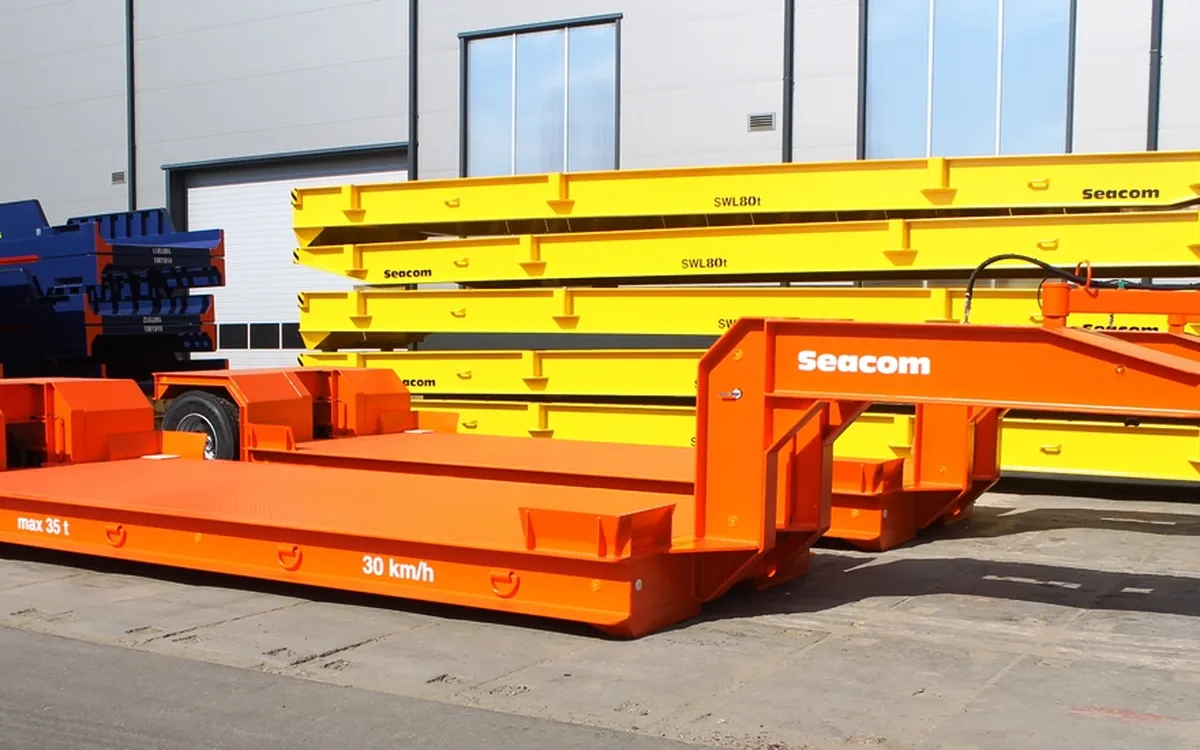
The tractor backs under a trailer, raises the fifth wheel to lift the front off its legs and tows it on board. On the ship it pushes the trailer into its slot, lowers it and drives off for the next one. With a gooseneck on the fifth wheel, the same tractor tows roll trailers with static cargo.
All four wheels are driven because a loaded trailer on a wet, steep ramp needs traction that a 4x2 tractor cannot supply.
Sizes and key figures
Terberg's RT models differ mainly in engine and gross combination weight (GCW). The RT223 has a 160 kW Volvo engine and a GCW of 75 to 150 t; the RT283 has 210 kW and 130 to 165 t; the RT323 has 235 kW and 165 t. All meet EU Stage V.
Front axle capacity is 16 t and rear axle capacity 38 t at 20 km/h. The fifth wheel carries 36 t and lifts up to 35 t, with a lowest fifth wheel height of 962 mm. For steelworks Terberg builds the RT403, with a 315 kW engine, 45 t fifth wheel lift and a GCW that can reach 375 t depending on conditions.
Where it is used and what cargo
RoRo tractors load unaccompanied trailers on ferries and RoRo cargo ships, pull roll trailers carrying static cargo and move trailers between the quay and the parking area. They work in ferry ports, deep-sea RoRo terminals and inside industrial plants such as steelworks and paper mills. Freight rates for cargo through these terminals can be compared at rates.navo24.com.
Electric RoRo tractors
Electrification has reached the 4x4 segment. Terberg's RT253EV uses a CeTrax electric motor with a 200 kWh or 300 kWh battery, CCS2 charging and a GCW of 60 to 80 t, with the same axle and fifth wheel ratings as the diesel RT models. Gothenburg RoRo Terminal, owned by DFDS and CLdN, has ordered six after trials, and CLdN has put its first electric 4x4 unit into service.
Wikipedia lists a growing group of electric terminal tractor makers, including Terberg, Kalmar, Volvo and Orange EV. Short, repeated shifts in a port suit battery operation, though steep ramps and heavy combinations still favour diesel for the largest loads.
How to choose: pros and limits
Size the tractor to the heaviest combination it will pull up the steepest ramp in the port, not to the average load. Check fifth wheel lift, the gooseneck type for roll trailers, cab visibility when reversing and telematics for fleet tracking. Pros: fast trailer turnaround, safe ramp work, one machine for semi-trailers and roll trailers. Limits: low top speed for off-road use, and electric models currently cover lower combination weights than the largest diesel units.
Variants
Questions shippers ask
What is a tug master?
A common name for a RoRo terminal tractor, used to tow trailers on and off ships.
Why do RoRo tractors need 4x4?
Ship ramps are steep and often wet. Four-wheel drive gives traction to pull heavy combinations up them.
How heavy a load can a RoRo tractor pull?
Terberg's diesel RT models are rated from 75 t up to 165 t gross combination weight depending on model.
Are electric RoRo tractors available?
Yes. Terberg's RT253EV is a 4x4 electric RoRo tractor, already ordered by Gothenburg RoRo Terminal.