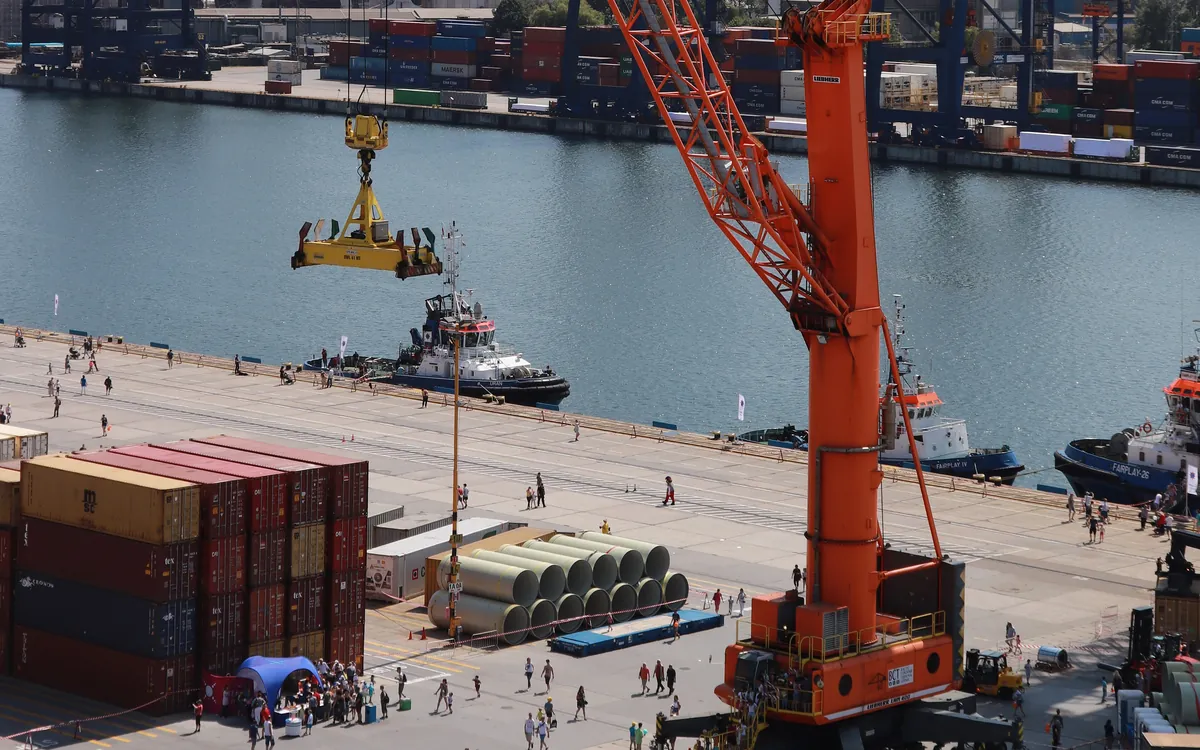
The rubber-tyred harbour crane on hook duty for steel, machinery and project cargo. Two cranes can lift one piece together with synchronised controls.
What a mobile harbour crane is
Unlike a ship-to-shore container crane on rails, a mobile harbour crane (MHC) has its own wheeled chassis. It can move between berths, park clear of a quay when not in use and switch between hook, grab and container spreader. That flexibility makes it the standard crane for multipurpose and breakbulk berths.
On heavy-lift duty the crane works on its hook with slings, beams and spreaders. Two cranes can lift one piece together with synchronised controls when the load is heavier or longer than one crane can manage.
How it works
The crane drives to position on individually steerable wheel sets, then sets down outriggers in an X-shaped support base that spreads the load into the quay. Liebherr groups the wheel sets hydraulically in three groups so no single set or patch of ground is overloaded, and keeps the pressure under six tonnes per wheel.
Lifting, slewing and luffing run in closed hydraulic loops driven by a diesel engine or from shore power. A four-chord lattice boom resists sideways pull, and the luffing cylinder sits above the boom so a swinging load cannot hit it. The cab sits on the tower, giving the operator a view down into the hold.
Sizes and key figures
Mobile harbour cranes range from compact models for small ports to the LHM 800, which Liebherr calls the most powerful mobile harbour crane in the world. It lifts up to 308 t, has a 64 m jib and weighs 742 t in total. The hoist reaches up to 120 m/min, and Liebherr rates bulk turnover with a grab at 2,300 t/h.
With that jib the LHM 800 reaches across vessels up to 22 rows of containers wide. Capacity falls with outreach, so the 308 t figure applies close to the crane; the load chart for the specific configuration decides what can be lifted at a given radius.
Where it is used and what cargo
Heavy-lift MHCs work at multipurpose and project cargo berths: transformers, generators, turbines, boilers and refinery modules, wind turbine nacelles, blades and tower sections, rail vehicles, yachts and large steel structures. The same crane can unload steel coils and slabs, handle bulk with a grab and work containers between project calls, which keeps utilisation up.
For the shipper, the crane decides whether a piece can move over a particular berth or must use the ship's own heavy-lift gear. Freight rates for cargo through these terminals can be compared at rates.navo24.com.
Engines, electric drive and automation
Current Liebherr harbour cranes carry diesel engines that meet EU Stage V or EPA Tier 5 final emission limits. Liebherr also offers hybrid drives, assistance systems and automation features for its maritime cranes.
The control cabinet is designed for -40 °C to +80 °C, so the same crane can serve Arctic and tropical ports.
How to choose: pros and limits
Check the heaviest piece, the outreach needed to reach its position on the ship, and the ground bearing capacity of the quay. Pros: mobility along the berth, multipurpose use and tandem lifting. Limits: the quay must carry high outrigger loads, capacity drops quickly with radius, and very heavy items above the crane's chart need a floating crane or a heavy-lift ship with its own cranes.
Variants
Questions shippers ask
What is the largest mobile harbour crane?
Liebherr describes the LHM 800 as the most powerful mobile harbour crane in the world, with a maximum lifting capacity of 308 t.
Can two harbour cranes lift one load?
Yes. Tandem lifts with synchronised controls are common for project cargo heavier or longer than one crane can take.
Does the maximum capacity apply at full outreach?
No. Capacity falls with radius, so check the load chart for the distance from the crane to the load.
What emission standard do new mobile harbour cranes meet?
Liebherr's current diesel engines meet EU Stage V or EPA Tier 5 final.