




















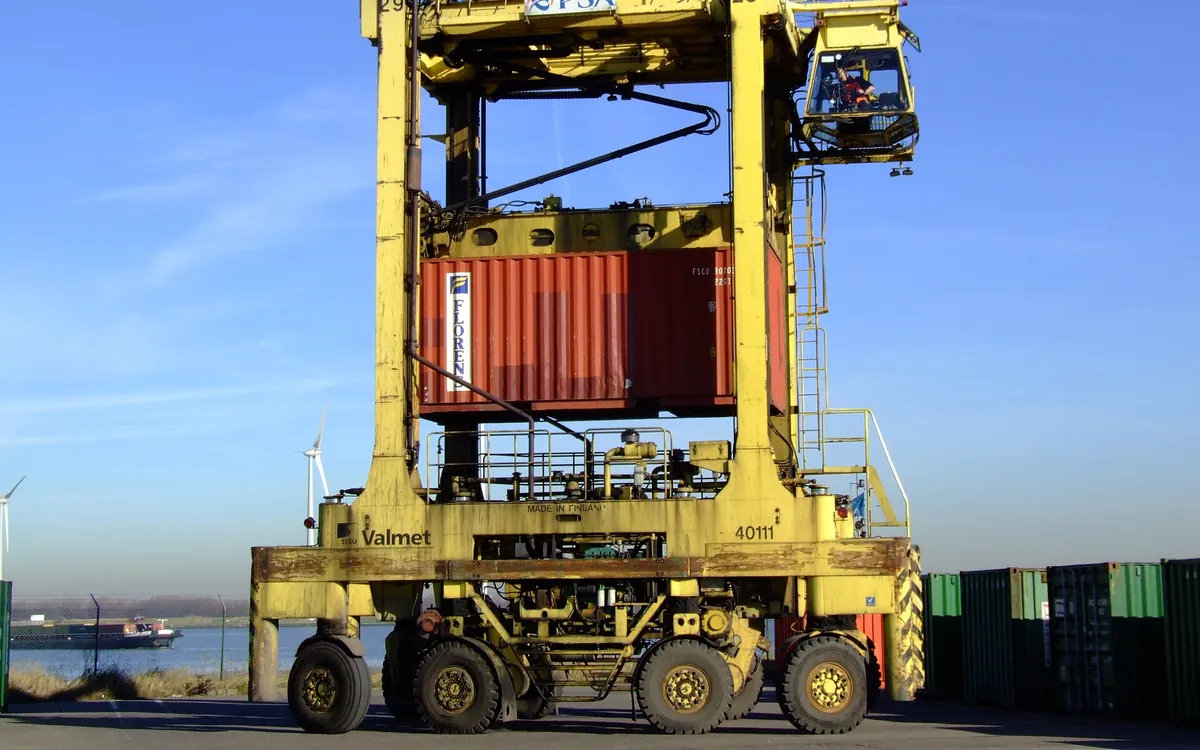
Drives over a container, picks it up between its legs and carries it. One machine does the quay transfer and the stacking.
What a straddle carrier is
A straddle carrier is a tall, narrow vehicle that carries its load underneath rather than on top. In container ports it picks up ISO containers with a spreader that locks onto the top corner castings, and it needs no crane or forklift to load or unload itself.
The driver sits sideways at the top of the machine, facing the middle, to see both ahead and behind. Similar machines move steel, precast concrete and boats on land, where they are often called travel lifts.
How it works
The frame forms a portal with an inside clear width of 3.5 m on Kalmar models. A rope hoist raises the spreader, which can shift sideways by plus or minus 350 mm and slew by 6 degrees to line up with the box. On current Kalmar machines the four wheels are driven by electric motors and the wheel brakes are wet discs.
At the quay the straddle carrier collects boxes set down by the STS crane, so crane and carrier do not have to wait for each other. In the yard it parks the container in a row of stacks it can drive over.
Sizes and key figures
Kalmar offers capacities of 40, 50 and 60 t under the spreader, enough for two full 20 ft containers on the larger models. Stacking reaches up to 1 over 3, with maximum lifting heights of 9.2 m or 12.0 m depending on the model. Service weight runs from 66 to 72 t and the wheel load fully loaded from 13.3 to 16.5 t.
Travel speed reaches 30 km/h on the lighter models and 25 km/h on the heavier ones. Lifting speed is 30 m/min empty and 13 to 20 m/min loaded, depending on capacity. The turning circle is 3.63 m inside and 9.55 m outside.
Kalmar quotes service intervals of up to 1,000 hours, and tyre options of 16.00R25, 450/95R25 and 480/95R25.
Where it is used
Straddle carriers are common in European and Australian container terminals and in intermodal yards. Kalmar lists the typical jobs: loading and unloading trucks, stacking up to 1 over 3, working with quay or rail cranes, feeding reefer stacks and shuttling between a depot or warehouse and the main yard.
They handle dry and reefer containers of 20 and 40 ft, with optional twin-lift spreaders for two 20 ft boxes and extendable spreaders for 45 ft. Freight rates for cargo through these terminals can be compared at rates.navo24.com.
Electric, hybrid and automated
Kalmar builds three drive types. The diesel-electric carrier uses a diesel generator and electric drive. The hybrid adds a lithium-titanate battery that stores braking and lowering energy, and Kalmar claims up to 40% lower fuel use and up to 50 t less CO2 a year than a diesel-electric machine. The FastCharge model is fully electric and recharges during operation, with an optional small diesel for moves away from a charger.
Automation is established: Kalmar AutoStraddle is a proven system for driverless straddle carriers, and all Kalmar models can be delivered ready for automation or retrofitted later.
How to choose, pros and limits
Straddle carriers give speed and independence. One fleet covers quay transfer, stacking and truck service, and a breakdown takes one machine out of service rather than a whole block. They also cope well with irregular peaks.
The limits are stacking density and maintenance. Stacks of three or four boxes need more land than RTG or RMG blocks, the machines are heavy and complex, and they need trained drivers or a full automation system. Terminals with little land usually choose gantry cranes instead.
Variants
Questions shippers ask
How high can a straddle carrier stack?
Up to 1 over 3 on Kalmar machines, so stacks up to four containers high, depending on the lifting height of the model.
How fast is a straddle carrier?
Up to about 30 km/h on Kalmar models, with lower speeds for the heaviest loaded units.
Straddle carrier or RTG?
Straddle carriers give flexibility and handle transport too; RTGs stack higher and denser but need a separate truck fleet.