





















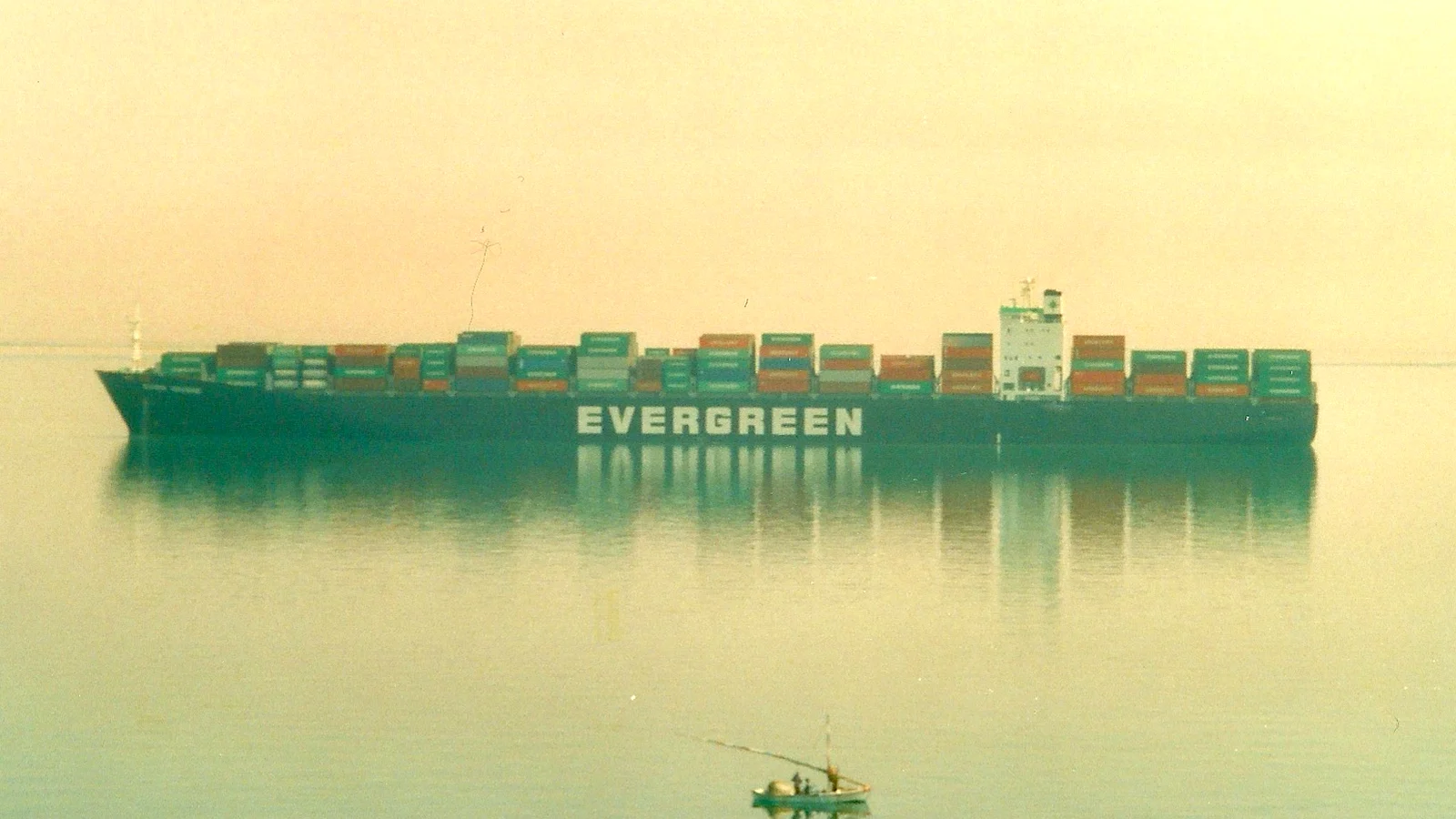
Nearly three years after Evergreen stopped using the canal, the Ever Eon went back in. Sources give Saturday 7 or Sunday 8 November. She was outbound from the Netherlands to Singapore. Maritime Executive reported that Ossama Rabiee, the canal’s chairman, welcomed her. She is an ultra-large boxship built just last year.
The canal authority named the Ever Eon as the first ship of the Evergreen Suez Canal return. Marine Insight places her on the NEU 7 service. The Loadstar puts her on the China Europe Shuttle (CES). Rabiee said more will follow. The Loadstar’s summary of Alphaliner data counts eight ad hoc transits planned on Evergreen’s Far East-Europe services, plus four sailings for the Red Sea market itself. In its 26 October Daily View, Lloyd’s List said its Intelligence data showed more than 100 containerships of 16,000 TEU and above through the canal since the start of September. That compares with 99 in all of 2025 and the first eight months of 2026 combined.
Three Red Sea loops, all calling at Jeddah and Aqaba
Three Red Sea loops are scheduled around the same weeks as the Ever Eon’s transit. As The Loadstar reported on 11 November, Evergreen’s 7,024 TEU Ever Superb was due to leave Qingdao on 14 November. Her rotation includes Jeddah, Sokhna and Aqaba. Emirates Shipping Line scheduled an inaugural China-Red Sea sailing from Shanghai on 13 November. The service runs fortnightly.
Sourcing Journal adds a third loop. The Premier Alliance is adding Sokhna to its MD1 service, with the YM Trust due to sail from Ningbo on 13 or 14 November. All three loops call at Jeddah and Aqaba. These are schedules only, and no source confirms a departure. The Loadstar also reports three more eastbound CES transits planned this year, and a westbound passage by the Ever Even reaching Suez on 12 December.
The Loadstar sees a risk in the overlap. Extra cargo could concentrate at a few Red Sea gateways. Ports receiving fewer calls risk losing traffic and utilisation, it adds.
Expeditors flagged Jeddah delays before the new calls
DP World’s South Container Terminal at Jeddah handled more than 221,200 TEU in July, the best month since operations began in 1999. First-half volumes had risen 79% year on year. In its September update Expeditors reported landside delays of 10 to 12 days after discharge. The Loadstar says further services could test terminal capacity. DP World has invested in additional handling equipment and is expanding capacity.
Security is a separate risk: Maritime Executive reports that the Houthis have declared an embargo on Saudi seaports. It adds that Saudi-linked vessels have been attacked in the southern Red Sea in recent months. The Houthi email to shipping companies of 20 July, as Reuters reported via Al-Monitor, says vessels are banned from loading or discharging cargo at any Saudi port. They may be targeted within the group’s operational reach. Bloomberg reads it as covering all ships calling at those ports, and Saudi vessels are only part of that.
What the Suez return means for Rotterdam yards
Flexport says Suez can cut transit by roughly seven to ten days. A string that has just switched arrives off its Cape timetable, next to ships still on the old route. For the week of 16 to 22 November, Flexport’s Amstutz counted 31 containerships arriving via Suez, with 61 coming via the Cape. Arriving capacity in northern European ports is forecast at 131% of normal. Suez supplies 40% of it. Rotterdam is forecast at 145% and Antwerp-Bruges at 151%, both above Flexport’s congestion line of 120%. The Loadstar says Flexport forecasts at least three weeks above that line between mid-November and January, and Sourcing Journal counts three of the next 11 weeks.
Rotterdam was tight before this. The Loadstar quotes Flexport on average dwell of 3.37 days in week 42, with yard utilisation at 80% to 90%.
Xeneta warned in September, in a report covered by Seatrade Maritime News, that a string switching to Suez can arrive up to 14 days early while Cape tonnage is still at sea. Expect bunching at the first port of discharge if the port stays the same. Published vessel schedules list transit times and cut-offs by ship. Our earlier piece on early ships and full yards covers that effect.
“Stay very close to the Suez arrivals,” Flexport’s Jannik Amstutz told the webinar. “It is definitely going to put more pressure on the congestion in north Europe.”
How much capacity uses Suez: 60% or 63%?
Drewry, quoted by Sourcing Journal, said 60% of Asia-Europe capacity was using the Suez route around the start of November. Food Business Middle East cites Alphaliner’s 63%. That figure counts Far East-Europe capacity on services that had fully or partially resumed the route by mid-October. The dates differ, and so do the definitions: Drewry says the capacity is using the route, Alphaliner counts services that fully or partially resumed it, and the trade lanes are Asia-Europe and Far East-Europe. They are not a like-for-like pair.
What this means for shippers
On Jeddah cargo, ask the forwarder for a gate-out estimate alongside the vessel ETA, because the 10 to 12 days Expeditors reported came after discharge. For a booking on a string that has just switched to Suez, have the carrier confirm the changed rotation before the booking is final. With the Evergreen Suez Canal return, ask the carrier for the ship’s name and the string it sails on, then look up its arrival week.