





















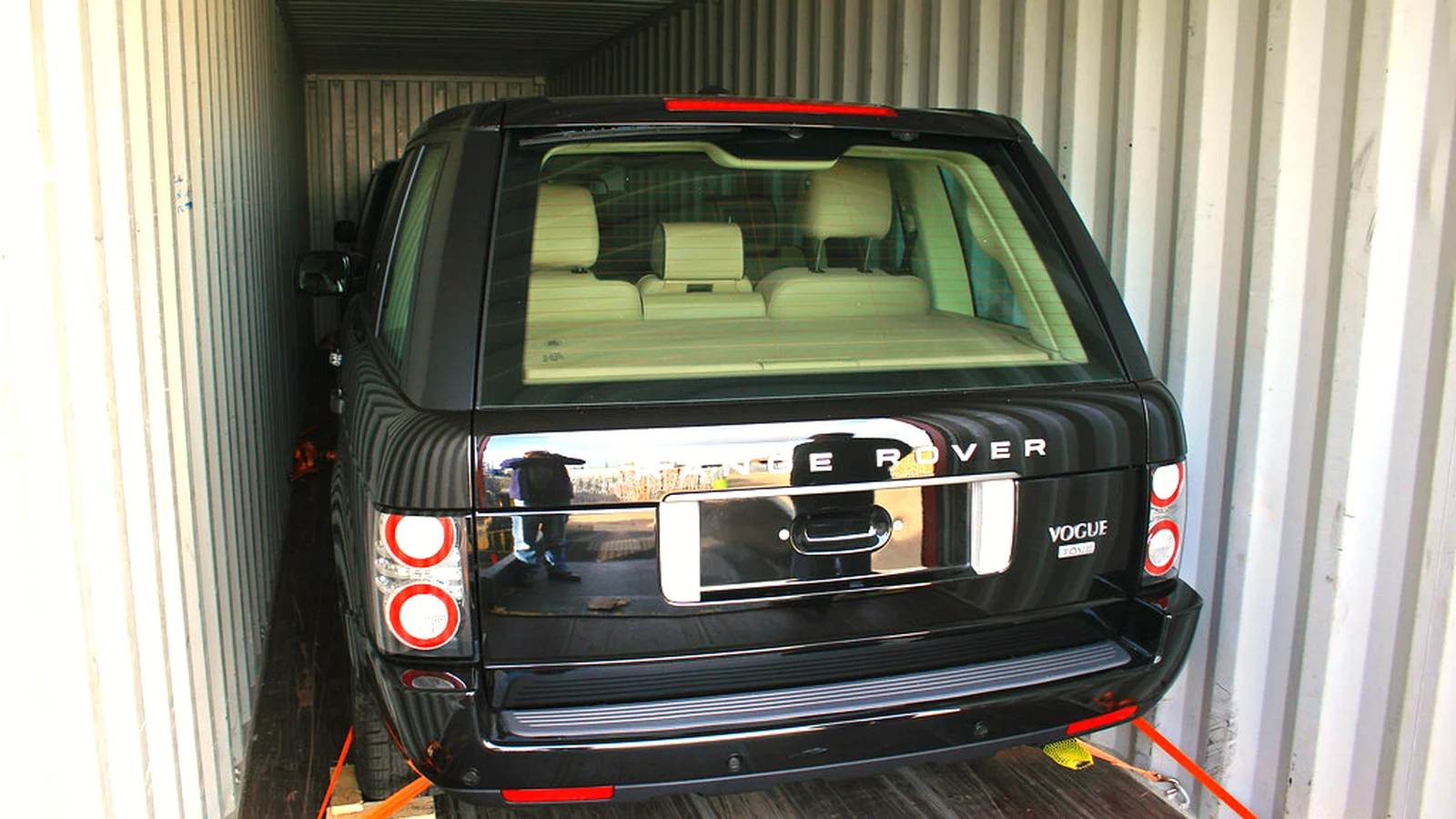
Ask how many cars fit in a container and you get different answers. Nobody is lying. A Fiat 500 and a Ford Transit are both “a car”, and a box with a rack in it is a different box from one without. I wanted a number I could defend, so on 7 November 2026 I fed eight vehicles into our load planner and wrote down what came back.
Why a container, when RoRo exists
Vehicles are primarily moved on their own wheels, up ramps onto ro-ro ships and car carriers, so nothing is lifted. Cargo Handbook notes that damage to vehicles often arises from incorrect handling during loading and unloading and while they are driven around the storage lot.
A container closes the car in at the origin and opens it at the buyer’s door. You pay for the whole box, though. One car in a 40-footer is a lot of steel to ship for one set of keys, which is why people try to fit two, three, four. The question is how many go in.
20, 40 or 45 feet
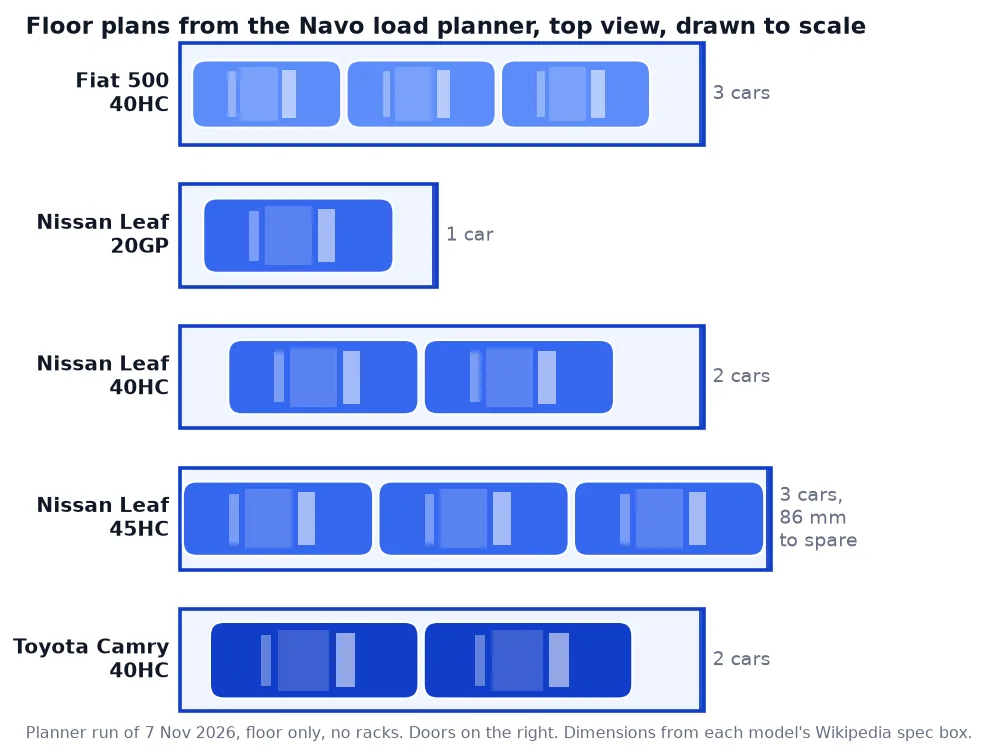
How many cars fit in a container comes down to floor length first. Floor length is the number that matters. The planner’s equipment table lists nominal industry figures, and real boxes vary by build and operator. A 20-foot box has 5,895 mm of it. A 40-footer has 12,029 mm (12,024 mm for the high cube). The 45-foot high cube has 13,556 mm. Width is 2,350 mm in all of them and the door opening is 2,340 mm, which a driver steering past wide mirrors will notice. Height: 2,392 mm standard, 2,697 mm high cube.
In a 20-footer my planner runs gave one car, even for the Fiat 500. In my runs two never fit in a 20-footer without a rack, and Maersk’s guide names two vehicles as the typical stowage there. The 40-foot is where the count gets interesting. The 45 looks like extra room and mostly isn’t, see below. Ask the forwarder whether the lane has racks at all.
What the planner returned for eight vehicles
The test was plain. Each vehicle went to the POST /v1/loading/plan endpoint as a box standing on the floor, no racks, no second tier. I raised the quantity until the planner asked for another container and recorded the last count that fitted. Dimensions are from the Wikipedia spec box of each model. Two of the eight are generic size-class inputs, not real models. The hatchback is 3,940 by 1,695 by 1,500 mm and 1,100 kg, about a Yaris. The SUV is 4,600 by 1,855 by 1,700 mm and 1,600 kg.
| Car | 20GP | 40GP | 40HC | 45HC |
|---|---|---|---|---|
| Fiat 500 (2007) | 1 | 3 | 3 | 3 |
| Nissan Leaf (2nd gen) | 1 | 2 | 2 | 3 |
| VW Jetta (A7) | 1 | 2 | 2 | 2 |
| Toyota Camry (XV70) | 1 | 2 | 2 | 2 |
| Honda CR-V (5th gen) | 1 | 2 | 2 | 2 |
| Ford Transit Custom SWB | 1 | 2 | 2 | 2 |
| Small hatchback (test) | 1 | 3 | 3 | 3 |
| SUV (test) | 1 | 2 | 2 | 2 |
Three things surprised me. A Camry and a Transit van give the same count, two in a 40-footer, although two vans fill 52.3% of a 40HC and two Camrys about 34%. Floor length decided the count, volume did not. Payload never came close either. The heaviest plan, three Leafs in a 45HC, used 19.2% of the allowed payload.
The Fiat 500 was the third surprise. It is 3,546 mm long, three take about 10.6 m, a fourth needs more than 14 m and even the 45-footer has only 13.5. Three in each box, 20-foot excluded.
The one car that wants a 45-footer
Nissan Leaf. At 4,490 mm, three cars need about 13.5 m of floor and the 45HC has 13,556 mm. The planner found the fit. In the 40HC the third Leaf went to a second container. 86 mm of margin is thin: real cars have mirrors, and the driver has to get out.
For the other seven the 45 added nothing. The Fiat 500 (3,546 mm) and the 3,940 mm hatchback gave three cars in a 40HC and three in a 45HC. Among the eight models I tested, a car of roughly 4.0 to 4.5 m is where a 45 can change the count, so for that size ask the forwarder whether a 45 is even on offer for your lane. A much shorter car is a different sum: by floor length alone, four cars of up to about 3.4 m fit a 45HC, while a 40HC takes four only up to about 3.0 m, so measure before you assume.
What racks do to the count
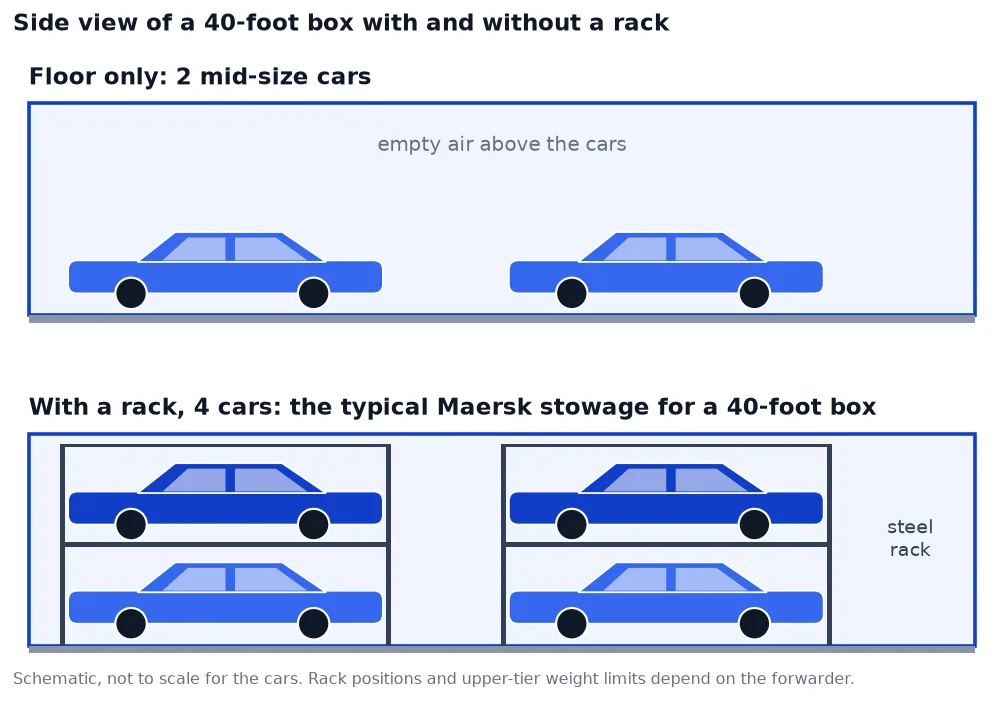
All of that is floor-only. A rack, or a cradle built from timber, lifts one car over another, so the second car stands in air that was empty. Maersk’s guide for vehicles in containers (revised January 2023) gives the typical stowage as two vehicles in a 20-foot and four in a 40-foot. That is double my floor-only result for mid-size cars.
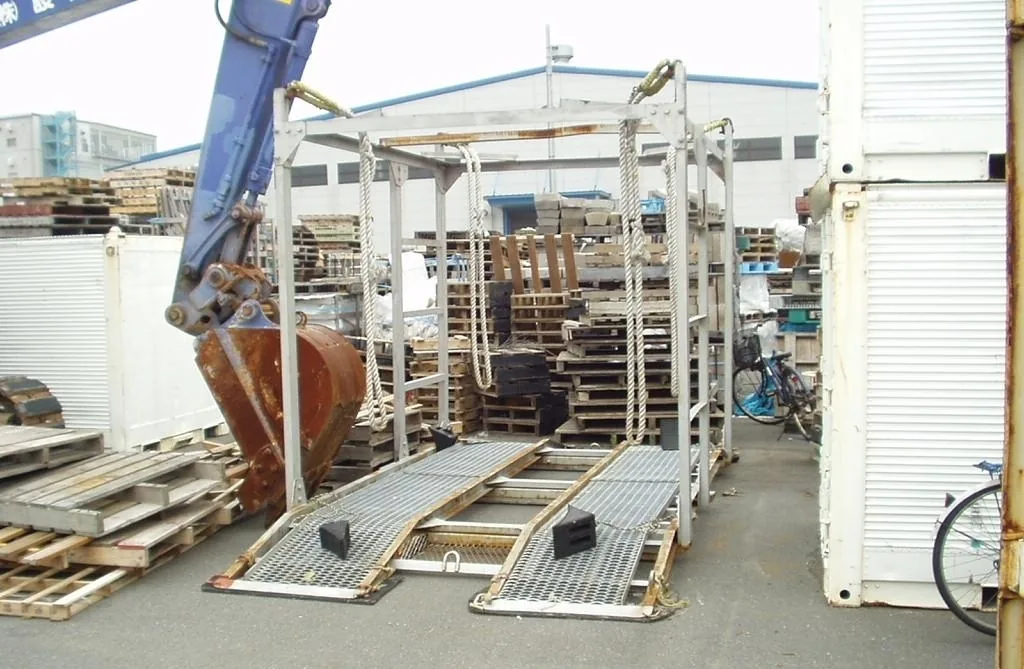
The same guide shows the timber version. Cradles of roughly 4 by 4 inch lumber go in so that the axles of the upper-tier cars rest on them, with verticals wedged into the corrugation of the walls. A forklift with extra-long blades lifts the first car and hangs it on chains from the upper lashing rings, two chains to a wheel if the car weighs over 3,750 lb. Then the car comes down on the cradle, gets lashed and blocked. Only after that does the second car go in below.
Maersk’s guide also mentions patented racking systems that stow four vehicles in a 40-foot container. Which method you get depends on the forwarder, so ask before you count on four.
Securing the car in the box
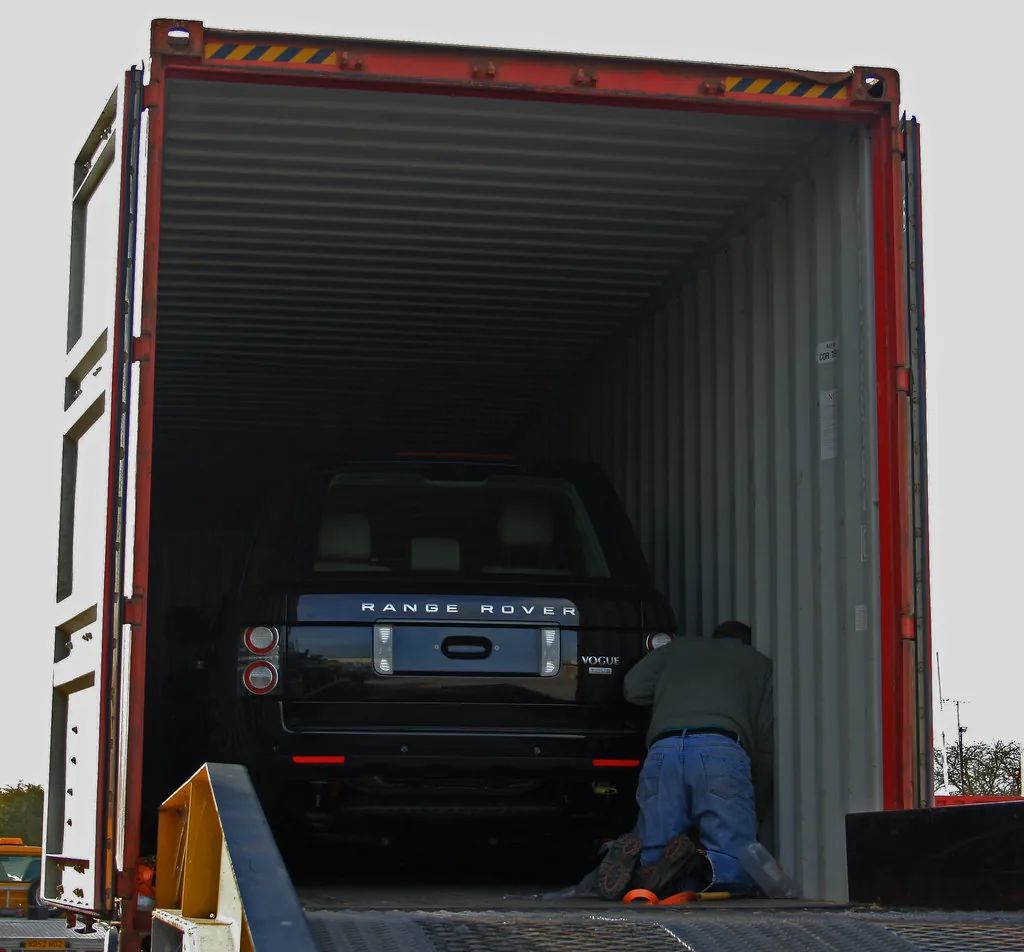
Maersk’s guide says vehicles must be lashed and secured so that they cannot move, from the chassis strong points to the lower lashing rings on the container sides. Wedges or timber against the tyres are only an added measure. Wooden floors of closed containers are generally not suitable for nailing, and nailing to the floor may only be acceptable with the consent of the container operator.
Take an SUV in a 40-foot box. The box is 2,350 mm wide inside, and the planner draws the SUV as a plain rectangle. Add a roof rail and the load stops matching my table, because the dock has to deal with mirrors, roof bars and a door that the driver must squeeze out of.
The CTU Code covers securing in its Annex 7. Read it, or make sure whoever packs your box has.
An SUV next to small cars
Maersk describes an upper and a lower tier. If you want to mix models, my assumption is that a big SUV goes on the floor and a smaller car above it, but I did not test that. The upper tier is limited by what the rack is rated for, so ask the rack operator for its rated load before you plan which car goes up.
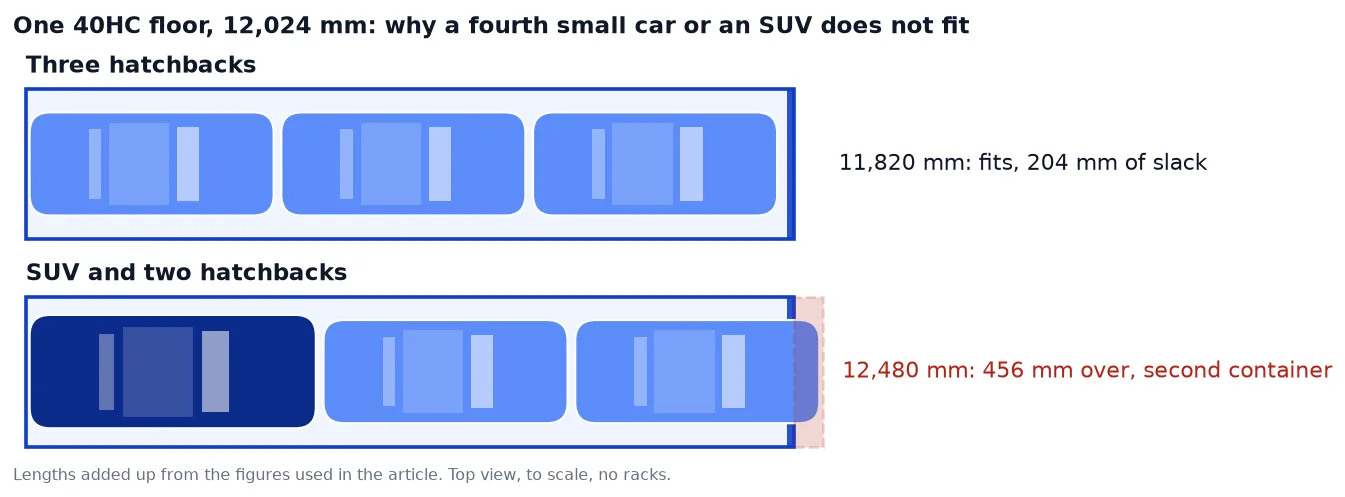
Without a rack the planner gave me less than I hoped for. Three hatchbacks fit in one 40HC: 39.4% of the volume, 3,300 kg in total. Swap one of them for an SUV and the planner asked for a second container. Two SUVs and a hatchback: same. A fourth hatchback landed alone in box number two. Down in the 20GP, a single SUV and a single hatchback already needed two boxes.
The SUV is 4,600 mm, each hatchback 3,940 mm, together 12,480 mm. The 40HC floor is 12,024 mm. We are 456 mm over, and no layout gets that back. Three hatchbacks take 11,820 mm and leave 204 mm. Promising a buyer three small cars in an unracked box on 204 mm of slack is a bet I would not take.
Spare parts in the same box would use floor length too. The planner takes pieces with their dimensions and weights and returns placements, so the check can be done before a car has moved.
Lashing: the line that was not a pass
The count is not all the planner returns. For the three-hatchback box it produced a certificate with eighteen lines. Door clearance against a 2,340 by 2,585 mm opening passed. So did overlaps, crush strength, VGM, centre of gravity (50% of stack height) and floor line load, 279 kg/m against a 3,000 kg/m limit. One line said “action” instead of “pass”. It asked for two direct lashings, each rated 2,000 kg or more, with 2,820 kg of combined working load limit. The alternative is blocking against the walls. Four voids were flagged as needing bracing or dunnage.
Maersk says lash from the chassis strong points to the lower rings. The planner calculates sliding to EN 12195-1, with blocking against the walls and lashing to the container’s own lashing points. For one SUV and one hatchback in a 20GP the worst container needed aggregate working load limit of at least 1,367 kg, or blocking against the walls. Read that line before you buy straps.
Paperwork comes before the arithmetic
In the IMDG Code a car with fuel and a battery is UN 3166, class 9, unless it meets special provision 961. Maersk’s guide, which covers non-battery vehicles and sends electric cars to a separate guide, gives two ways through. My table has a Nissan Leaf, a battery car, so for it check the electric-vehicle conditions, not these two routes. Route one is special provision 961, non-dangerous goods. The tank is drained, nothing leaks, the key is out, the battery is protected against short-circuit. A used car adds a disconnected battery with the cable ends taped. Special provision 962: the car ships as UN 3166 with a dangerous goods declaration. A hybrid with a lithium battery has only the second route.
A write-off bound for scrap travels without its battery, and the battery stays out of the container too. Maersk refuses a damaged car with the battery installed. Route two, provision 962, adds two documents: a Dangerous Goods Declaration and a Container Packing Certificate. Other lines may be stricter than Maersk. Get their conditions in writing before anyone touches the fuel.
After booking you have a container number, and a buyer waiting for keys will ask where the box is. You can follow the container by that number until it arrives.
Measure your own cars before you book
The honest answer is “it depends on yours”. My eight cars are not yours, and every count above is floor-only. Start with a tape and folded mirrors: length, width, height, plus roof bars or a rear carrier. Weight comes from the registration papers. Enter all four numbers into the planner, start with the 40HC and move to the other boxes, and keep raising the quantity until a second container appears. Take a margin off whatever it says.
Then two calls. One to the forwarder: do you load with racks, and how many cars per 40-footer? One to the carrier: what are your conditions for fuel, battery and documents? The answers differ from line to line. In my runs the length margin was what broke the plans, and the paperwork rules above are worth reading before the booking, not after it.
Frequently asked questions
How many cars fit in a 40-foot container?
Without racks, our load planner run on 7 November 2026 fit three small hatchbacks or two mid-size cars and SUVs. With racks, Maersk's vehicle guide describes the typical stowage as four cars in a 40-foot box and two in a 20-foot box.
Does a 45-foot container hold more cars than a 40-foot?
In our run only one of eight cars gained from it: the Nissan Leaf, three in the 45HC against two in the 40HC, with a margin of a few centimetres. For the other seven the count did not change.
Can a mixed load of an SUV and small hatchbacks share one 40-foot box without racks?
Not in our run. One SUV plus two hatchbacks and two SUVs plus one hatchback each needed a second container, because the combined length passes the 12,024 mm floor of a 40HC.
What does a carrier require before a car goes into a container?
Maersk's guide for vehicles asks for a drained fuel tank, no leaks, the key out of the ignition and a battery protected from short-circuit. A used car also needs the battery disconnected and the cable ends taped. Hybrids with lithium batteries ship as UN 3166 dangerous goods. Other carriers may differ, so check the booking conditions.