





















GOAT told sneaker buyers that Instant orders placed on a weekday morning would ship the same day. The FTC’s complaint of December 2, 2024 says the marketplace’s own data shows an estimated 63% did. The agency took the count from a random sample of one million orders placed between July 2019 and August 2022. By its estimate, the other 37% left later than promised. A shipping method named at checkout is a promise. How to choose a shipping method starts with what you can keep.
The $25 promise: what the FTC complaint alleges
GOAT charged $14.50 for Instant (Standard) orders and $25 for Instant (Next Day), plus up to 8% for priority processing. Buyers were told Next Day orders typically arrive within 1 to 2 business days. The purchase flow showed a “Get it by” date two business days after the order. According to the complaint, GOAT shipped more than 16% of Next Day orders on the second business day or later.
The FTC enforces the Mail, Internet, or Telephone Order Merchandise Rule, which covers mail, Internet and telephone order sales in or affecting commerce. It asks for a reasonable basis behind any advertised shipment time. No basis, no promise. If the seller cannot ship in the time it stated, or within 30 days when it stated none, the buyer must be offered a choice: accept the delay, or cancel for a prompt refund. The complaint alleges GOAT often made no such offer. GOAT neither admitted nor denied the allegations. On December 12, 2024 the court entered an order for a monetary judgment of $2,013,527, which GOAT stipulated it had placed in escrow to secure customers’ shipping claims.
The complaint measures a shipment from the moment the merchandise is physically in a carrier’s hands. Your own handling time is inside the promise, because the clock runs until the carrier holds the parcel.
How to choose a shipping method you can keep
Handover day comes first. The carrier comes second. For small, light parcels, USPS Ground Advantage is a plain default: expected delivery in 2 to 5 days (Alaska, Hawaii and offshore destinations may be slower), tracking included in the price, weight up to 70 pounds, with prices starting at $8.40 at a Post Office location. It reaches all 50 states, and businesses can ask USPS for negotiated pricing. If the stock is still on a vessel, check the inbound container’s live status before checkout names a ship date. For goods bought abroad, EU duties, UK VAT and carrier liability change what the buyer pays.
A cubic foot that can bill as 13 pounds
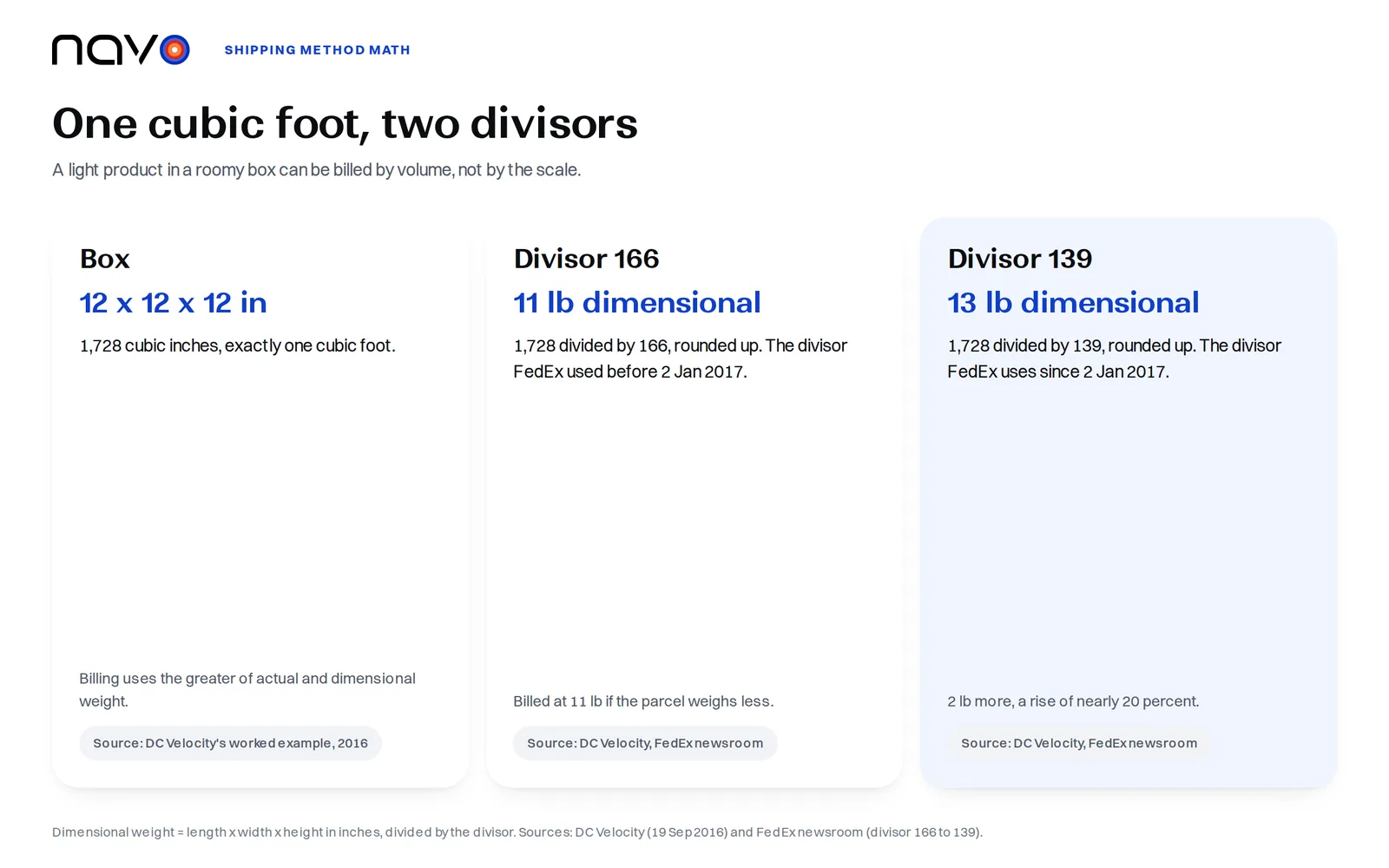
A light box can still bill heavy. Size does it. USPS applies dimensional weight to packages larger than one cubic foot, 1,728 cubic inches. The method is the same at every carrier: multiply length, width and height, then divide by the carrier’s divisor. The example below is FedEx’s. DC Velocity put numbers on FedEx’s change: a parcel of exactly one cubic foot yields an 11-pound dimensional weight at a divisor of 166, rounded up, and 13 pounds at 139, a rise of nearly 20 percent. The shipper pays the higher of dimensional and actual weight.
FedEx announced that from January 2, 2017 its US domestic divisor for Express and Ground would change from 166 to 139. The divisor had fallen once before, from 194 to 166 on January 3, 2011. A smaller divisor means more dimensional weight from the same box.
What a rate card cannot tell you
A published rate card cannot know your zones, your weight mix or the discount in your carrier account. Price your three most-shipped boxes with each carrier at real dimensions and compare the totals after dimensional weight. Then take the slowest handling time you met last month. Put it on the checkout page. Add a day.
Frequently asked questions
Is insurance included with USPS Ground Advantage?
The USPS Ground Advantage page lists $100 of insurance as included, for outbound and return shipments, and offers up to $5,000 of additional coverage for merchandise.
When does USPS add a fee for a long package?
USPS lists a $4.50 fee for packages between 22 and 30 inches long and $10.00 above 30 inches. Packages over 2 cubic feet (3,456 cubic inches) carry $21.00.
When did FedEx Ground start applying dimensional weight to small packages?
FedEx announced on May 2, 2014 that from January 1, 2015 Ground would apply dimensional weight pricing to all shipments. Before that it applied only to packages of three cubic feet or more.