





















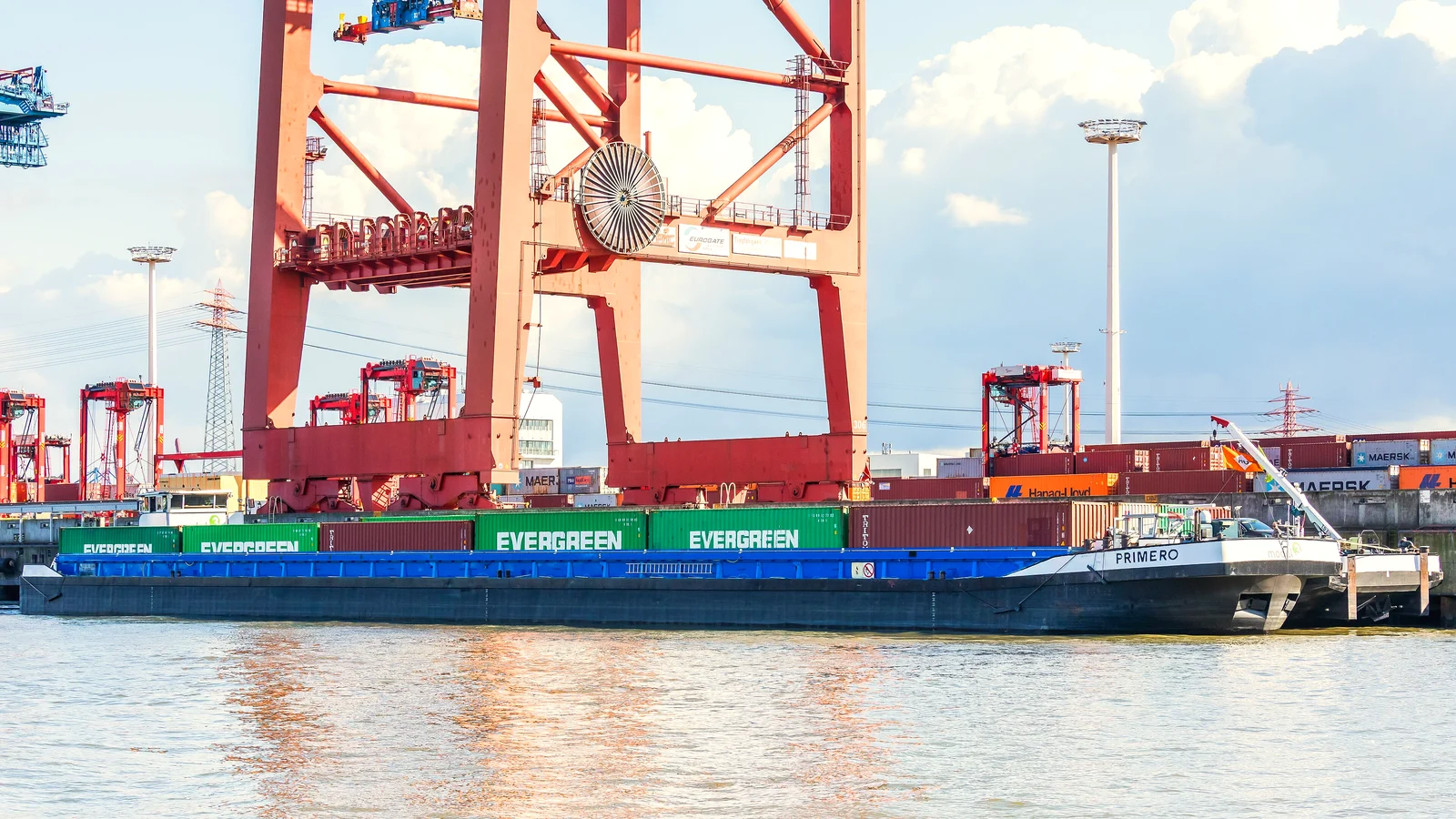
One industry blog post tells readers that you can start a freight forwarding business without warehouses or a huge office, with little more than a computer, an internet connection and a phone. The license requirement is the part that blog skips. Under 46 CFR 515.3, and with the exceptions that part allows, no person in the United States may advertise, hold oneself out or act as an ocean transportation intermediary unless that person holds a valid license issued by the Commission.
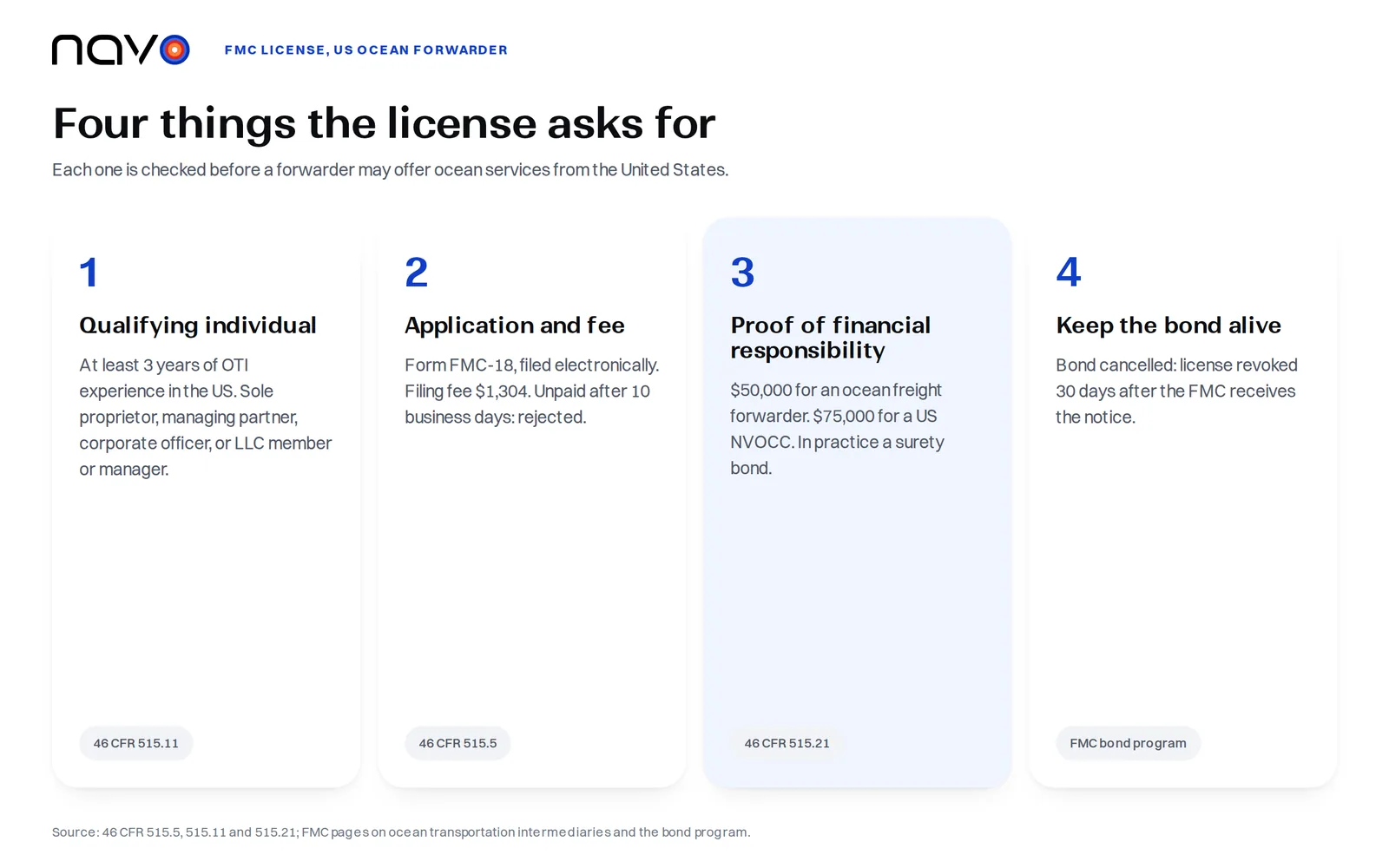
A US forwarder has four things to settle. Whether it will act as a forwarder or as an NVOCC, because the bond differs. Who will be the qualifying individual. Where the bond comes from. And the application fee, which has to arrive within ten business days of the filing or the application is rejected. The sections below take them in turn.
The license starts with one named person
An ocean freight forwarder, as defined in 46 CFR 515.2, dispatches shipments from the United States on a common carrier, books or arranges space for them on behalf of shippers, and handles the documents that go with each shipment. A non-vessel-operating common carrier (NVOCC) works differently: it does not run ships, it is a shipper in its dealings with the ocean carrier, and, per the FMC’s own intermediary page, it issues its own house bill of lading and must publish a tariff. A US-based NVOCC needs the license too, while a foreign one may register instead.
Every application names a qualifying individual. Section 515.11 requires that person to have at least three years of experience in ocean transportation intermediary activities in the United States, and the same section lists who can fill it: the sole proprietor, an active managing partner, an active corporate officer, or a member or manager of an LLC. The Commission also looks at character, and what it may weigh includes operating as an intermediary without a license, undischarged bankruptcies and outstanding tax liens. The application goes in on Form FMC-18, filed electronically, with a filing fee of $1,304.
The bond: $50,000 for a forwarder, $75,000 for an NVOCC
Section 515.21 sets financial responsibility at $50,000 for an ocean freight forwarder and $75,000 for an NVOCC based in the United States. The FMC’s bond page says the instrument can be a bond, a guaranty or insurance, and that to date all of it has been surety bonds, written on Form FMC-48 by a surety on the Treasury Department’s Circular 570 list. If the bond is cancelled, the license is revoked thirty days after the Commission receives the notice.
Boateng Logistics of Carlsbad, California, is a small example of the numbers involved. In February 2024 FreightWaves reported that the company had filed for bankruptcy liquidation, listing assets of up to $50,000 against liabilities of between $1 million and $10 million. The largest unsecured creditor was the Small Business Administration, owed $750,000 on a 2020 disaster loan, and several factoring companies were on the list as well. The federal safety database showed its freight forwarder authority granted in January 2023, about thirteen months before the filing, and its surety bond was slated to be canceled soon after the petition. That is a US trucking-side authority and not an FMC ocean license. The liabilities in that petition were twenty to two hundred times the $50,000 an ocean forwarder has to bond.
A lien clause and 240 containers
Lion Global Forwarding, an Australian NVOCC, was behind on payments to its own creditors in October 2024. One of them was the company it had hired to carry Nick Scali’s furniture out of China. Lion asked its customer to pay. According to Holding Redlich’s account of the judgment, the statements of account came to about AUD 3.3 million, and the goods Lion held under the lien clause in its standard terms were worth about AUD 18.6 million, roughly 240 containers. Nick Scali feared it would pay Lion and still have to pay the carrier to get its boxes. The judge granted that the fear had “some justification” and still found no contractual basis to resist payment. The Federal Court rejected the application for release in [2024] FCA 1247. In Holding Redlich’s reading, what Lion did with the money was irrelevant to the validity of the lien.
An ASX announcement from Nick Scali dated 19 November 2024 says that one of its freight forwarders and customs agents was under a liquidator and that a significant number of containers were delayed at the ports. The announcement adds that the retailer had obtained court orders for the shipping lines to release the containers on certain undertakings, and that it expected storage and detention costs it could not yet quantify. The announcement says these costs add risk to the earlier NPAT guidance for Australia and New Zealand in the first half of FY25, a range of $30 to $33 million.
A founder who wants to start a freight forwarding business should read the lien clause in their own terms of trade before the first booking. In this case that clause decided who could hold the boxes while two sides argued about money. The case was decided under Australian law and does not bind a US forwarder. What carries over is the practical point that the terms of trade are the document that settles who holds the cargo. Shippers who book with a new forwarder can check its FMC record first, and once boxes are moving a container tracking API that takes a container number shows where they are.
Working capital is left to the founder
The rules fix the bond amount and say nothing about how many weeks of carrier invoices a new forwarder should be able to cover before its customers pay. FreightWaves does not say why Boateng failed, and Holding Redlich’s account of the Lion judgment does not say how much Lion owed the carrier it hired. Anyone planning to start a freight forwarding business has to work that number out from their own rate sheet and the payment days of the first customers. A rough method: add up a month of carrier invoices at the volume you expect, then ask how many of those days your cash can carry if the slowest customer pays late.
Frequently asked questions
What happens to a forwarder's license if its bond is cancelled?
Revocation comes with an Order of Revocation, and the company's name comes off the list of active intermediaries on the FMC website. The bond can be cancelled by the surety or by the forwarder, and either way the clock is thirty days from the Commission receiving the notice.
Can a company based outside the United States get an FMC license?
A non-US NVOCC can hold an FMC-issued license if it has a qualifying US presence. Under 46 CFR 515.11 that means an unincorporated office resident in the United States and qualified to do business where it sits. Its qualifying individual may count experience gained in the US or abroad, as long as it relates to shipments in US oceanborne foreign commerce. A foreign NVOCC that does not seek a license can register instead, with financial responsibility of $150,000.
How long does the FMC give an applicant to pay the filing fee?
Ten business days after the application is submitted. Under 46 CFR 515.5 an application is rejected if the fee, and any bank charges the Commission is billed, have not arrived by then. The new-license filing fee in the current rule is $1,304, and it is not refunded once the application has been processed in whole or in part.