




















“If water levels reach or fall below 30cm at Emmerich, 180cm at Duisburg-Ruhrort, 105cm at Cologne, or 80cm at Kaub, transportation cannot be guaranteed.” That sentence sits in the operating terms of Hapag-Lloyd’s notice of 25 September on the Rhine low water surcharge, and it matters this weekend, because Kaub stood at 72 cm at midnight on 14 November.
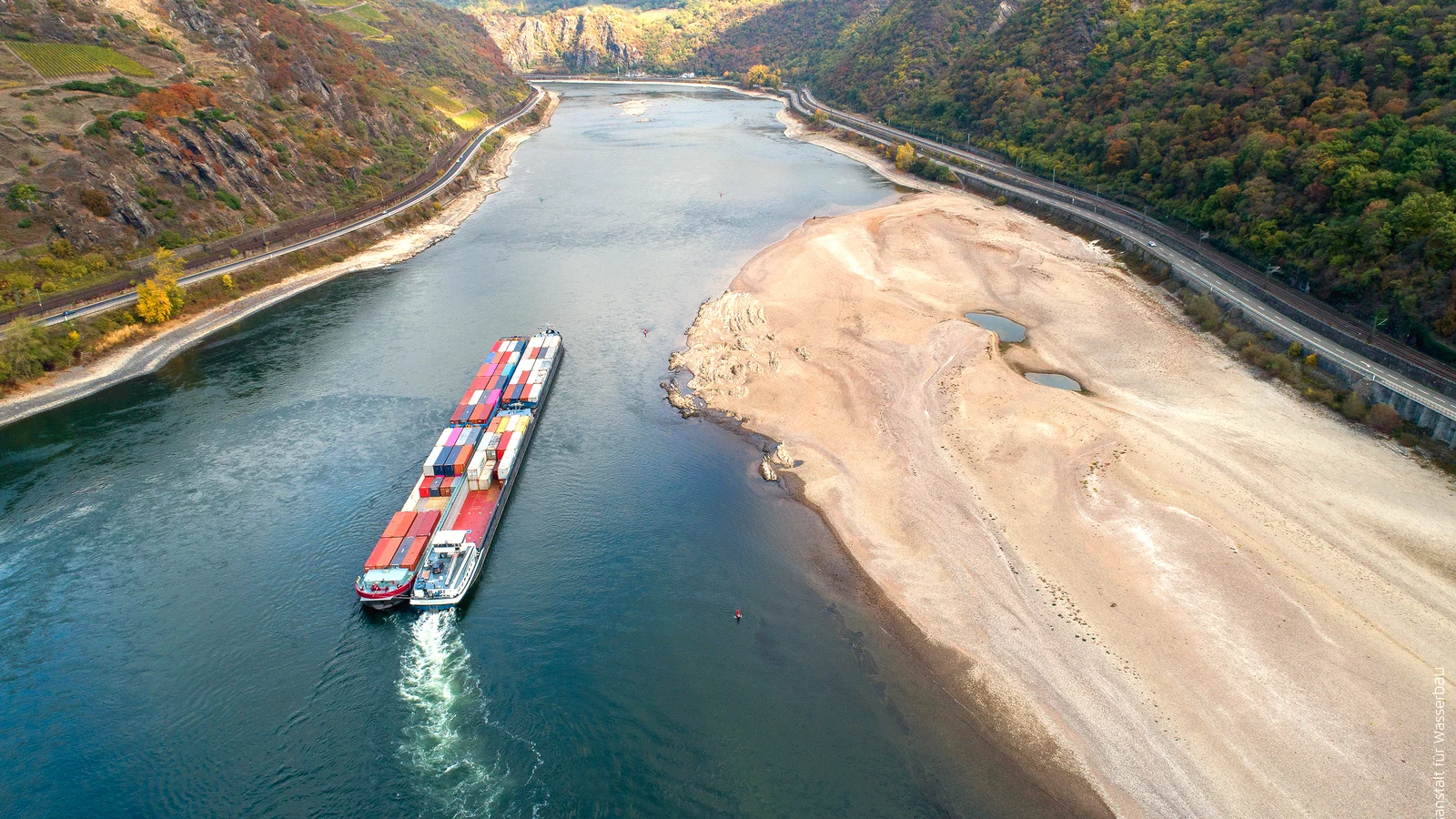
Kaub sits in the Middle Rhine gorge, which the Forwarder News tracker describes as the shallowest point on the main barge route between Rotterdam, Antwerp and southern Germany. Its PEGELONLINE midnight readings from 2 to 12 November were all 25 cm or lower, with a floor of 5 cm on 8 November. Then the gauge climbed, to 57 cm on 13 November and 72 cm on 14 November, above the 61 cm high of 29 October.
What a container pays at 72 cm
Hapag-Lloyd prices by Kaub gauge band for all terminals south of Koblenz, and the Kaub scale on Contargo’s gauge page carries the same figures for every band between 80 and 41 cm.
| Kaub band | 20’ box, EUR | 40’ box, EUR |
|---|---|---|
| 80 to 71 cm | 300 | 380 |
| 70 to 61 cm | 400 | 480 |
| 60 to 51 cm | 550 | 645 |
| 50 to 41 cm | 775 | 930 |
At the bottom of the scale, Hapag-Lloyd’s Rhine low water surcharge is a flat EUR 1,350 for either box size. Maersk’s Benelux barge notice of 12 August, as the tracker reports it, uses its own tiers: at 72 cm Kaub moves from the below-61 cm tier (EUR 350 per 20’, EUR 465 per 40’) to the below-81 cm tier (EUR 195 and EUR 250), lower than Hapag-Lloyd’s 300 and 380.
On Contargo’s surcharge terms, the basis is the 5:00 CET ELWIS reading, and the day that counts is the actual departure of the vessel: from the inland terminal for exports, from the seaport for imports. Between the 71 cm and 70 cm readings the surcharge on a 20-foot box moves from EUR 300 to EUR 400.
Only Cologne is back above its line
Both lines draw a line at 80 cm for Kaub. Hapag-Lloyd says transport cannot be guaranteed; Contargo says its obligation to transport ends, while adding that it still tries to move the containers. The header of Contargo’s gauge page on 14 November shows Kaub at 73 cm, Duisburg-Ruhrort at 164 cm and Cologne at 106 cm, with Emmerich at 2 cm. Against the marks in Hapag-Lloyd’s notice, only Cologne (105 cm) is back above its line, narrowly; Duisburg-Ruhrort (180 cm), Emmerich (30 cm) and Kaub (80 cm) are not. Contargo’s forecast by departure date puts Kaub at 72 cm on 14 November, 72 cm on 15 November and 71 cm on 16 November, all inside the 80 to 71 cm band of the table above.
Contargo explains why its Rhine low water surcharge looks steeper than in earlier low-water spells. The rise comes largely from the sharply higher cost of chartering barges, and the company adjusts the scale to daily market conditions and gauge readings.
Barge schedules may need days to catch up
Recovery time is the open question, and the best answer predates the rebound. In its report of 15 October, The Loadstar quoted SeasC4U’s Gunther Ginckels on replacement capacity: trucks can take up to two weeks to find, rail up to six weeks of advance notice, and even with trucks used extensively there was reportedly not enough road capacity, in some affected areas, for 15% to 30% of the affected volumes. Logistics experts, he added, estimate up to 10 days for vessel schedules to normalise after water levels recover.
Contargo’s business news of 9 November put congestion at 48 hours in Antwerp and 37 hours in Rotterdam.
For a shipper this turns into two questions for the forwarder: which vessel departure date the surcharge was keyed to, and whether the quote is a table band or an individual agreement, which Hapag-Lloyd applies below its published scales. Ask for the vessel name and sailing date, compare them with the invoice, and check the box’s position in container tracking when the two disagree.
Contargo lists its scale by departure date. Hapag-Lloyd’s notice ties the surcharge to the water levels published on the ELWIS website and names no day for the reading.