





















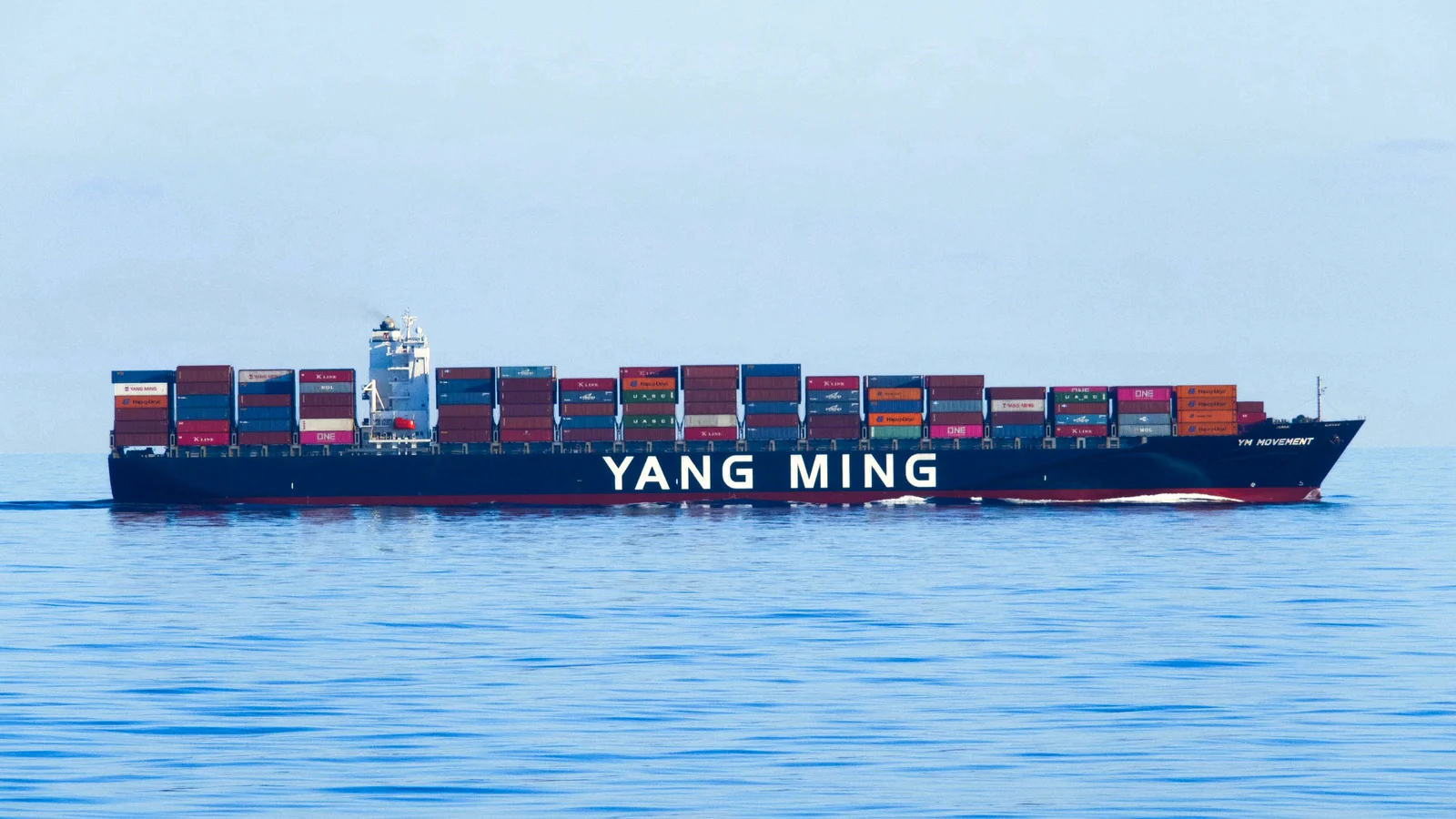
On 16 November Maersk and Hapag-Lloyd announced that three Gemini services will move onto the trans-Suez route. DHL Global Forwarding published its market assessment the same day. Its message: the Suez Canal return will not clear port congestion by itself. More than 10% of the world container fleet, about 3.6 million TEU, is still tied up in port congestion. A shipper books against both at once.
What the carrier promises
The Maersk advisory of 16 November gives dates. AE2 goes first, with Mary Maersk on voyage 650W, planned berthing at Ningbo on 4 December. AE3 follows with Alette Maersk 652W at Shanghai on 20 December. AE1 comes last, Damietta Express 702W at Shanghai on 14 January. All three are estimated berthing times.
Maersk calls Suez the fastest and most efficient way to serve Asia, Europe and the Middle East. There is a condition. Any change to the services, it adds, depends on stability in the Red Sea.
What the forwarder counts
DHL, a forwarder, counts differently. Around 60% of relevant Asia-Europe headhaul services are planned to run through Suez, the return is uneven between trade lanes, and the transition could take another six to twelve months if security conditions hold.
Bjoern Schoon, DHL’s senior vice president of ocean freight for Asia Pacific, names the job: carriers “must reposition ships, rebalance schedules and manage services operating across different routings.”
DHL forecasts about 4% fleet capacity growth for 2026, against 5% demand growth so far this year. The orderbook stands at 47.8% of the active fleet, per Linerlytica data that DHL cites.
A shorter route frees ships. Arrival is another matter: DHL expects schedule reliability, not capacity alone, to stay a key challenge, and in the Middle East it reports berth delays of more than two weeks at some Gulf gateways.
Where the queue moves: North Europe in week 47
The sharpest number comes from Flexport, as reported by The Loadstar. Flexport forecasts arriving vessel capacity in North Europe at 131% of normal in week 47, with about 40% of it coming through Suez. That week 31 containerships are due via the canal and 61 via the Cape. Flexport warns that ships on the shorter route could arrive alongside ships still sailing around the Cape.
Flexport treats anything above 120% as a congestion risk. It expects at least three weeks over that line between mid-November and January. Flexport puts Rotterdam’s average container dwell time at 3.37 days in week 42, with yard utilisation at 80% to 90%.
The Loadstar reports that shorter Suez routings could cut transit by seven to ten days, with the risk that pressure shifts between ports and the delays stay.
Jeddah shows the Red Sea side. It had landside delays of ten to twelve days after discharge in Expeditors’ September update, while Evergreen and Emirates Shipping Line are adding direct calls there.
Reading the two papers together
The two papers barely disagree on the Suez Canal return. They answer different questions. Maersk promises more efficient transit times. DHL puts the weight on schedule reliability, and the Maersk advisory says nothing about berth waits.
The advisory gives no transit-time figure, and the day a box leaves the terminal stays open.
A live pull shows what a booked date rests on today. In a pull of 50 containers from the Navo tracking API on 17 November, 19 were on the water (16 in transit, 2 at transshipment, 1 arriving). On the 19, the ETA was flagged as estimated and no predicted ETA was filled in. The sample is small and covers mixed lanes, not Asia-Europe alone.
Before a December booking
Ask the carrier for the current rotation. Then ask for the arrival week at the discharge port. Set that week against the ones Flexport marks above 120%, since ships on both routings could land together. Then plan the yard days: trucking slots, free time on the container, storage at the receiving warehouse. Desks that book many lanes can check sailing schedules before committing to a rotation that changed this month.
For a 4 December load at Ningbo on AE2, the question to send today is which week the vessel is due at Rotterdam and Wilhelmshaven, and how many free days the terminal gives when it does arrive.