





















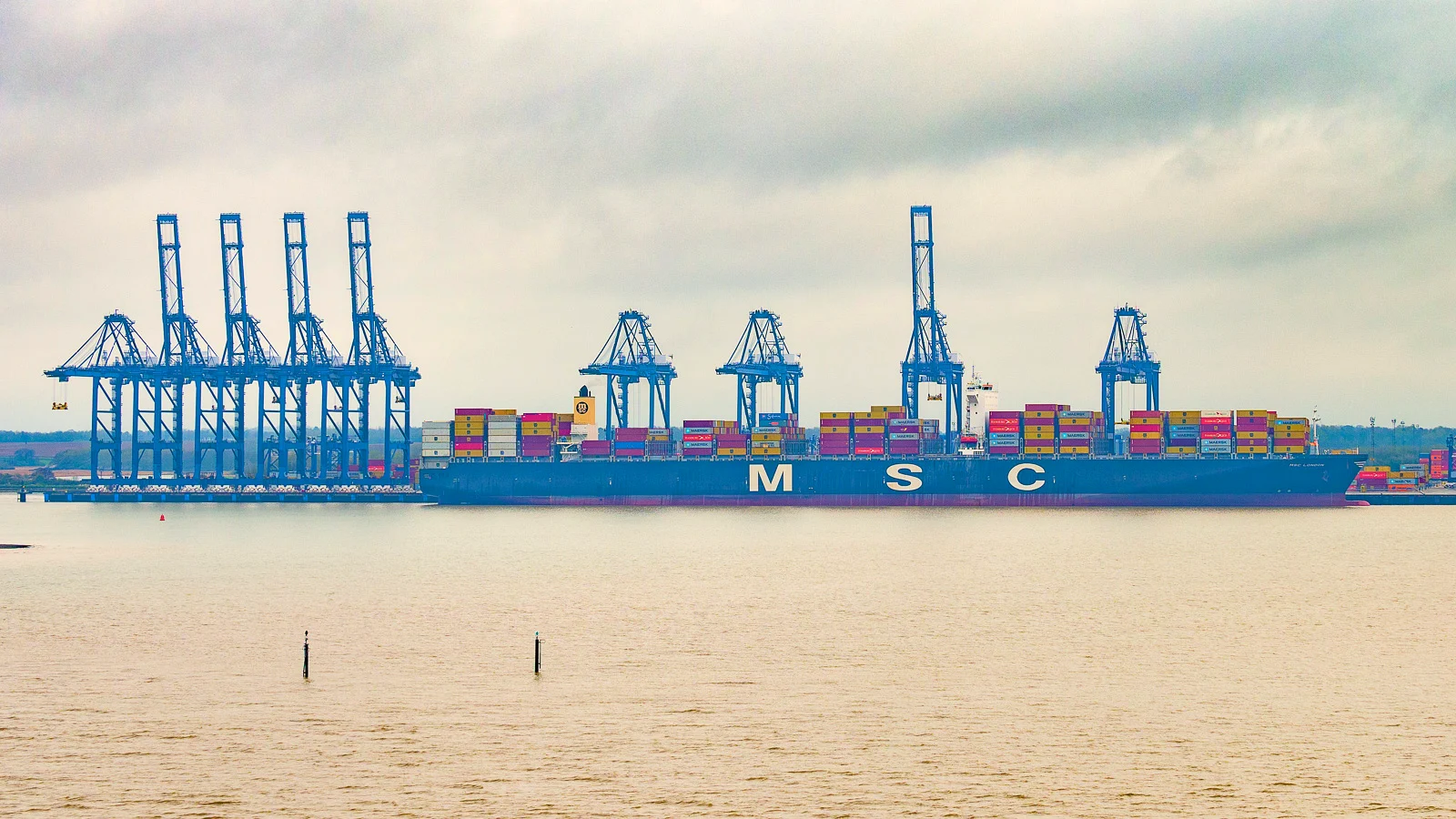
“The extent of the damage and cause remain unclear, although strong winds may have contributed,” Kuehne+Nagel wrote in its port update for 4 to 10 November about the Yantian crane collapse of 9 November. A Maersk ship was berthing at midday local time when it struck a ship-to-shore crane. Kuehne+Nagel says the crane collapsed toward the container yard.
What the record holds
The ship was the 15,516 TEU Maersk Cincinnati, Singapore-flagged, 366 metres long, built in 2024, berthing at berth 12. The Yantian District Emergency Management Bureau confirmed on 10 November that an investigation was under way, as Trasporto Europa reported. No official information on injuries or damage had been released. Images on Chinese social media appear to show crane sections beside the hull and on some container stacks, though Port News says it remains unclear whether the crane fell into the yard or toward the vessel and nearby containers. Shenzhen’s weather service had issued a monsoon warning at 6.10 am for gusts of force 8 or above, which Marine Insight describes as a possible contributing factor and not a confirmed cause. Chinese shipping sources suggested a sudden gust during the manoeuvre. Nobody has confirmed it.
Marine Insight, relaying Xinde Marine News, says Maritime Optima records put the arrival at 04:04 UTC, which is 12:04 local time. By 11 November there was no update on the departure or on when the berth would return to service. A Portcast advisory dated 12 November, which names Maersk as its source, says the vessel remained at berth past its scheduled departure and that berth 12 faced localised berthing delays.
The port has lost a crane before. On 16 September 2024 a crane at Yantian berth 2 fell onto the 1,730 TEU MSC Riona. No injuries were reported.
The same ship, days after a rotation change
Five days before the collapse, Hapag-Lloyd’s Week 45 Asia notice said voyage 636E of the same ship would omit Tianjin Xingang for schedule recovery and phase into NE3. That is the Asia North Europe 3 loop Maersk and Hapag-Lloyd run together under the Gemini Cooperation.
On voyage 645W it was due at Ningbo and Shanghai next, then Tanjung Pelepas, then northern Europe. Portcast says the berthing delays at Yantian cause downstream schedule disruptions and lists Yantian, Ningbo and Shanghai among the affected ports.
Ningbo was next. Both ports were already crowded in the week of the incident. Kuehne+Nagel measured a seven-day average vessel wait of around 2.25 days at Ningbo, where MSICT dredging was suspended because of high berth occupancy and improvement was expected from Week 46, and around 2.28 days at Shanghai, where yard density is high and transfer resources between terminals are limited. A forwarder can compare sailings on the same lanes in a schedule lookup while the carrier’s revised dates are still missing.
Before the next ETA: ask for voyage 645W
A confirmation issued before 9 November shows the old schedule, and as of Marine Insight’s report no recovery plan had been published. For cargo booked on this ship the reference that matters is the vessel and voyage, 645W. Put three questions to the carrier or forwarder in writing: was the box loaded at Yantian or does it still sit in the yard, what is the revised departure from berth 12, and what is the revised arrival at Ningbo and Shanghai.
A box still in the Yantian yard and a box already loaded on the ship are different cases, and no source yet says how many of each there are. After the Yantian crane collapse, the written answer should say which one applies to your container.