





















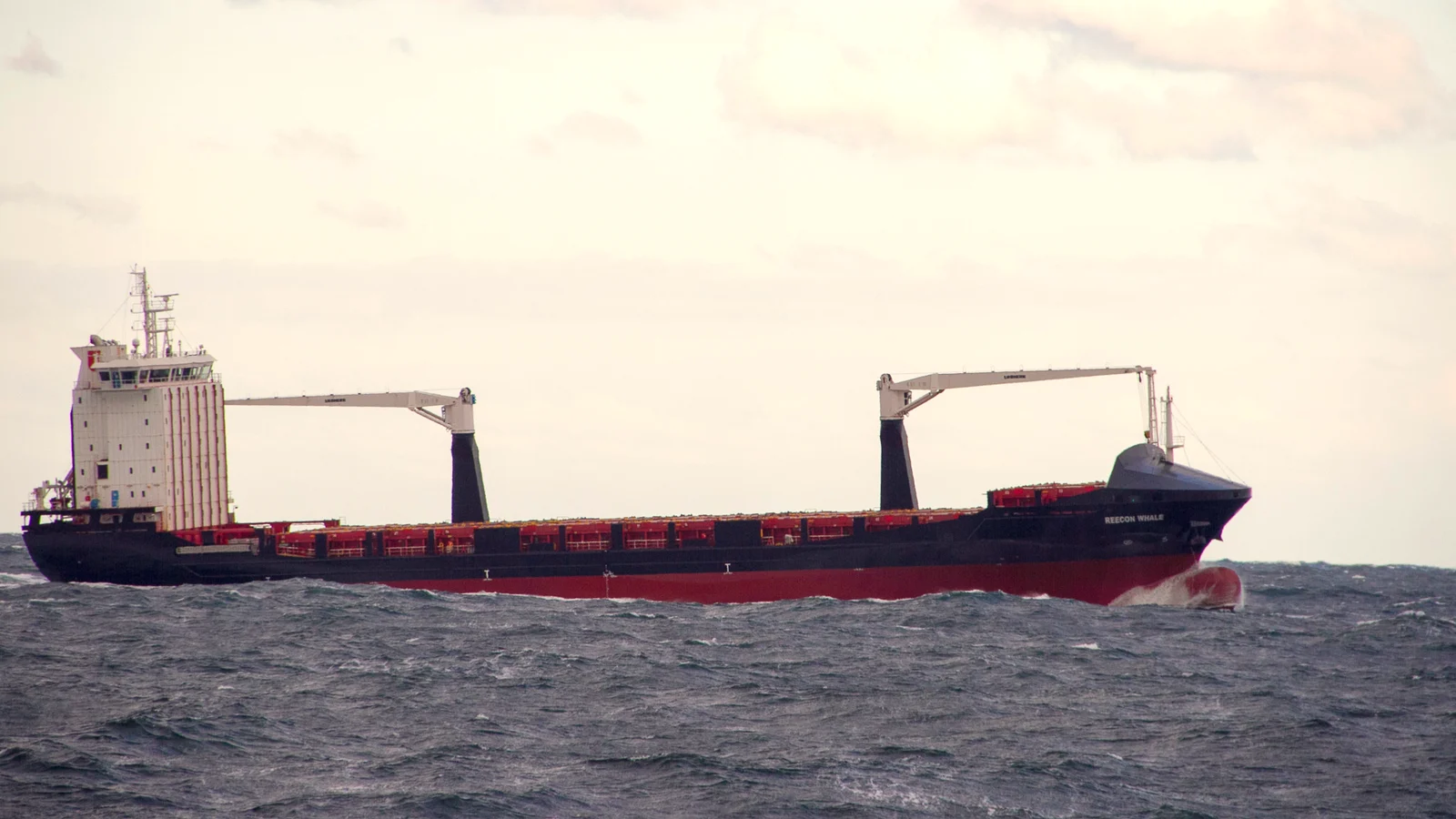
ZIM called the expected financial damage from the Contship Jet attack minimal in a preliminary assessment, reported by Israel Hayom on 29 October. ZIM’s statement describes a small container ship with a limited number of containers, and the same article has the vessel going down with all 421 of them. For anyone with a box on that ship or a booking to Constanța next week, the open question is Black Sea war risk insurance: which policy answers when a drone hits a chartered ship, and how long that cover stays in place once the market reprices the route.
28 October: three drones off Cape Kaliakra
The Liberian-flagged Contship Jet was sailing from Haifa to Constanța when Container News says three maritime drones struck it near Cape Kaliakra. The rescue centre in Constanța was notified at 12:01 local time, the crew left the ship at 12:13, and all 18 seafarers, 14 Filipinos and four Ukrainians, were landed in Varna without injuries. A military aircraft had warned the captain that three drones were heading for the vessel, according to Naftemporiki, which adds that the ship manoeuvred, was hit once, and was hit twice more as the rescue ships approached.
The identity of those responsible has not been officially established.
The cargo story is less settled than the crew story. Israel Hayom reports lithium-ion batteries, corrosive liquids and acids among the contents and says everything sank with the ship. Navy Commander Kiril Mihaylov told BTA that 20 of the 421 containers had fallen overboard, and Container News says authorities have not published a full cargo assessment. BTA also puts the position at about 21 nautical miles south-east of Shabla, against 17 nautical miles off Cape Kaliakra in Israel Hayom and Container News, and has the ship sinking around midnight. ZIM’s customer advisory says the owners of the vessel, which ZIM charters, reported the crew safe and that the situation of the vessel and cargo is being assessed. Israel Hayom places the attack inside Bulgaria’s exclusive economic zone, and BTA calls it the fifth drone attack there this month.
16 September: the list that already covered this position
Six weeks earlier the Joint War Committee issued circular JWLA-035, which Ambrey describes as extending the Black Sea listed area from the waters off Russia and Ukraine to the whole sea, minus the territorial waters of Türkiye, Romania, Bulgaria and Georgia. Ambrey counts 45 merchant vessels struck outside the old area in the 12 months to 21 September, against none in the 12 months before. Israel Hayom puts the attack within Bulgaria’s exclusive economic zone, outside its territorial waters. The list excludes only the territorial waters of those four states, so on its wording the ship was inside it. The list is a hull-market document, and the circular leaves its use in individual contracts to negotiation.
The circular is headed “Hull War, Piracy, Terrorism and Related Perils” and says that applying it to individual contracts “will be a matter for specific negotiation”. The Romanian forwarder Arwen Olsen, which promotes a routing through Koper and so has a reason to stress the risk, puts additional war premiums on Romania and Bulgaria transits at 0.4% to 1% of hull value, up from 0.1% a month earlier. Its page then sketches a scenario in which major insurers withdraw: war premiums passed into freight as surcharges on every container, cargo insurance harder to obtain, and general average tying up remaining cargo for months if a ship is lost. If salvage or general average is declared, the cargo owner’s side looks like the one in this account of the Espirito Santo Express
7 days: what cargo war cover pays and when it ends
A standard all-risks cargo policy leaves war losses out. Clause 6.1 of the Institute Cargo Clauses (A) 2009 excludes loss caused by war, civil war and “any hostile act by or against a belligerent power”, and clauses 7.3 and 7.4 exclude acts of terrorism and acts by anyone with a political, ideological or religious motive. Those perils sit in two separate sets of wording. The Institute War Clauses (Cargo) 1/1/09 pick up the war wording as clause 1.1 and add capture and derelict weapons. The Institute Strikes Clauses (Cargo) 1/1/09 take the terrorism and political-motive wording. Which of the two answers for a drone strike by an unnamed attacker depends on how that attacker is classified, and the claim is only as good as the wording the cargo owner actually bought. The war clauses attach only while the goods are loaded on an oversea vessel (clause 5.1.1), whereas the strikes clauses attach from the first move of the goods at the place of storage, and both extend in clause 2 to general average and salvage charges incurred to avoid a covered loss. No public underwriter statement on how such an attack will be treated was found.
War cover can also disappear between bookings. The Institute War Cancellation Clause (Cargo) lets either underwriters or the assured cancel it, effective after “7 days from midnight of the day” notice is issued, and insurance that has already attached stays in force. The file dates from 1982, so check which version a given policy incorporates. For war risks the dividing line is loading, not booking: a box loaded before the cancellation takes effect keeps its war cover for the voyage, and a box loaded after it may sail without any. The clause covers war risks only, so strikes cover is a separate question for the broker. For Black Sea war risk insurance on a Constanța shipment, get a written answer from the broker before booking on two points: whether war and strikes cover is in place, and whether anyone has served notice of cancellation.