





















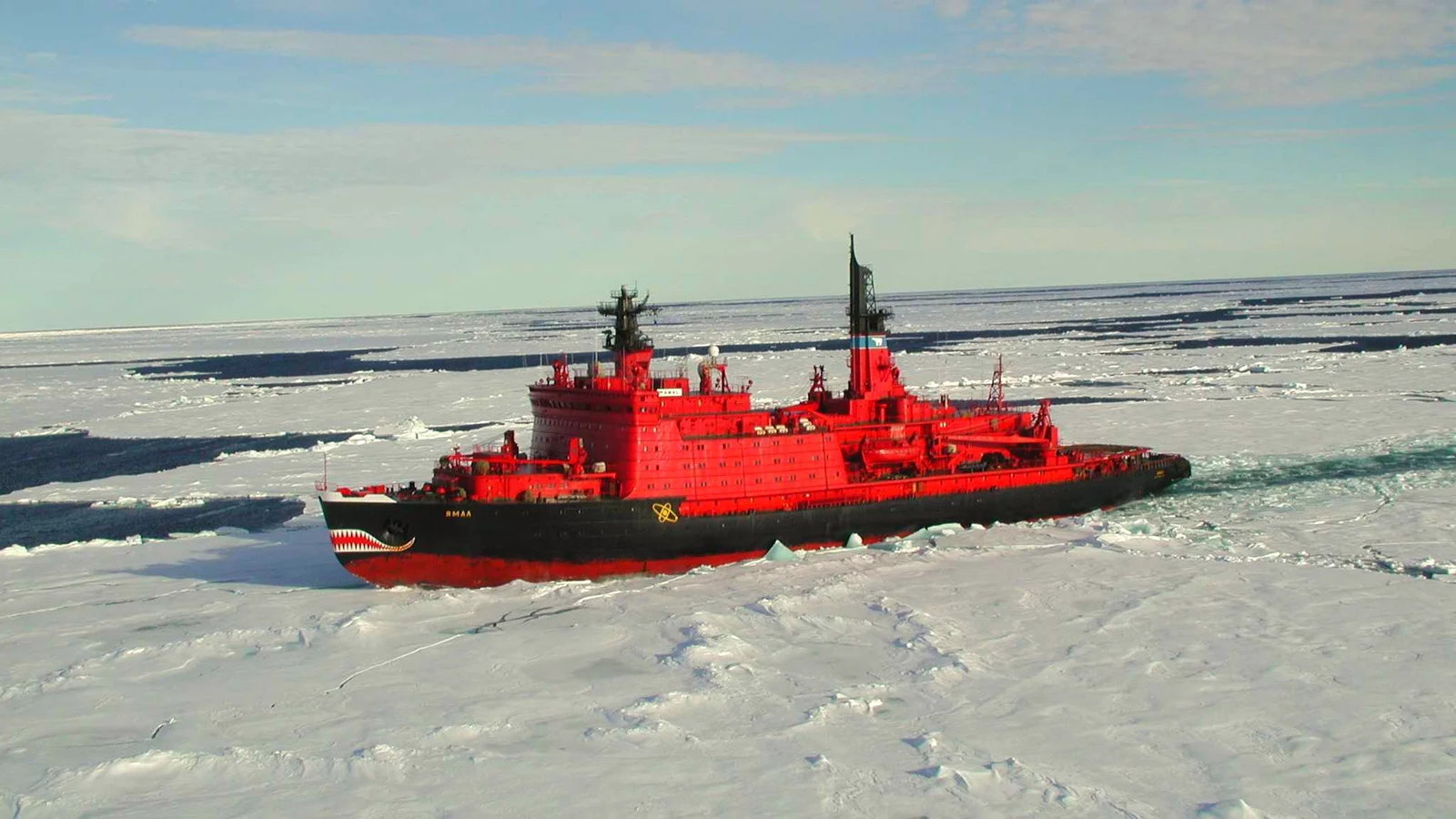
Finland’s winter navigation guide says that icebreaker assistance is free of charge. Finnish Customs publishes a fairway due of 0.824 euros per net tonne for a cargo ship of ice class IA Super and 7.677 euros for one of class II or III, more than nine times as much. Finland has no separate bill for the escort: the dues go partly to icebreaking, and the ice class of the hull sets the price. Canada does bill for it. Icebreaking fees differ by currency and by method, so the sections below keep each country in its own unit.
Canada
Canada sets its icebreaking fees by the crossing. Every commercial vessel of 200 gross tonnage or more that transits an ice zone in the ice season pays the Canadian Coast Guard’s icebreaking fee, which is $3,818.61 (Canadian dollars) per transit from 1 December 2025 to 30 November 2026. The threshold is gross tonnage, a measure of the hull’s enclosed volume.
There are three ice zones: northeast Newfoundland and Labrador (15 January to 15 May), the Great Lakes except Lake Ontario, the St. Lawrence River and Gulf of St. Lawrence (21 December to 15 April), and Lake Ontario (21 to 24 December and 1 to 15 April). The fee falls due even without a single escorted mile. The rate is indexed each 1 December, so the 3,818.61 figure runs only to 30 November 2026 and is due for its yearly adjustment. A stop in a Canadian port only to bunker, make emergency repairs or answer a medical emergency does not trigger the fee.
An ice class certificate cuts the bill by 15, 25 or 35 percent. On the 2025-26 rate that is $3,245.82, $2,863.96 or $2,482.10. The operator must send the certificate to the Marine Services Fees Billing Collection and Compliance office, or the discount does not apply.
The base rate was $3,100 when the 2019 fee schedule took effect on 1 July 2019, and it has been indexed to consumer prices from 1 December 2019. That schedule also limited a ship to eight chargeable transits per ice season and three per 30-day period, and the current page does not restate the cap.
A Fisheries and Oceans evaluation of Coast Guard marine navigation, conducted from February 2024 to March 2025, reported that fees for four services (aids to navigation, marine communications and traffic services, icebreaking and waterways management) generated more than $189 million from fiscal 2019/20 to 2023/24 and did not cover the full cost of all the services. It also reported that the icebreaking program did not reach its aspirational target of zero delays in ship escort requests south of the Arctic over the same years.
Finland and Sweden
The 2015-2016 Baltic icebreaking report says Finland collects no special fee for the icebreaker service, and the 2024-25 winter navigation guide still calls assistance free of charge. Cargo ships of 300 net tonnage or more generally pay fairway dues under the Act on Fairway Dues instead. The charge equals net tonnage multiplied by a unit price. For cargo ships that price depends on the ice class: 0.824 euros per net tonne for IA Super, 1.924 for IA, 4.518 for IB and IC, 7.677 for II and III (unit prices from 1 January 2025). The table shows the unit price and the dues for a cargo ship of 1,000 net tonnes. A maximum of 94,408 euros per port call caps the bill for cargo ships.
| Ice class | Unit price, EUR per net tonne | Dues for 1,000 net tonnes, EUR |
|---|---|---|
| IA Super | 0.824 | 824 |
| IA | 1.924 | 1,924 |
| IB or IC | 4.518 | 4,518 |
| II or III | 7.677 | 7,677 |
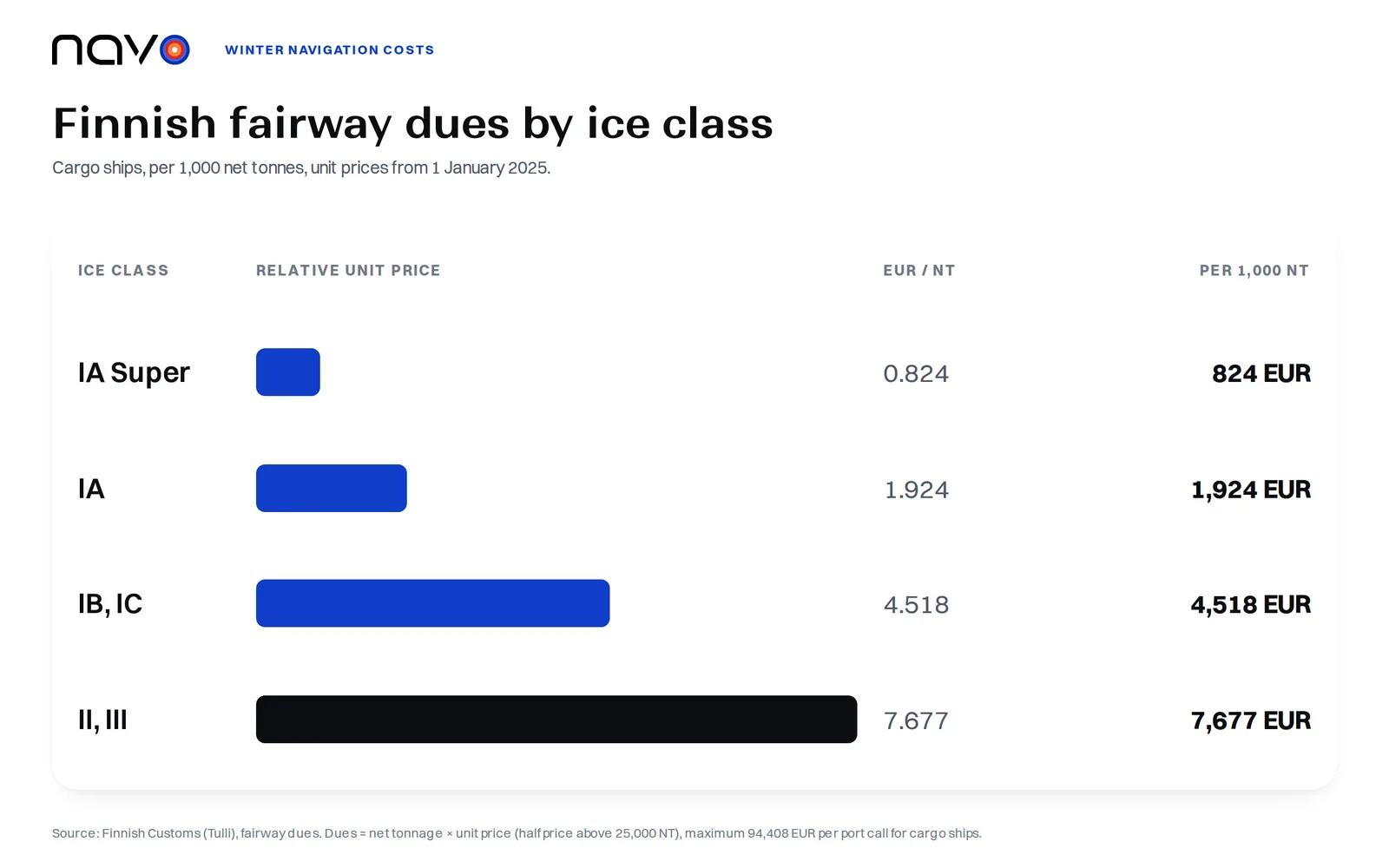
The dues changed in 2025. Fairway dues were halved in 2015 under temporary legislation, and from 2025 they are collected in full. The amendment raised unit prices and maximum amounts by 75.2 percent, Finnish Customs reports. The Baltic icebreaking report for 2015-2016 put the Finnish icebreakers’ stand-by and operating cost at near 38.5 million euros that winter, and listed bunker costs of 8 million euros, without saying whether that sum sits inside the first figure. It also said the yearly figure usually runs from 30 to 50 million.
Sweden’s Maritime Administration has two documents on this. Its winter navigation guide for 2025 says that no charge is levied on towing or other icebreaker assistance given in connection with ice-breaking at sea, while charges for towing in the nature of salvage and for other assistance work are fixed year to year. A vessel needs the Finnish-Swedish ice class or equivalent and the minimum deadweight for its ice region. The agency’s dues page says icebreaking in the fairways is financed entirely by fairway dues. Icebreaking on order against compensation has its own tariff, separate from the fairways. The 2015-2016 Baltic report put the Swedish state’s icebreaking cost at 20 to 40 million euros depending on the winter. For that winter it estimated 24.5 million.
Before a winter booking
In Canada the ice class certificate cuts the per-crossing fee by 15 to 35 percent, and the operator has to submit it to get the discount. For a Finnish call, ask the agent to confirm the ship’s ice class before it sails, because that class sets the dues. A shipper booking a winter sailing can compare sailing schedules and then check status, route and ETA by container number once the box is moving.
Frequently asked questions
Which ships are exempt from the Canadian icebreaking fee?
The Coast Guard page says the fee does not apply to movements within port boundaries, pleasure craft, fishing vessels, government vessels, tug or pilot boat transits that only support another vessel, transits made before or after the ice season, or routes where only ice routing and information services are available. A stop only to bunker, make emergency repairs or answer a medical emergency is not charged either.
Do very large cargo ships pay the full Finnish unit price on all their tonnage?
No. Finnish Customs says that for a cargo ship above 25 000 net tonnage, the tonnage in excess of that amount is multiplied by half the unit price of its ice class.
Does Finland charge a separate fee for icebreaker assistance?
No. The 2024-25 winter navigation guide still calls icebreaker assistance free of charge. Cargo ships of 300 net tonnage or more pay fairway dues instead, calculated as net tonnage multiplied by a unit price that depends on the ice class: from 0.824 euros per net tonne for IA Super to 7.677 for classes II and III, with a maximum of 94,408 euros per port call.