






















On Friday, 29 August 2025, postal traffic bound for the United States came close to a standstill. By 6 September, 88 postal operators had told the Universal Postal Union (UPU) that they had suspended some or all services to the US until a solution was in place. The count comes from the UPU’s 6 September release.
US-bound postal traffic was down 81% on 29 August, against the Friday before
From 29 August 2025 the United States suspended duty-free de minimis treatment. Carriers or other qualified parties had to collect duties from senders in advance and remit them to U.S. Customs and Border Protection, with exceptions such as documents and bona fide gifts valued up to 100 USD, as the UPU explained on 26 August. According to the UPU’s 6 September release, airlines signalled they were unwilling or unable to take on that job, and postal operators had no link yet to CBP’s list of qualified parties. Traffic from UPU member countries to the US was down 81% on Friday 29 August, compared with Friday 22 August.
As of 5 September posts could reach a landed-cost calculator through an API, so that duties could be worked out and collected from customers at origin. The suspension stayed in force. In its 24 June 2026 release CBP describes its new requirements as indefinitely suspending duty-free treatment, and they require importers to give more detailed information on international mail shipments.
What to settle before the first parcel leaves
In international shipping for ecommerce, start with one destination. Work through these points before the first order leaves.
- Pick one destination and read its rules. USPS says that an item you may not ship inside the US cannot be mailed to any other country either, and that each destination country adds its own limits. This covers parcels sent from the United States. Check every product you sell against that country.
- Classify every product. A harmonized tariff (HTS) code on the paperwork helps ensure that import charges are assessed accurately and helps clearance, says UPS. Shopify’s duty settings list HS codes among what each product needs for checkout collection.
- Complete the commercial invoice. Customs officials assess duties and taxes from the customs paperwork, whether it is attached to the parcel or sent electronically when the delivery is booked. UPS calls it critical to fill out the invoice and any additional customs forms fully and as specifically as possible.
- Decide who pays duty and tax. With UPS, you choose the Incoterm when you create the label. Skip it, and UPS defaults the shipment to what it labels DDU (delivered duty unpaid). The receiver then pays duties, taxes and fees.
- Pack the parcel. The UPS packaging guidelines, which UPS calls general guidelines and not the full extent of its requirements, ask for at least two inches of cushioning between the items inside and the corners, sides, top and bottom of the box, and reinforced tape on closures and seams. Masking tape is out. So are cellophane and duct tape. For sharp or fragile goods UPS describes a two-box method: an outer box 6 inches larger in depth, width and length than the inner one, with 3 inches of cushioning around the inner box.
- Send one parcel to a real address in the target country. Use a product you actually sell, at its real price. Keep the invoice, the label and the delivery notice for your file. Once an order outgrows parcels and goes by sea, track the container by container, bill of lading or booking number.
What one small parcel was quoted at from Shanghai to Los Angeles
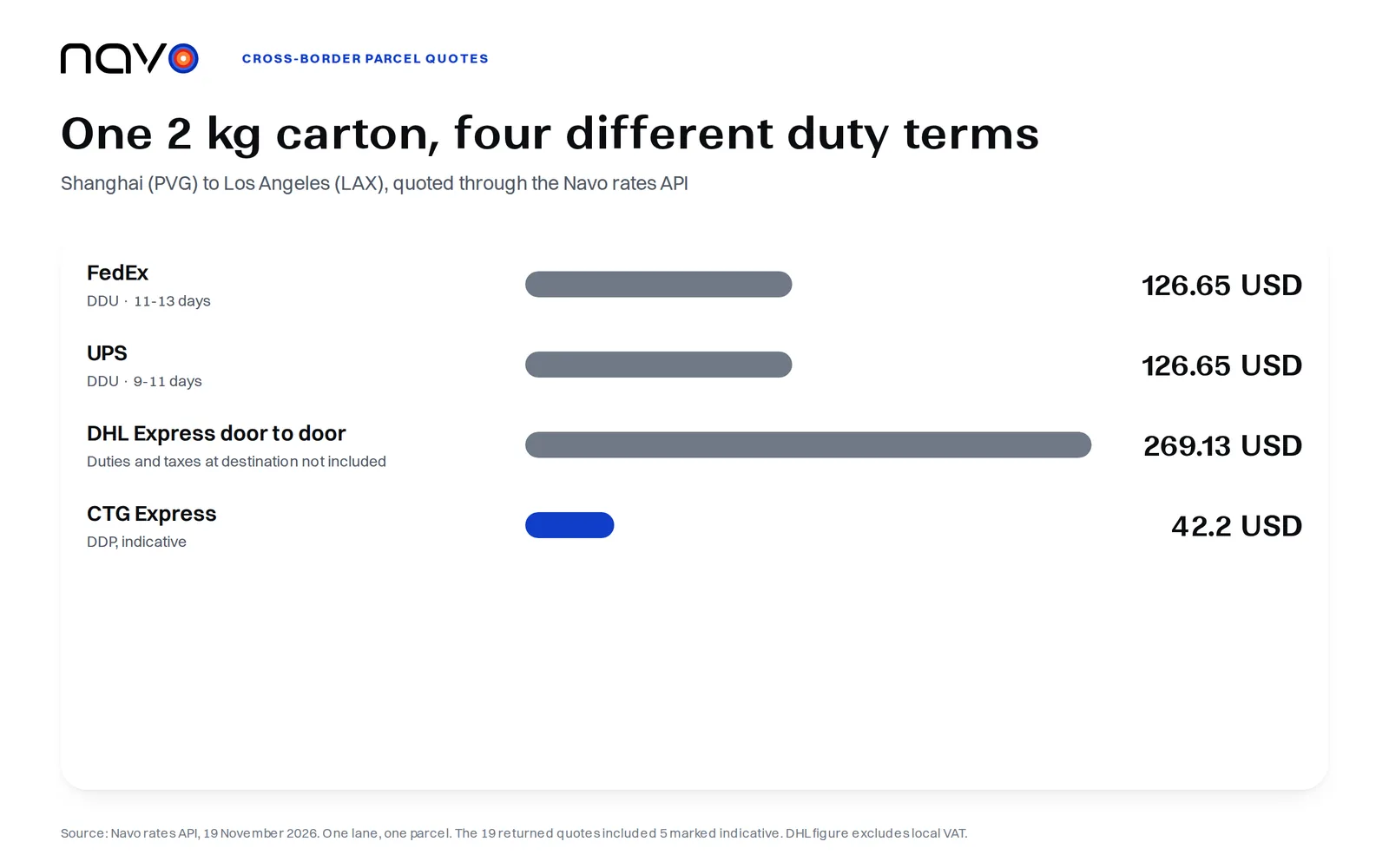
On 19 November 2026 a rates API run for one 2 kg carton from Shanghai (PVG) to Los Angeles (LAX) returned 19 quotes, 5 of them marked indicative. Four parcel quotes show how differently international shipping for ecommerce handles the duty. FedEx and UPS were each quoted at 126.65 USD, both on DDU terms, with 11-13 and 9-11 days. DHL Express door to door came to 269.13 USD on the published DHL tariff without an account discount, with local VAT excluded and duties and taxes at destination not included. CTG Express was the one DDP quote among these four, at 21.1 USD per kg, 42.2 USD in total with duties paid, and the API marked it indicative. The run covered one lane and one parcel. Sea freight was not tested. Neither were returns.
What the buyer pays at the door, and who answers for it
When a parcel is shipped abroad, customers might be charged duties and import taxes when a shipment arrives. Shopify lets the store collect an estimate at checkout instead, so buyers avoid unexpected charges on delivery. Shopify adds a limit. Some checkout customizations, destinations and order types are not supported.
Who pays? DHL describes the question in Incoterm terms. Under DDP the seller pays export and import formalities, fees, duties and taxes. Under DAP the recipient pays the import fees, duties and taxes. The seller pays freight.
With UPS, leaving the bill to the buyer is not risk-free. If the receiver does not pay, UPS may recover the amounts from the shipper. UPS recommends telling the recipient about the charges before the transaction. Do it before checkout.
Frequently asked questions
Can I mark a customer order as a gift on the customs form?
DHL eCommerce's guide says that for an e-commerce business the reason for sending a parcel internationally will likely always be "sale". As of August 2025 the US exemption the UPU describes covers bona fide gifts valued up to 100 USD, and a purchase by a customer is a sale.
Can I reuse a box from an earlier delivery?
UPS tells shippers to choose a rigid box with flaps attached. It says to avoid re-using boxes. It adds that your own packaging is fine if the boxes are new or almost new. Its general guidelines list the Box Strength Guidelines chart as the way to pick the strength of the shipping container.
What is the difference between duty and import VAT?
DHL eCommerce describes duty as a tax on goods imposed on imports and exports. Import VAT is an in-country tax paid when receiving goods from abroad. DHL says both are usually paid before the goods are released from customs.