





















Ro-ro shipping a used car starts at the same kind of ramp at every line, but the paperwork behind each line differs. Wallenius Wilhelmsen has its guide for used units, version 1.2.2 of January 2026. Höegh Autoliners splits its rules between cargo acceptance requirements and a page for car owners. Grimaldi Lines publishes cargo modalities for used vehicles that name its Tilbury terminal, so other Grimaldi ports may differ.
A leak is a problem at all three lines, while fuel, batteries and the contents of the car are treated differently.
| Wallenius Wilhelmsen | Höegh | Grimaldi (Tilbury file) | |
|---|---|---|---|
| Tank | a quarter at most | a quarter for petrol or diesel | enough to load and discharge, 5 litres recommended |
| Used electric car | not accepted until further notice, with one exception after a port inspection | not accepted | not accepted |
| Used hybrid | accepted, plug-in at 50% charge at most | accepted at a quarter tank | not accepted |
| Used LPG and hydrogen | LPG at a quarter tank in one document, gas-filling volume under 50% in another | not accepted | not accepted |
What stops a car at the ramp
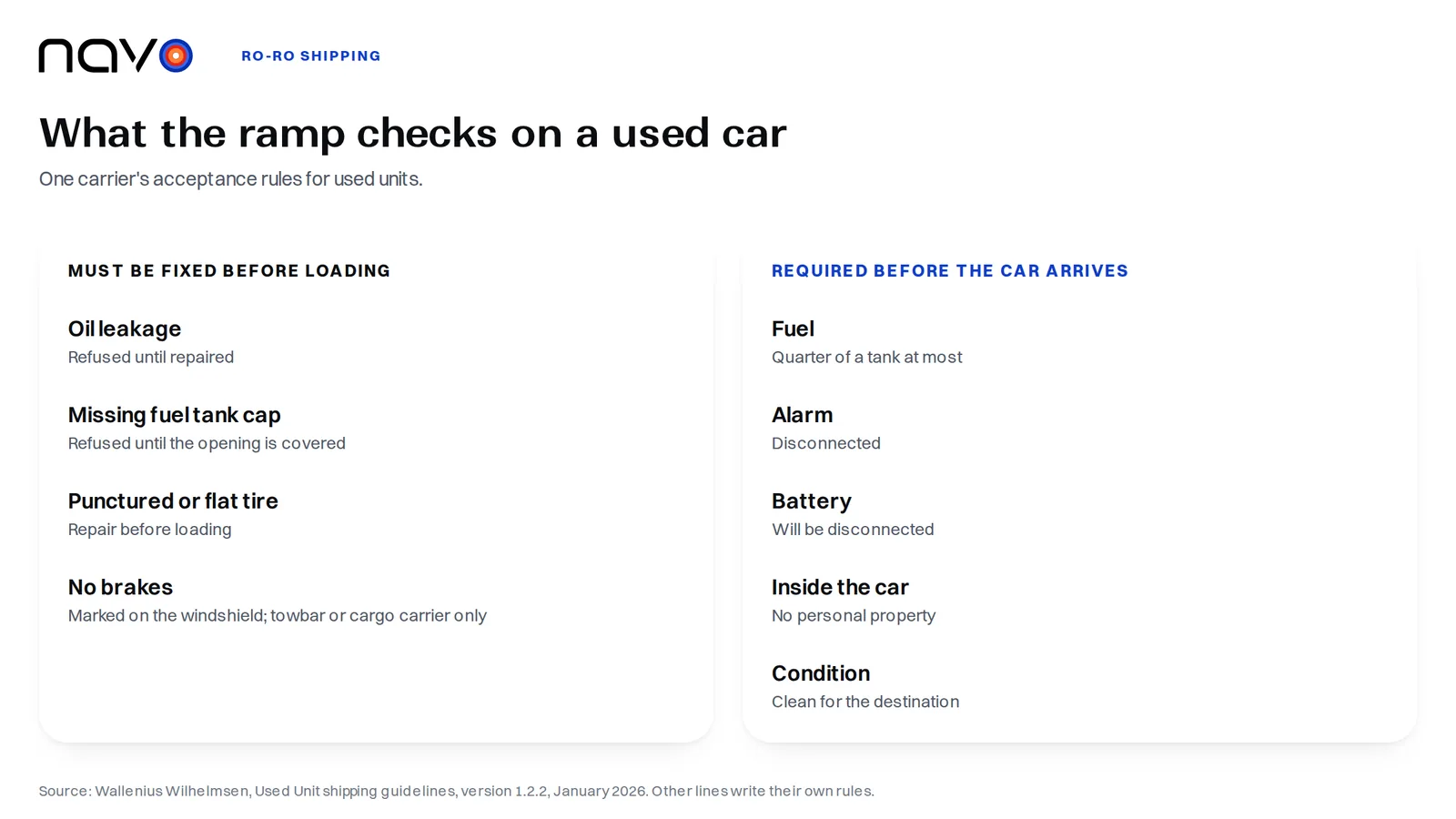
Leaks are the clearest shared rule. Wallenius Wilhelmsen refuses vehicles with oil leakages until repairs are completed, and Höegh’s checklist for previously owned vehicles puts damaged or defective batteries and leaking fluids on its not-allowed list. Grimaldi lists any kind of leakage, current or potential, among the defects that get a car refused entry into the terminal and rejected for loading.
On tires and brakes, Wallenius Wilhelmsen wants punctured and flat tires repaired before loading, and a unit without brakes goes aboard only with a safe handling method, a towbar or a cargo carrier, and a mark on the windshield. In Höegh’s checklist for previously owned vehicles, the line asks for inflated tires and operative steering, brakes and transmission. At Grimaldi, a car presented with flat or heavily damaged tires is rejected, and a flat tire found after delivery and before loading has to be repaired by the shipper using a terminal approved fitter. There is also a starting check: a vehicle that cannot be started during loading and cannot be driven aboard in a normal manner is rejected and waits on hold until the shipper repairs it.
How much fuel can be in the tank
Wallenius Wilhelmsen caps the tank of a self-propelled vehicle on liquid fuel or LPG at a quarter. Höegh gives the same quarter for a used petrol or diesel car. Grimaldi’s document asks a different question. It asks for enough fuel to perform loading and discharging, recommends 5 litres in the tank of a car or van (and a minimum of 25 litres for trucks), and puts any refuelling needed to finish the operation on the shipper’s account.
For a petrol or diesel car, anything from a few litres up to a quarter tank fits both limits and Grimaldi’s text, which names no ceiling. A full tank is over the Wallenius Wilhelmsen and Höegh limit. Gas vehicles are handled differently, and the two Wallenius Wilhelmsen documents give different figures for LPG, a quarter of the tank in the used units guide and a gas-filling volume below 50% in the instruction for used alternative fuel vehicles. Wallenius Wilhelmsen asks the shipper of a used compressed gas vehicle to confirm a gas-filling volume below 50% of the tank, subject to inspection at the load port, while Höegh’s checklist for previously owned vehicles lists used LPG, LNG, CNG and hydrogen vehicles as not accepted. Grimaldi’s document says LPG and hydrogen vehicles may not enter its terminal and will not be accepted for loading.
An electric or hybrid car: where a used battery stops the booking
For a used electric car, the answer is no in all three documents, with one exception at Wallenius Wilhelmsen. Wallenius Wilhelmsen’s cargo handling instructions do not accept a used battery electric car with a lithium-ion battery until further notice. The exception is a special safety inspection, completed and approved at the load port before loading. Höegh’s checklist for previously owned vehicles lists used battery electric vehicles as not accepted, with no exception in the same list. Grimaldi’s document says that used electrical propelled vehicles or hybrids are not accepted.
Hybrids split the lines. Wallenius Wilhelmsen lets a plug-in hybrid ship at a charge of 50% at most. Höegh takes a used hybrid at a quarter tank, with a recommended charge of 50% at most. Grimaldi refuses it in the same line as the electric car. For these alternative fuel units, Wallenius Wilhelmsen says its booking office requires the cargo classification at booking.
What stays inside the car
Wallenius Wilhelmsen’s list starts with the car’s own electrics: the alarm system must be disconnected, units that require electrical supply during the sea voyage are not accepted, and the batteries will be disconnected.
Wallenius Wilhelmsen allows no private personal property in a car: no suitcases, crates, boxes, pressurized cans, flammable substances, paints, perishable food, medical supplies, bicycles, firearms or ammunition. Standard equipment stays, secured: a toolkit without battery tools, a spare tire, a mounted fire extinguisher. Used vehicles in containers, trailers or trucks are not accepted, with exceptions possible through the local representative.
Höegh’s checklist for previously owned vehicles is shorter than the Wallenius Wilhelmsen list but adds some items: loose parts, household goods and waste, loose or additional batteries and portable fuel tanks. Höegh accepts an original, fixed-mounted fire extinguisher. Grimaldi’s document, issued for its terminal operation, has no itemised list like this. It bans hazardous cargo inside any vehicle outright, and a vehicle that breaks the ban is rejected from entering the terminal. For cars and vans it adds a direct line: no cargo goes inside or on top of them, and no cargo or personal effects can be stowed on the driver’s and front passenger’s seats.
When the car is turned away, who pays
The documents give no price list, but they say who carries the cost. At Grimaldi, a vehicle that cannot be started during loading and cannot be driven aboard is rejected for loading and stays on hold until the shipper has repaired it. Separately, the terminal handling of non self propelling units is for the shipper’s account. If hazardous cargo is found inside a vehicle that was already loaded on board, Grimaldi takes all required legal and safety actions, and the shipper bears all costs and responsibilities in case of non-compliance. Höegh says plainly that a vehicle is not insured automatically, and the shipper buys the coverage. Wallenius Wilhelmsen’s guide says that if its guidance is not followed and subsequent expenses are incurred, this shall be at shippers’/owner’s cost.
Ask the line for its tariff for a hold or a re-presentation. None of the three published documents quotes one.
After loading: finding the ship
Once ro-ro shipping has started, the car is out of your hands. Keep the line’s tracking identifier. Höegh lets you follow a car by booking number, bill of lading or VIN on its My Cargo page. If the line gives you the ship’s name or IMO number, that number is the key. A vessel query through Navo’s API returns the live AIS position of a vessel in the database by that number (the reference page marks it as a preview, so fields may change). Take the Höegh PCTC Höegh Australis, 9,100 CEU, delivered in December 2024, IMO 9962691. The query returned its position at 12:50 UTC on 18 November 2026: 15.99°S, 2.84°E, 14.1 knots on heading 323, under way using engine.
Wallenius Wilhelmsen’s guide is v1.2.2 of January 2026. The Grimaldi file is stored in a 2020 upload folder on its UK site and shows no version date in the text, so ask the line for the current version.
Frequently asked questions
Can a motorhome ship with its standard items inside?
In Wallenius Wilhelmsen's guide, a motorhome (a unit with a purpose-built accommodation area) may carry the standard items listed for it, secured, clean and packed in their own places, at the shipper's own risk. Gas cylinders are allowed only if securely fixed, listed in the standard equipment list and accompanied by a valid gas-free certificate. The shipper must supply a signed check list of the standard equipment shipped inside the unit at the customer's own risk.
Can a boat on a cradle ship by ro-ro?
Wallenius Wilhelmsen applies the same acceptance criteria as for motorhomes. The operator only accepts loading boat cradles that are constructed with sufficient strength for sea transportation.
What does Wallenius Wilhelmsen ask for a used hybrid?
For a used hybrid, Wallenius Wilhelmsen wants a diagnostics (OBD) report from any authorized workshop showing no errors in the high voltage battery system and the electric wiring, plus photos of the front, back and sides of the unit. A car with an aftermarket battery installation is not accepted for shipment.