





















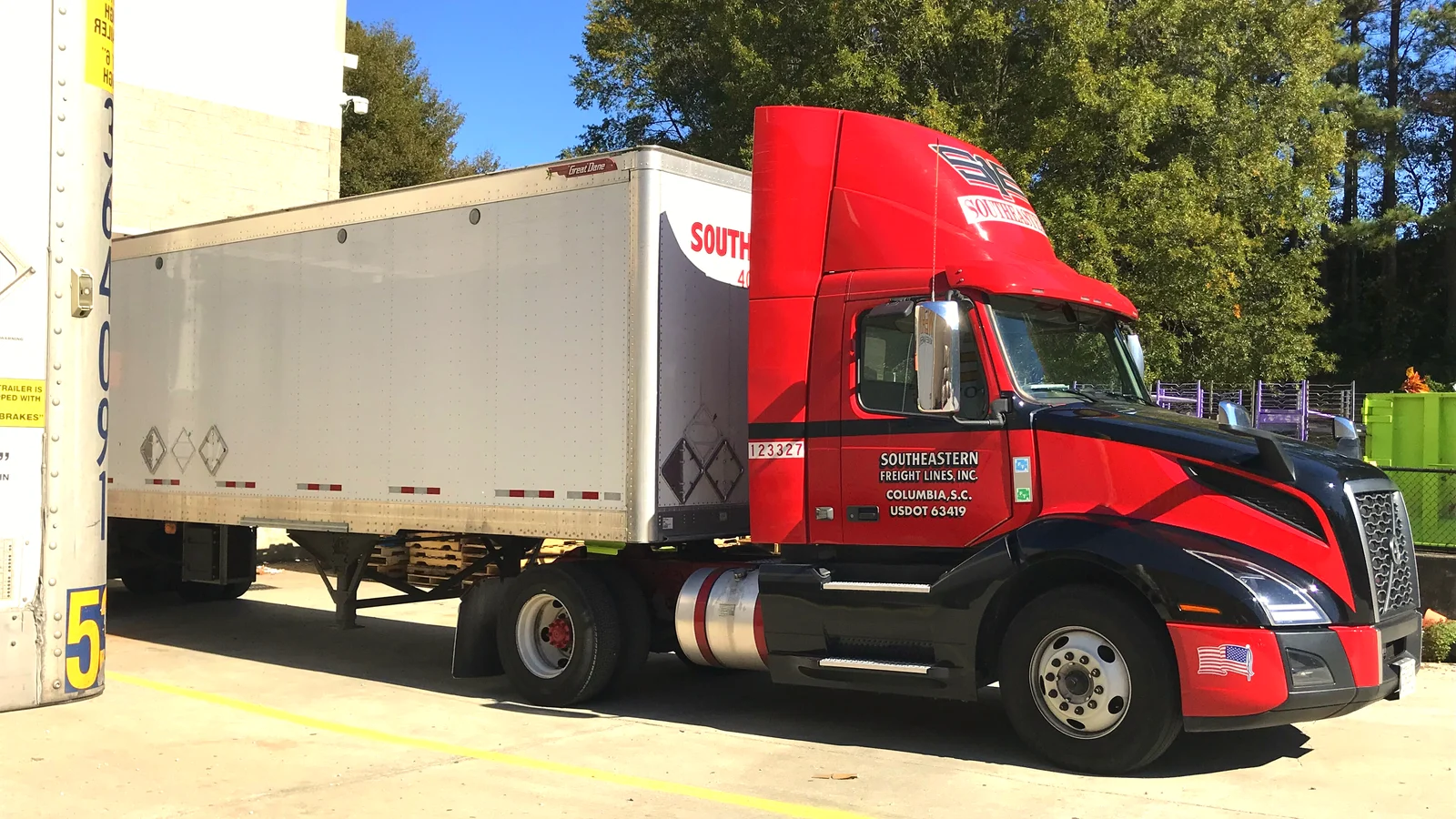
A print shop in Vassar, Michigan, loaded two boxes of custom prints onto an XPO truck on 10 August 2022. The prints were new. They reached Orlando eight days later. The delivery receipt said the shrink wrap was no longer intact, and the independent inspector found one box “completely missing”.
The shop was Larsen Graphics. Ask a federal judge what is a bill of lading and the answer comes from the Supreme Court, which the judge quoted: “The bill of lading is the basic shipping contract between the shipper-consignor and the carrier.” The opinion is public.
The prints arrived broken and the carrier pointed to a cap
The prints had been worth $19,728.40, and XPO offered $3,300. Its liability, the carrier said, was capped at $2.00 per pound under an “AFS Transportation Agreement”. Larsen was not a party to that agreement. The straight bill of lading for the first shipment was not signed by Larsen and did not limit carrier liability at all.
A week later, on 17 August, two more boxes went to a customer in Florida. The prints were worth $25,672 and freight was $1,267.98. They arrived five days later, crushed and torn. The damage inspector saw what appeared to be a bird poop stain on one print. Larsen sent replacements. It paid another $1,392.64 and $1,853.26 in freight.
Larsen sued in March 2023 under 49 U.S.C. § 14706, the Carmack Amendment. It asked for $47,858.68, the loss from both shipments minus the $3,300 XPO had already paid. On 15 April 2024 Judge Thomas Ludington ruled. XPO did not dispute that $47,912.78 was the actual loss. The court noted that Larsen never explained the small gap between that figure and the $47,858.68 it had pleaded.
The court’s reading of the statute is short. Carmack holds motor carriers strictly liable to the shipper for damage to its cargo unless the shipper has agreed to some limitation in writing. The scheme relieves shippers of the burden of proving negligence. The shipper shows three things: the goods were handed over in good condition, they arrived damaged, and the loss has a dollar figure. After that, the burden shifts to the carrier, which must show both that it was free from negligence and that the damage came from one of five excepted causes. The judge, quoting an earlier decision, added that the Amendment “only applies to shipping contracts that begin in one state and terminate in another”. Michigan to Florida qualified.
Neither bill of lading carried a limit. The court granted Larsen summary judgment for the full actual loss.
What the form asks the shipper to fill in
So what is a bill of lading in practice? The court, quoting an earlier decision, gives it three purposes: it records that the carrier received the goods, it defines the terms of carriage, and it serves as evidence of the contract. The boxes the shipper completes are what those purposes rest on.
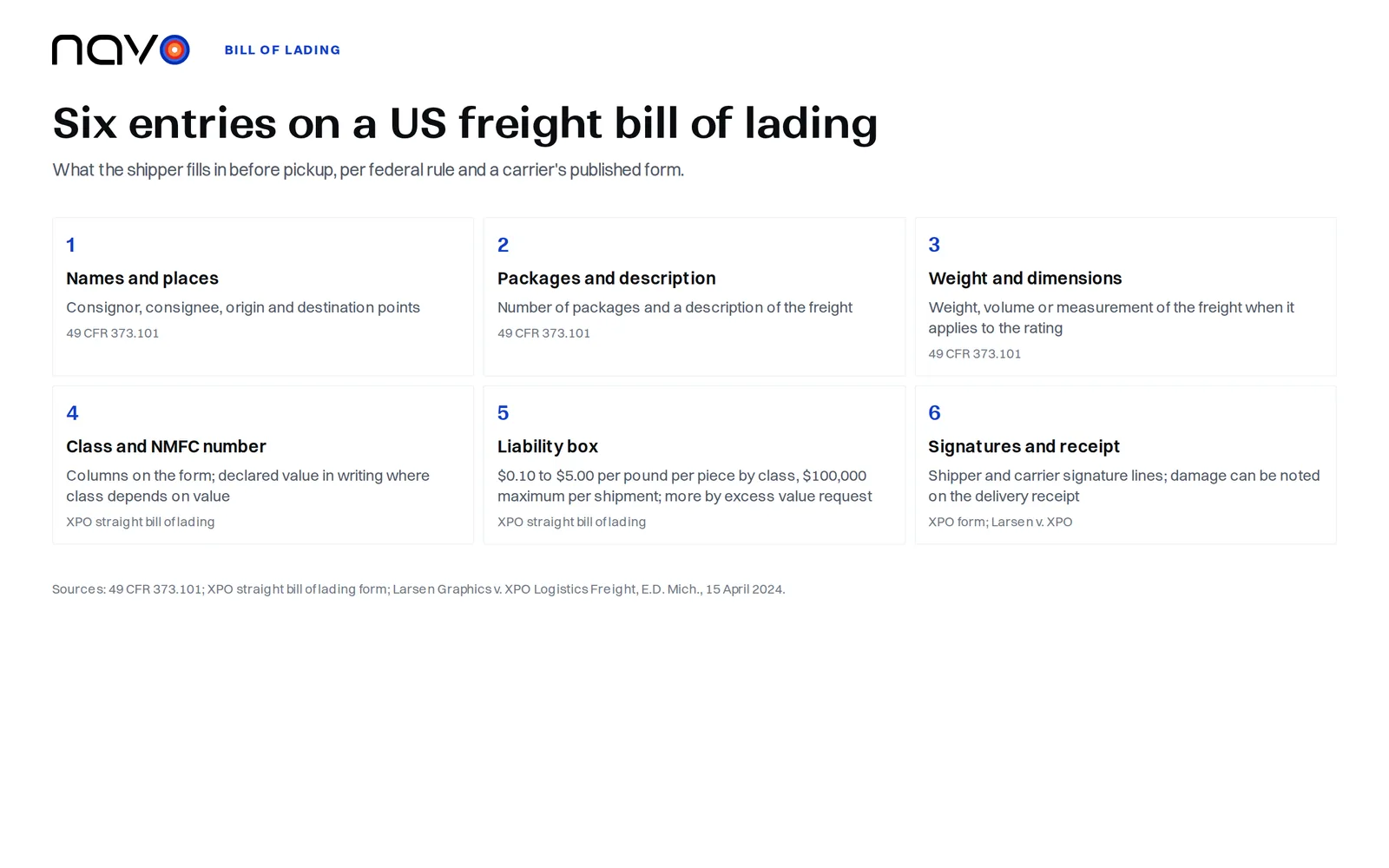
A for-hire carrier’s receipt or bill of lading must contain the information listed in 49 CFR 373.101. XPO’s published straight bill of lading shows what a carrier asks the shipper to write on top of it. Larsen’s shipments went through its broker, Freight Buddy, whose website lets shippers print a “custom made Bill of Lading”. The XPO form is a published reference for the boxes, not an exhibit from the case.
- Names and places. The rule requires the names of consignor and consignee and the origin and destination points. Copy them from the order, not from memory.
- Packages and description. The rule requires the number of packages and a description of the freight. Write what is in the box, in terms the carrier can rate. Packing is the other half of a claim, and what packaging requirements decide in a damage claim is covered separately.
- Weight and dimensions. The rule requires weight, volume or measurement of freight when it applies to the rating. NMFTA assigns each commodity a freight class from 50 to 500 based on density, handling, stowability and liability, so the weight and measurements written here feed the class.
- Class and NMFC number. The form has a column for both. Where the class depends on value, the form requires shippers to state the declared value in writing.
- Liability limits and the special agreement box. For shipments originating in the US, XPO’s form limits liability between $0.10 and $5.00 per pound per lost or damaged piece, by NMFC class, with $0.10 for household goods and articles other than new. The form caps total liability at $100,000 per shipment, or $10,000 for household goods. A shipper who wants more requests excess value in the SPECIAL AGREEMENT box, declares the value and agrees to pay an additional charge by initialing.
- Signatures and the receipt. The form has an authorized signature line for the shipper and one for the carrier. It treats the goods as in apparent good order only as far as they are unconcealed and visible without further inspection. At delivery, the consignee can note damage on the receipt. XPO’s receipt for the first shipment did.
XPO’s form is marked ORIGINAL - NOT NEGOTIABLE. That is a straight bill. The judge noted that straight bills of lading are commonly used when a carrier takes goods directly to a buyer who has typically already paid. The straight bill is one form among several, and the types of bills of lading are laid out separately.
What a carrier may write into its terms
The statute lets a carrier limit its liability to a value established by written or electronic declaration of the shipper, or by written agreement between the carrier and shipper, if that value would be reasonable under the circumstances. Household goods are treated separately. On XPO’s form the SPECIAL AGREEMENT box is where a shipper asks for more than the printed limits. In Larsen’s two shipments, no limit appeared on either bill of lading.
Deadlines have a floor. A carrier may not give less than 9 months for filing a claim or less than 2 years for bringing a civil action, and the two years run from written notice that the carrier has disallowed any part of the claim. An offer of compromise does not count as a disallowance unless the carrier says in writing that part of the claim is disallowed and gives reasons.
Frequently asked questions
Is the $0.10 per pound limit on XPO's form the same for every shipment?
No. For shipments originating in the United States the form limits liability between $0.10 and $5.00 per pound by NMFC class, and the $0.10 figure applies to household goods, personal effects and articles other than new. For shipments originating in Canada it states a different limit, CAN$2.00 per pound with a CAN$20,000 maximum per shipment, unless the shipper completes the special agreement box.
Which causes relieve a carrier of liability under Carmack?
The court in Larsen listed five excepted causes: an act of God, an act of terrorism or war, an act of the shipper itself, an act of public authority, and the goods' inherent vice or nature. The carrier must also show it was free from negligence.
Can a shipper recover attorney's fees in a Carmack claim?
In the Sixth Circuit, usually not. The court in Larsen noted that the Carmack Amendment does not contain a general attorney fee provision and that most courts in the Sixth Circuit treat fees as ordinarily unavailable, with an exception for household goods. It left the request open and did not decide it.