





















Cybersecurity for shipping companies starts with a budget question: where does the first euro go? The order this article suggests, drawn from public logistics cases and US business email fraud data, is logins first, payment instructions second, recovery third. The UK’s National Cyber Security Centre, in its guide for small organisations, says that one in two UK small businesses suffers a cyber incident every year, and says small businesses are just as likely to meet online crime as larger ones.
Which of your people can lose the whole company with one password?
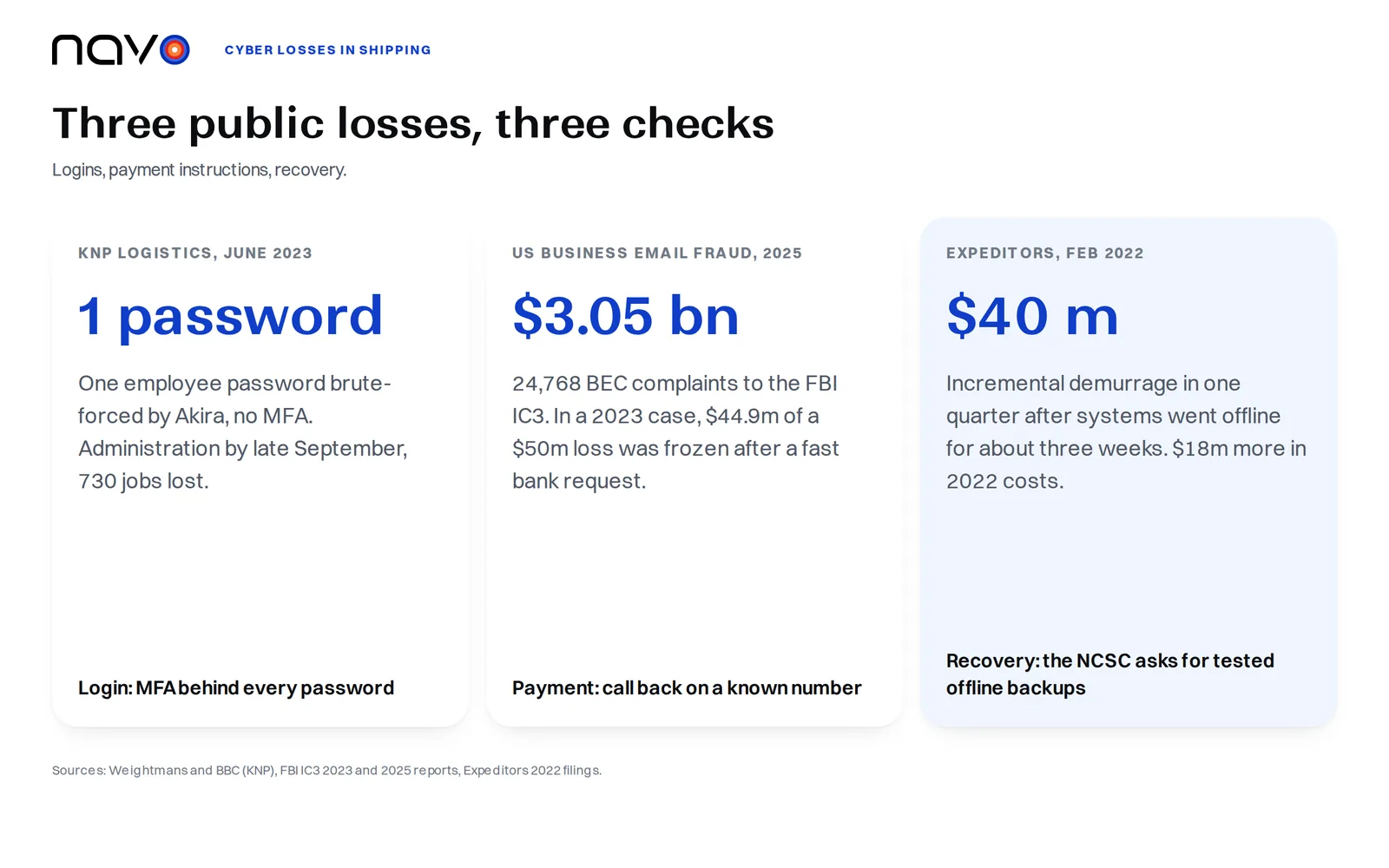
In June 2023 the ransomware gang Akira attacked KNP Logistics, the Kettering parent of Knights of Old, a haulage firm 158 years old. The law firm Weightmans, which later analyzed the case, says the gang got in by brute-forcing one employee’s password with no multi-factor authentication behind it. By late September KNP had gone into administration and 730 jobs were lost, by the BBC’s count. The Record adds that the sale of one entity saved about 170 jobs. The administrator told The Record that, against a backdrop of challenging market conditions and without being able to secure urgent investment due to the attack, the business could not continue. The password was one cause among several.
Advice to rotate passwords every quarter is easy to find. The NCSC notes that many systems force a change every 30, 60 or 90 days, and its 2018 password guidance argues against both that and complexity rules. Forced expiry harms more than it helps, because people pick small variations of the old password and stolen passwords are generally exploited immediately. Complexity requirements, it says, are a poor defense against guessing attacks. It also points to a password manager, three random words as a way to build a passphrase people can remember, and a reset only when a compromise is known or suspected.
The larger lever is the second factor and what faces the internet. The NCSC’s ransomware guidance said in its 2021 review that attackers increasingly arrive through exposed services such as Remote Desktop Protocol or unpatched remote-access devices. Its list opens with switching RDP off if nobody needs it, then MFA on every remote access point, and goes on to a VPN, least privilege and patching.
Who checks the payment instruction when the email looks right?
The FBI’s 2025 Internet Crime Report counts 24,768 business email compromise complaints for 2025, up from 21,489 in 2023, with reported losses of about $3.05 billion across all sectors. The bureau’s 2023 report defines the scam as one targeting businesses or individuals that work with suppliers or regularly make wire transfers.
The report describes accounts taken over through social engineering or computer intrusion. In March 2023 a construction entity in the New York area reported a $50 million loss to one such incident, and the receiving bank froze $44,936,460 of it after the bureau’s Recovery Asset Team sent the freeze request at once. The case comes from construction. A forwarder paying a carrier handles the same kind of payment instruction, which is the author’s reading and not the FBI’s. The FBI says verification procedures can include a direct phone call to a known verified number, not one taken from the email, alongside multi-factor authentication.
Confirm a changed bank detail by phone, on a number you already hold, before the first payment goes out. A real vessel and a real container can still sit behind a fake bank detail, so schedules and tracking only confirm that the shipment exists, not who should be paid. The shipment half of that check can run inside an AI assistant: Navo’s tracking and schedule tools can be called from inside your own AI assistant in plain language.
What do three weeks without systems cost, and what is left to restore from?
Expeditors, the Seattle forwarder, found a targeted cyber-attack on February 20, 2022 and shut down most of its operating systems worldwide, as its own release says. Its first-quarter earnings release says that for about three weeks it had a limited ability to arrange shipments or manage customs and distribution work. The same release puts roughly $40 million of incremental demurrage in the quarter, a charge for which the company was directly liable because freight could not be processed and moved through ports on time. The annual report note puts the full-year 2022 figure at about $47 million, net of recoveries. The 2022 annual report lists a separate $18 million of consultants, outside lawyers, other IT work and estimated shipment claims. Earlier carrier and forwarder cases are collected in our ransomware in logistics review.
The Expeditors filings call it a targeted cyber-attack and do not name the attack type or say how systems were restored, so they say nothing about backups. Separately, the NCSC calls up-to-date backups the most effective way of recovering from ransomware. It wants offline backups kept apart from the network, ideally offsite (or in a cloud service built for the purpose), because ransomware actively targets backups, and it wants the backup products patched so attackers cannot exploit known vulnerabilities in them. It notes that attackers have destroyed copied files or disrupted recovery processes in some cases. Its guidance also asks you to check that you know how to restore and to test it regularly. The NCSC warns that cloud services often synchronize immediately after files have been replaced with encrypted copies, which in the author’s reading means a folder that mirrors the office server is not the offline copy the guidance describes.
Cybersecurity for shipping companies can start this week. Switch on MFA for email and remote access. Agree the call-back rule for bank-detail changes. Restore one real file from the offline copy and time it.
For a team that would rather hand the routine lookups to software, Nav builds an agent around its own way of shipping. Questions go through Navo contacts.
Frequently asked questions
How many wrong logins should lock an account, and what else slows password guessing?
The NCSC prefers throttling, because a lockout can leave real users out of their accounts and hand an attacker an easy denial of service. If you do use lockout, it suggests allowing between 5 and 10 attempts first. It also lists a deny list of common passwords and security monitoring. Weightmans reports that KNP was breached by brute force, so check the logins that reach your systems from outside first. The NCSC cautions that lockout is a particular problem for large online systems.
What can be done if a wire has already gone to a fraudster?
In 2025 the FBI's Recovery Asset Team ran its Financial Fraud Kill Chain on 3,900 incidents with $1.16 billion in attempted theft and got $679 million frozen, a 58% success rate (71% in 2023). The process covers fraudulent domestic and international transactions when the complaint is filed quickly, so call your bank and report to IC3 the same day. IC3 is a US channel, so outside the US start with your bank and local police.
What makes a cloud backup safe enough against ransomware?
The NCSC wants the cloud service to keep previous versions from being deleted at once and to let you restore them. It also advises against relying on several copies inside one cloud service, so keep a second copy somewhere else.