





















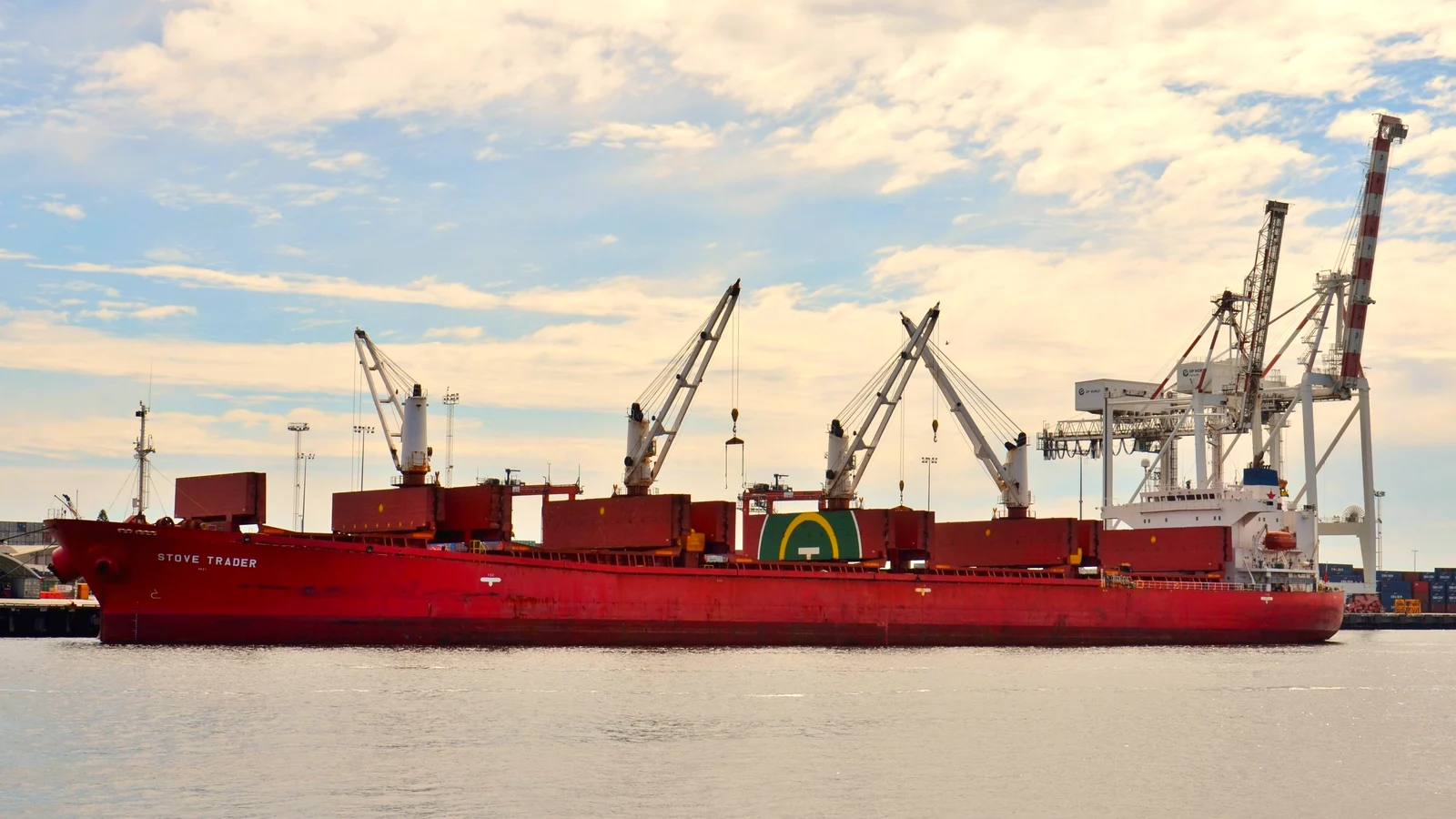
A fire tender dropped while a ship was lifting it aboard, and the repair bill was GBP 966. The seller got GBP 200 back. The ship’s rail, where the tender never arrived, used to mark the point where risk passed in incoterms for sea freight.
A fire tender that never crossed the rail
Old epics send their heroes through fire, storm and a decade at sea. Pyrene Co Ltd’s hero was lifted toward the Jalazad and dropped before it crossed the rail. The company had sold the fire tender to the Government of India, free on board, and the buyer’s side had booked the Jalazad. The case summary in the CMI database does not decorate it: through the ship’s fault the tender “was dropped and damaged while being lifted onto the vessel and before it was across the ship’s rail.” Property in the tender had not yet passed to the buyer. So Pyrene paid for the repair and went after the shipowner, Scindia Navigation.
The shipowner owned up to the drop. Then it reached for the Hague Rules to cap the bill at GBP 200. Pyrene argued the rules had not even started, since loading had not got past the rail. Devlin J, in the Queen’s Bench Division on 14 April 1954, called that argument fallacious. Loading, in his reading, covers the whole operation. Pyrene was bound by the rules. Judgment: GBP 200.
The rail lost in court but kept its place in the trade. It was where the risk was said to swing from seller to buyer. The ICC’s introduction to Incoterms 2010 retired it as the point of delivery under FOB, CFR and CIF. Goods are now delivered when they are “on board” the vessel. The change, ICC wrote, “avoids the rather dated image of the risk swinging to and fro across an imaginary perpendicular line.”
The port where the loss changes hands
ICC created the Incoterms in 1936. The latest version, Incoterms 2020, holds eleven three-letter terms. Seven work for any transport mode. The other four (FAS, FOB, CFR, CIF) are for sellers who place goods on board a vessel, or alongside it, at a sea or river port. From that port the risk of loss or damage is on the buyer. The bills are where the four incoterms for sea freight part ways.
FAS ends the seller’s job at the quayside. The seller delivers alongside the ship at the agreed place in the port of shipment and goes no further. The buyer contracts the carrier, pays the port-to-port transport and pays for the loading too, as an ICC Academy guide to FAS and FOB sets out.
FOB makes the seller lift it aboard. The goods go on board the vessel the buyer nominated, and the risk transfers right there. If the buyer’s ship comes late, the buyer pays for the wait: the same guide says that when the seller cannot load because the nominated ship is delayed by days or weeks, the buyer bears the risk and cost of storage at the port until the vessel arrives.
CFR hands the seller the booking. Who pays the piper calls the tune, and under CFR, as an ICC Academy article comparing it with CIF lays out, the seller books and pays the freight to the port of destination, loading costs included. The buyer still carries the risk from the moment the goods are on board at the port of shipment. A CFR seller owes the buyer no insurance.
Under CIF the seller must contract for cover for the buyer, from the port of shipment to the port of destination, and the buyer claims directly from the insurer. Subject to the sales contract, the cover can be limited: the Institute Cargo Clauses (C), or similar, rather than the more extensive Clauses (A). The comparison’s guest author adds that the seller “does not promise to ensure that the goods arrive at the destination intact, in the specified quantity, or at all.”
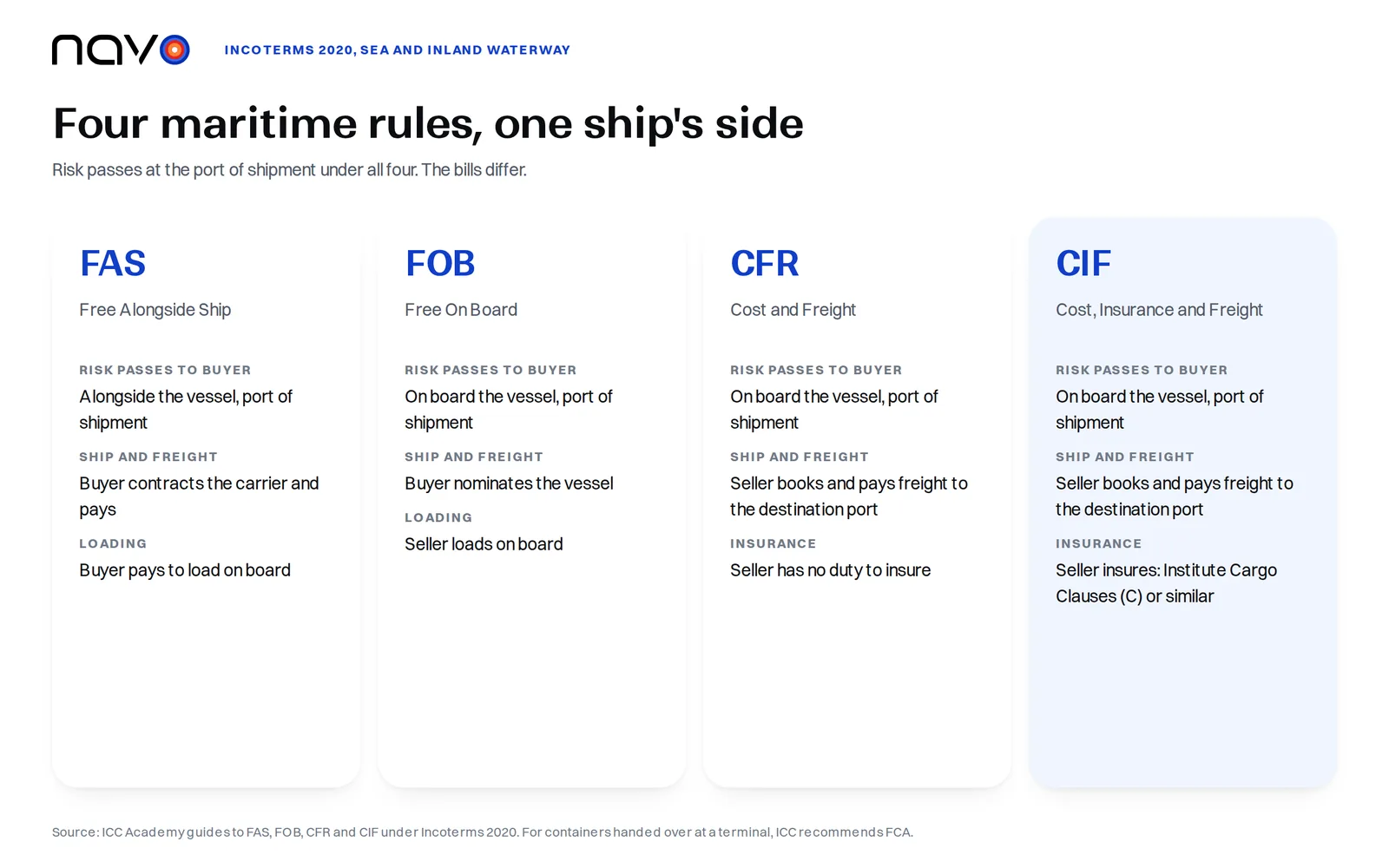
Once delivery has happened as the rule requires, a loss at sea after the port of shipment falls on the buyer under all four, whoever booked the ship.
Boxes spoil the tidy picture. The FAS and FOB guide notes that containerised goods typically reach the container terminal and may sit there several days before loading, which is why it calls FCA the more appropriate rule for that cargo. While drafting Incoterms 2020, ICC found that even experienced users were often choosing the wrong rule for their transaction. ICC Academy noted in 2020 that many sellers use FOB anyway, because the letter of credit from the bank often requires an onboard bill of lading for the seller to get paid. Incoterms 2020 changed FCA so that buyer and seller can agree the seller gets that bill.
Shanghai to Los Angeles: 22 quotes, no premium
The rules say who pays what, and a live quote shows what is left for them to settle. On 15 November 2026 at 15:03 UTC we asked Navo’s rates API for one 40-foot high-cube box, Shanghai to Los Angeles. Twenty-two quotes came back. Sixteen were live, six indicative. The lowest live quote was USD 6,648 from Hapag-Lloyd, 17 days in transit, with origin terminal fees extra (USD 251). At the top was CMA CGM, asking USD 15,114 for an 11-day crossing, also with origin terminal fees extra.
Thirteen of the sixteen live quotes carry the note “local charges (THC, DOC etc.) not included”. The other three, Hapag-Lloyd and two from CMA CGM, list origin terminal fees as extra. So every live quote leaves some local charges out. Insurance turns up once in twenty-two. That one quote is indicative. It names insurance only to exclude it.
A quote like this prices the carriage between ports, and none of the 22 lists a premium as included. A seller pricing CIF adds the premium on top. For FOB with containers, the ICC Academy comparison of 2020 and 2010 says the seller takes the risk and cost of the export, port terminal handling charges and loading costs among them, so those origin lines sit in the seller’s price. Anyone weighing FOB vs CIF can pull ocean rates for the lane and put the missing lines into the sum before comparing offers. Once the box is booked, container tracking follows it.
Frequently asked questions
Which Incoterms version applies if the contract names no year?
Each contract is governed by the version of the rules it refers to. If it names Incoterms without a year, an ICC Academy article says the version in force at the time of contracting would most likely be applied in a dispute. Best practice is to name the most recent revision, for example Incoterms 2020.
Does CFR include cargo insurance?
No. Under CFR the seller books and pays the freight, but owes the buyer no obligation to buy insurance. CIF is the sea rule that adds it, and the cover can be limited to the Institute Cargo Clauses (C).
What kind of cargo is FAS typically used for?
An ICC Academy article lists goods suited to delivery alongside the ship: typically bulk cargo like minerals, petrochemicals, crude oil, refined oil, gas, cement, steel, grains and vehicles.