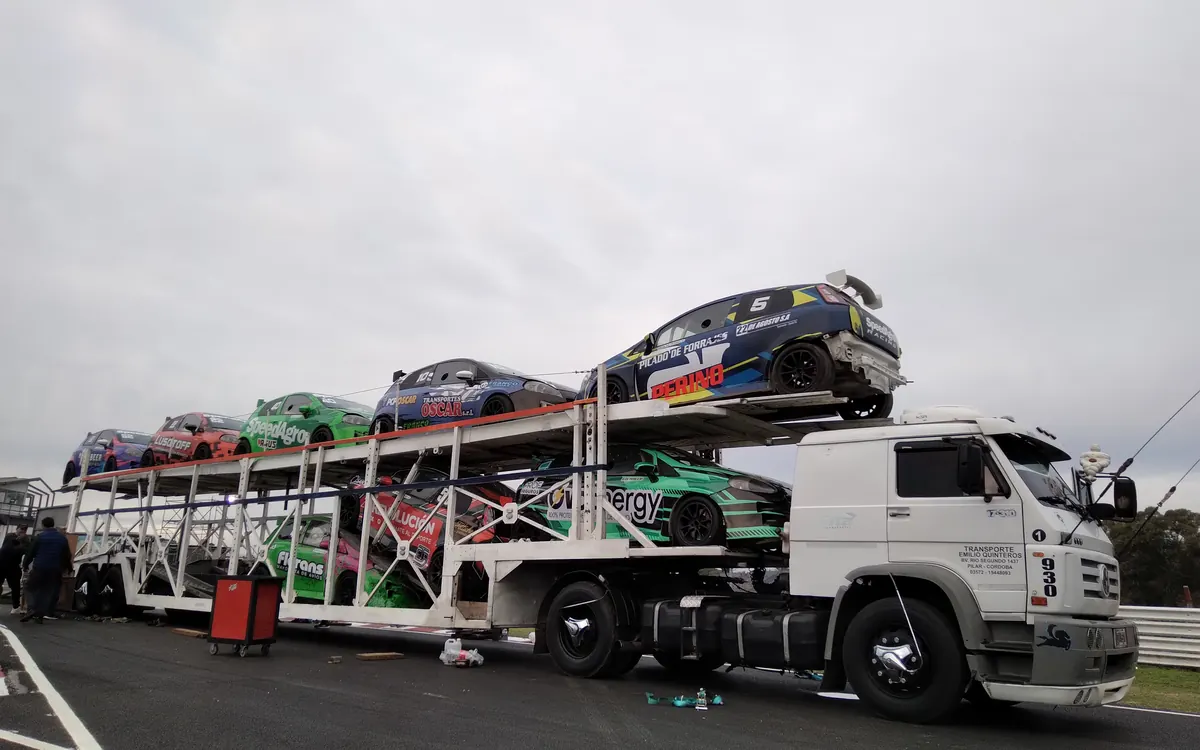
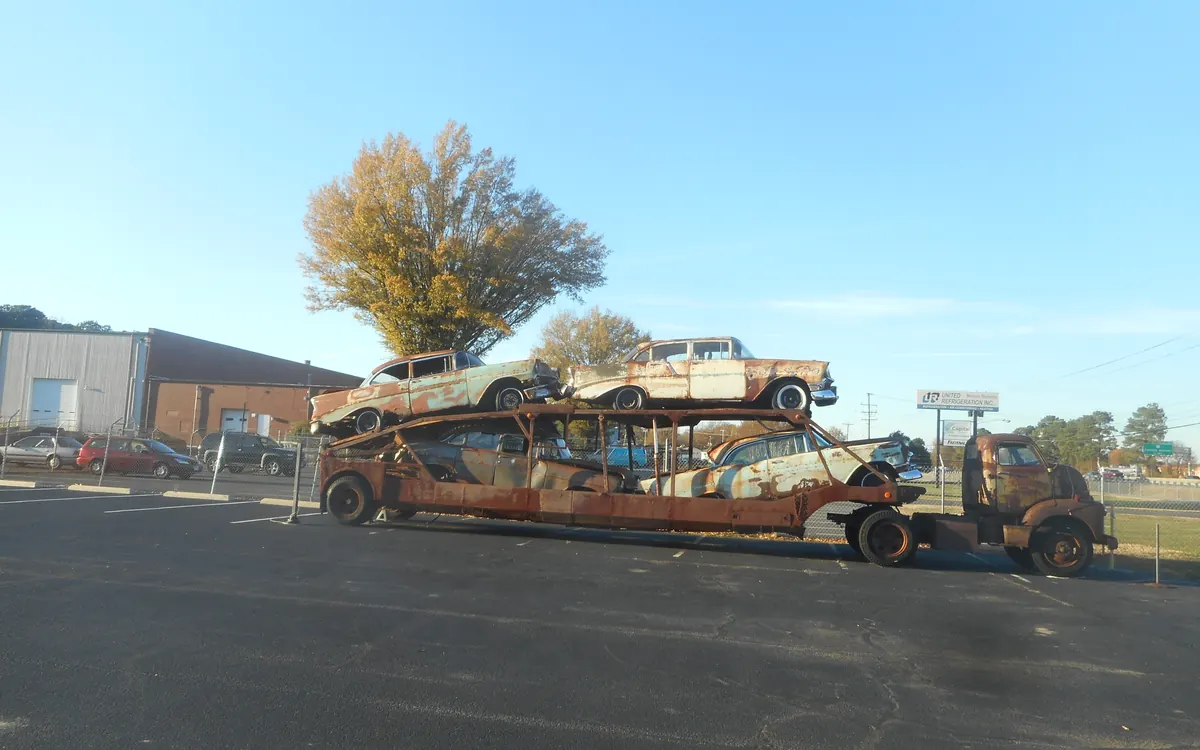
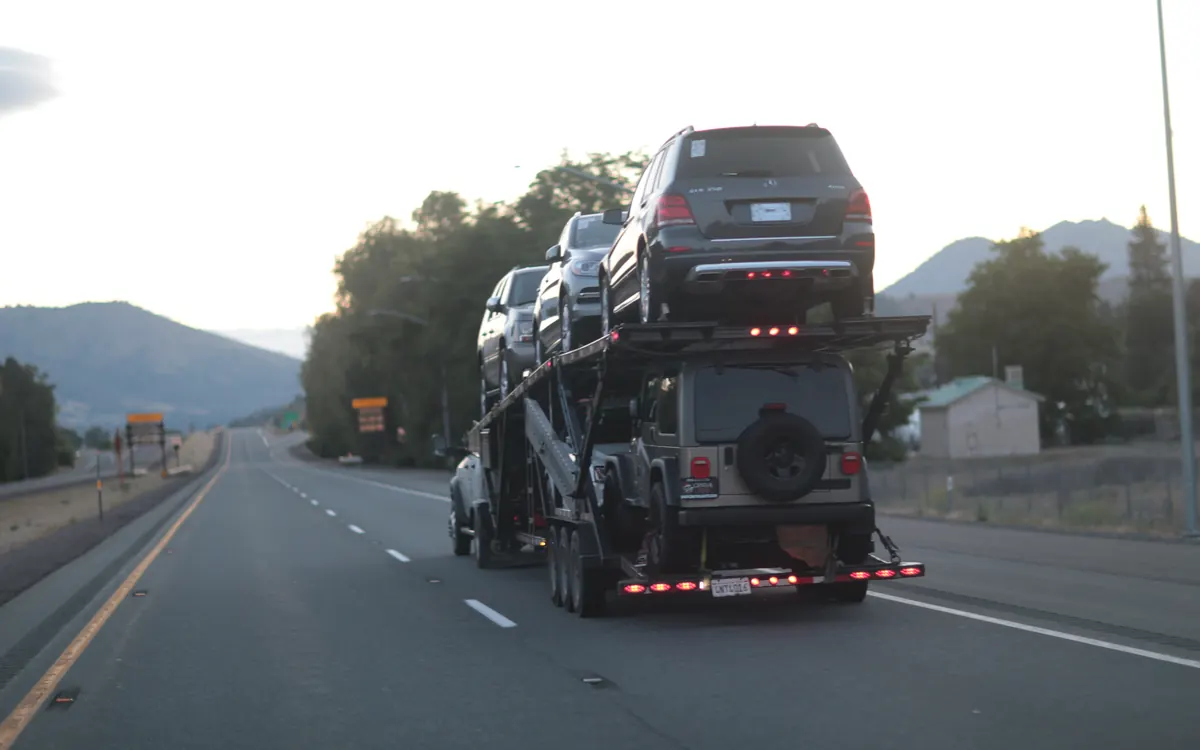
Trailer with built-in ramps and hydraulics for new and used cars, open or enclosed. A "stinger" unit adds an extra deck above the tractor cab.
What a car carrier is
Commercial car carriers move new cars from factories to dealers and, in the US, used cars for owners who relocate or buy online. Most attach to the tractor with a fifth wheel like other semi-trailers. Similar trailers carry forklifts, light commercial vehicles and agricultural tractors.
How it is loaded and unloaded
Open trailers usually have two decks, each split into ramps that hydraulics can tilt and lift independently. Cars drive up, are secured to the ramp with chains, ratchets or wheel straps, and the ramp is then angled to stack the load tightly.
To reach the upper deck, its rear half lowers hydraulically to form a drive-up ramp. The top deck is loaded first and unloaded last, because cars on the lower deck can block the top ramp. The hydraulics are worked from a control box on the trailer.
Car carriers have no winches, so non-running vehicles need a flatbed tow truck or a carrier equipped for them.
Capacity and legal limits
An American commercial car carrier typically takes 5 to 9 cars, depending on car size and trailer model. Weight is the limit: the US federal cap is 80,000 lb gross. Higher-capacity designs exist elsewhere, such as Chinese side-by-side carriers.
A stinger unit adds space over the tractor cab: up to 3 vehicles ride on the truck itself, one on the roof and two over the fifth wheel and drive axles.
Open or enclosed
Open skeletal trailers carry the most cars but leave them exposed to the elements. Enclosed trailers resemble dry vans, have walls and a roof that protect the vehicles, and are more commonly used to haul race cars.
When to book it
Book an open carrier for running cars in volume and an enclosed one for vehicles that must not be exposed. Tell the carrier if a vehicle does not run, as it cannot be driven up the ramps. Road rates for this equipment can be compared at rates.navo24.com.
Variants
Questions shippers ask
How many cars fit on a car carrier?
Typically 5 to 9 in the US, depending on car size and trailer; weight, not deck space, is often the limit.
Can it carry a car that does not run?
Standard carriers have no winch, so tell the carrier in advance; a tow truck may be needed.
Is an enclosed carrier necessary?
Only for vehicles that must be protected from the elements, such as race cars.