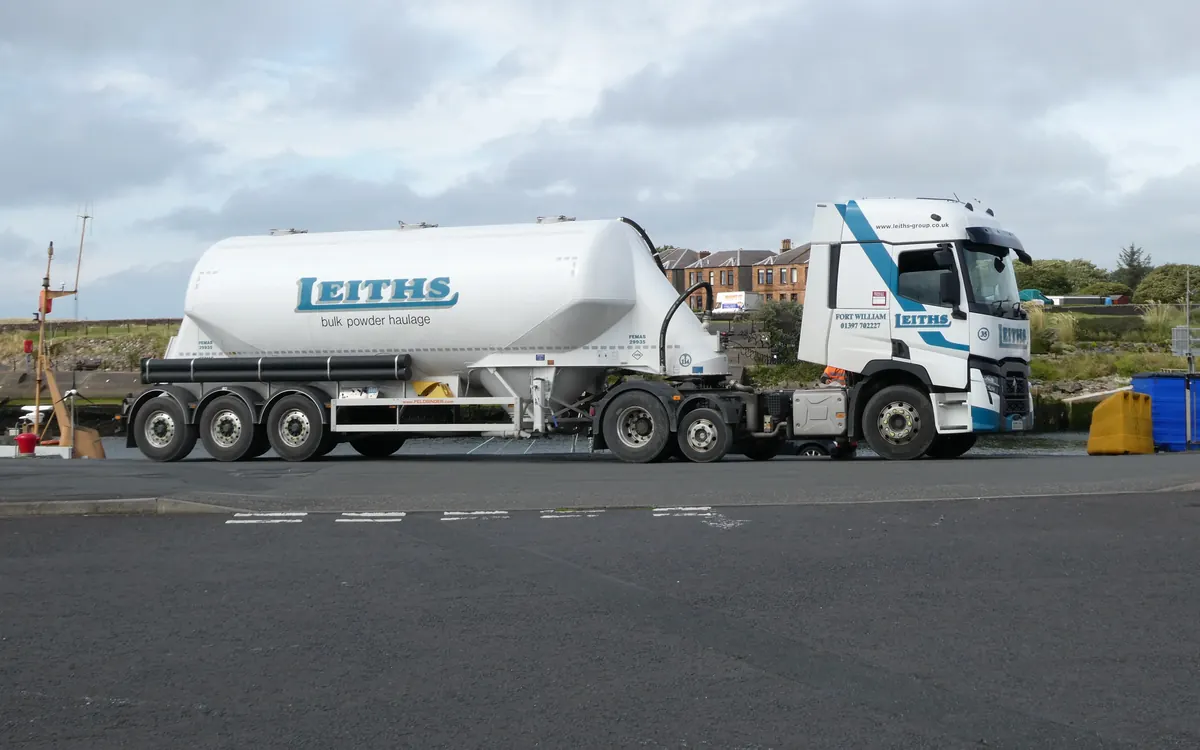
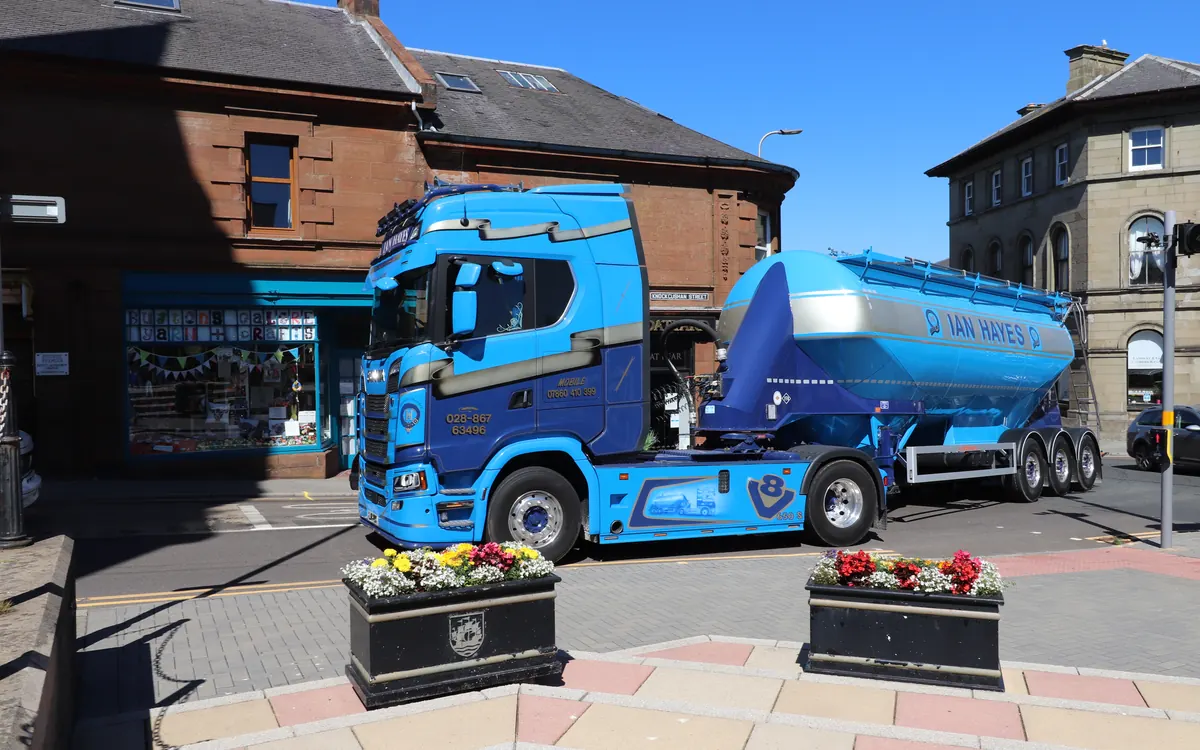
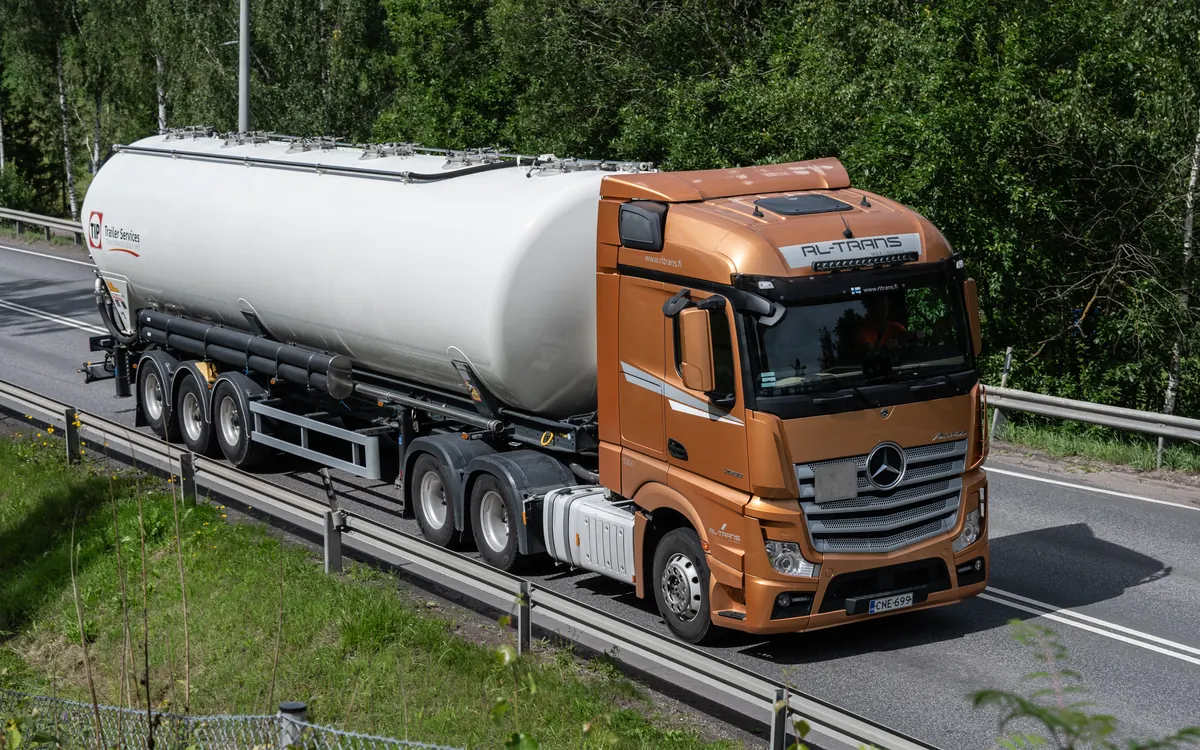
Tank for free-flowing dry bulk such as flour, grain, feed or cement. Hoppers at the bottom empty with the help of compressed air. Counted as a tank vehicle in German usage.
What it is
The silo semi-trailer carries powdery or granular goods that flow on their own. Instead of a deck or a box it has a closed vessel with outlet hoppers at the bottom. Access to the top is by a ladder at the rear and a walkway with a railing along the roof.
The tractor usually carries its own compressor unit, with silencer and air cooler, that produces the pressure for unloading, so the carrier must send a tractor with this equipment. Most multi-hopper trailers are self-supporting, without a separate frame under the vessel; in special cases the segments are separated by pressure bulkheads so that different products can travel apart.
How it is loaded and unloaded
Loading takes place through hoppers on top of the vehicle. The lids of the filling domes, also called manholes, are opened and the product falls in by gravity. The domes usually have a diameter of 450 mm and close with a hinged or sliding lid.
Unloading is mostly done with conveying air. This is very fast, and the product can be blown directly into the customer's storage silo. Air conveying is not suitable for goods that cannot take the mechanical stress, carbon black being the example given in the source. A tipping silo is raised by about 45°, up to about 60°, depending on how well the product slides, so that gravity helps it out of the vessel.
Typical cargo
Multi-hopper silos carry flour, grain, animal feed and cement. Tipping silos are used for sugar, plastic granulate and powders. The older banana-shaped tank is now rare and mainly used for cement and coal dust.
Cleaning and hygiene
A silo that changes products must be cleaned at a tank cleaning station. The usual proof of cleaning is the European Cleaning Document (ECD), which only cleaning stations certified by EFTCO may issue. Raw materials for animal feed production have extra cleaning requirements (GMP certification), so tell the carrier what the previous and the next load may be.
When to book it
Book a silo trailer when the product flows freely and the receiver has a silo or intake that can take pneumatic discharge. State the product, its bulk density, any food or feed requirements and whether the receiver needs a tipping silo. Road rates for this equipment can be compared at rates.navo24.com.
Variants
Questions shippers ask
Can a silo trailer unload straight into my silo?
Yes. Air discharge lets the driver blow the product directly into a storage silo, provided the intake connection fits.
Can it carry products that must not be damaged?
Air conveying stresses the product. Goods that cannot take this, such as carbon black, are not unloaded with conveying air.
Does the trailer need cleaning between loads?
Yes, when the product changes. Ask for the European Cleaning Document, and for feed loads check GMP cleaning.