




















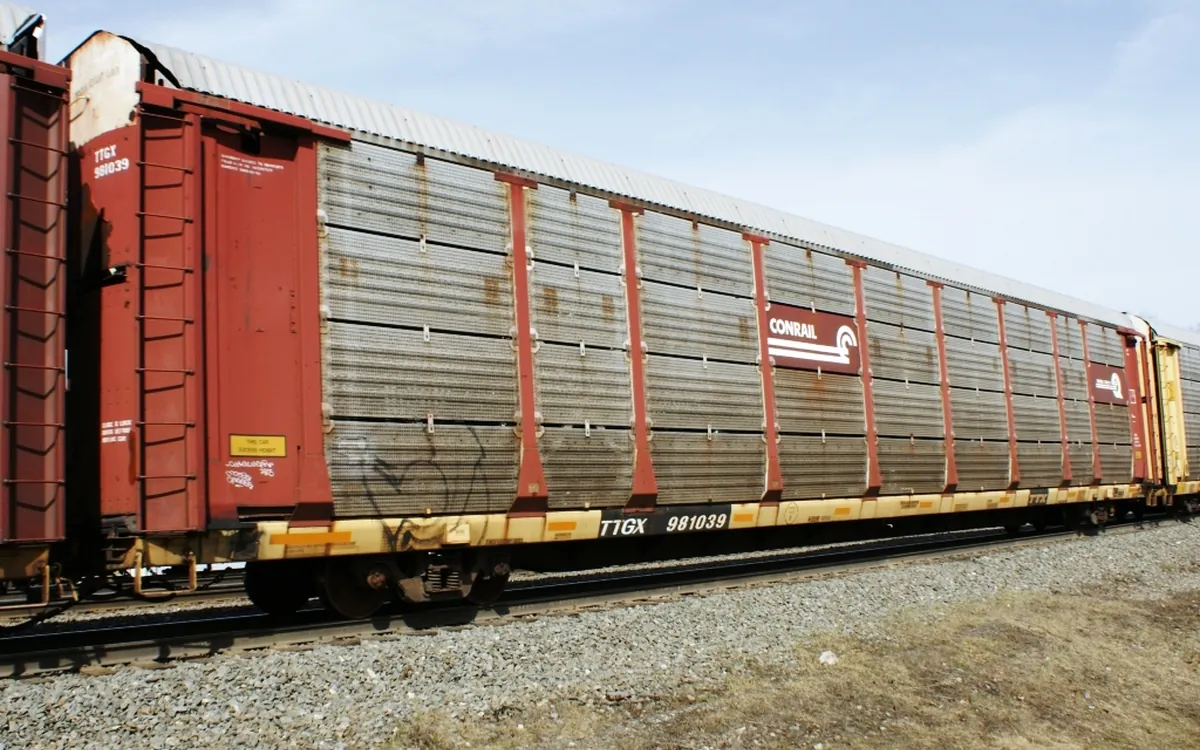
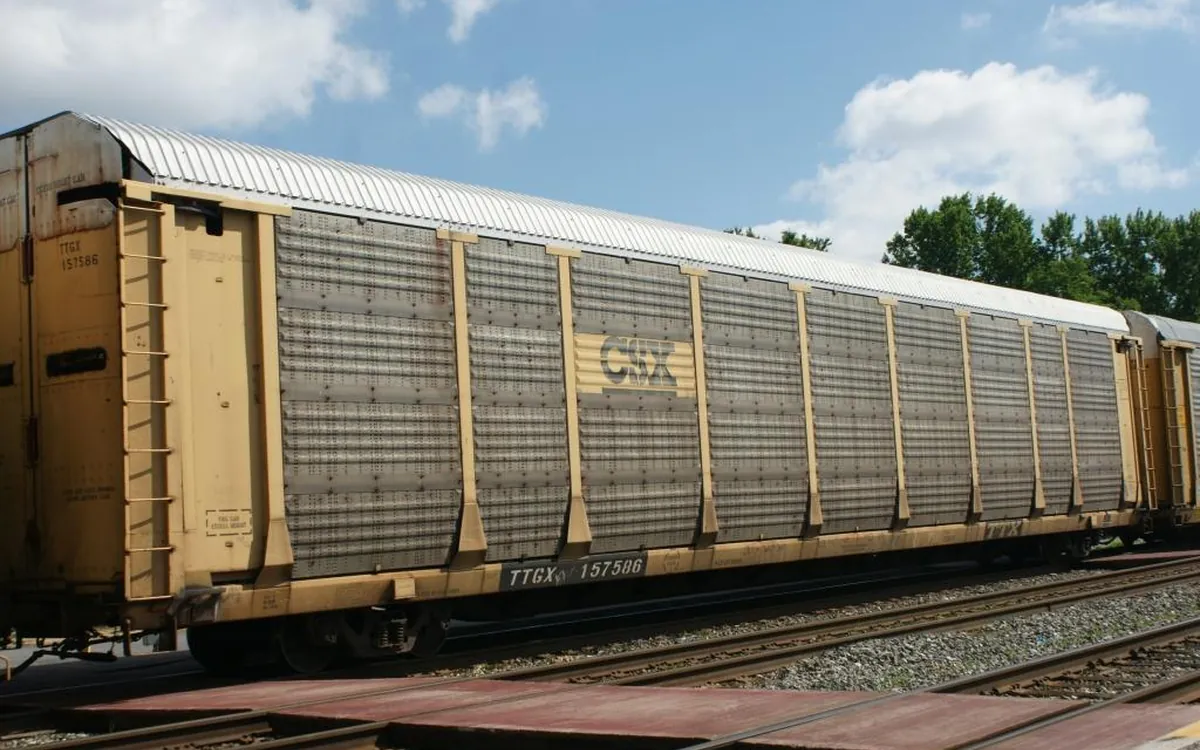
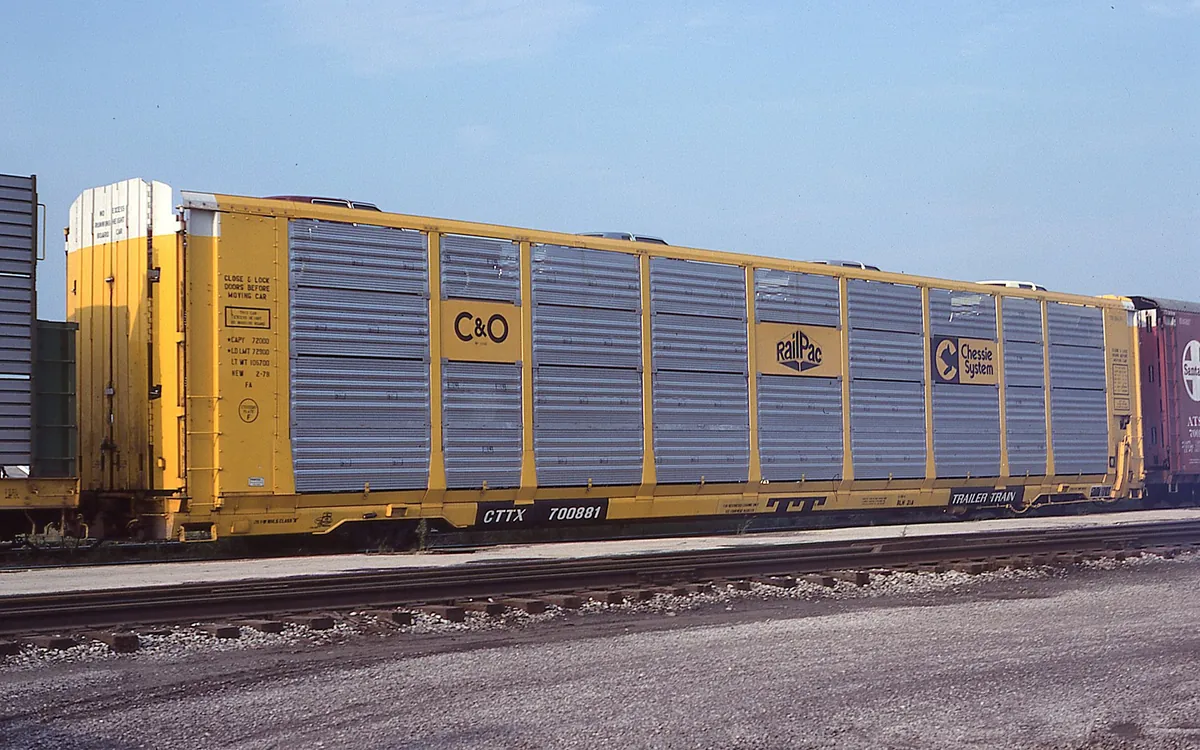
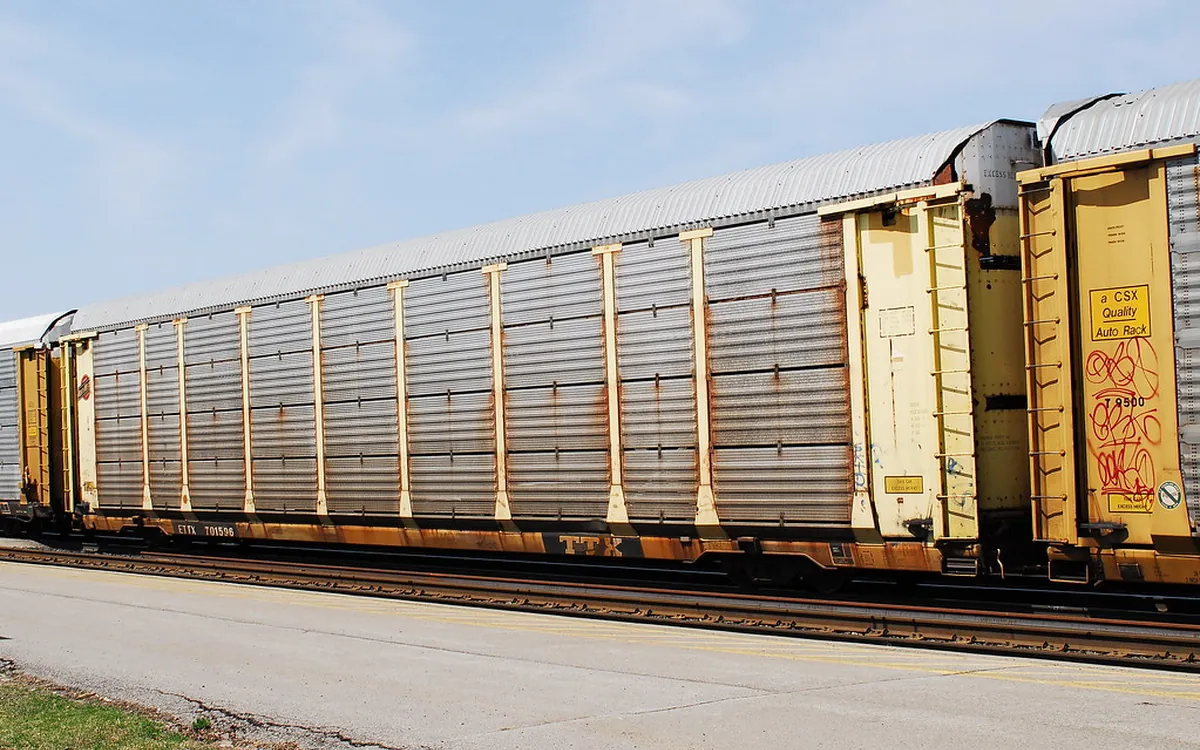
Enclosed rack on a long flatcar for new cars and light trucks, built as bi-level or tri-level; unilevel racks take tall vans. The first bi-level rack (1954) took six cars on a 53 ft flatcar.
What an autorack is
An autorack, also called an auto carrier or car transporter, is rolling stock for automobiles and light trucks. It carries new vehicles from factories to distributors and passengers' cars on services such as Amtrak's Auto Train.
The European equivalents are double-deck car transporters of class L, such as the Laaes and Laes. In North America autoracks are mostly four-axle, enclosed cars that are not permanently coupled to each other.
Decks and loading
Autoracks are built with three levels for cars or two levels for vans and light trucks. Newer single-unit designs let the number of decks change between bi-level and tri-level as demand shifts. Vehicles drive on and off from the end, through a rake of cars, at dedicated terminals.
From 1973 fully enclosed racks with continuous side panels, end doors and roofs were developed. The first production cars arrived in late 1974 and 1975, and roofs were on all autoracks by the mid-1980s once routes had enough clearance.
Sizes and capacity
Frisco's 83 ft tri-level of 1960 carried 12 cars. The 85 ft racks of 1960 carried 12 full-size or 18 compact cars. Lengths soon grew to 87 ft and then 89 ft, about as long as a passenger car, beyond which curves limit interchange service.
Articulated AutoMax cars built by Gunderson measure 145 ft 4 in long and 20 ft 3 in tall, with adjustable decks for up to 22 light trucks and minivans. An autorack on a flatcar needs the highest loading gauge in common use in North America.
History
Early automobiles travelled in boxcars, two to four per car. In 1954 Evans Products built a bi-level rack for six cars on a 53 ft flatcar, but it did not go into production. Canadian National introduced 75 ft bi-level cars for eight vehicles in 1956. In Germany, a Volkswagen design carrying 10 vehicles entered service around the same time.
Trailer Train, founded in 1955 by the Pennsylvania Railroad and the Norfolk and Western, bought the flatcars while railroads bought the racks. It became TTX Company in 1991.
In 1959 the Frisco built a bi-level prototype rack on a 42 ft flatcar. Pullman-Standard then built a full-size tri-level, SLSF 3000, which rolled out on January 29, 1960. The Santa Fe tested its own tri-level rack the same year. During the early 1960s, purpose-built auto carriers quickly took over rail transport of new cars in North America, because they held more vehicles in the same space and were easier to load than boxcars.
Variants
Unilevel, bi-level and tri-level racks cover tall vans, light trucks and cars. Multi-Max and the Union Pacific AutoMax can switch deck counts. Historic specials included the Vert-A-Pac, which carried 30 Chevrolet Vegas nose-down, and the Stac-Pac with removable enclosed containers.
Shipping vehicles by autorack
Give vehicle height and length so the railroad can assign bi-level or tri-level cars. Tall vans and trucks need bi-level or unilevel decks, which carry fewer units. Check the route for Plate K clearance and plan terminal capacity at both ends.
Enclosed tri-level racks protect vehicles better than open road trailers, where weather and traffic can cause damage. When railroads moved from open to enclosed autoracks, freight damage claims fell. In Europe, new cars and vans move in car transporters such as CRRC and Ermewa wagons operated by DB Cargo and wagons operated by Autolink.
Variants
Questions shippers ask
How many cars fit on an autorack?
An 85 ft tri-level carried 12 full-size or 18 compact cars. Articulated AutoMax cars take up to 22 light trucks and minivans.
Why are autoracks enclosed?
Side panels, roofs and end doors protect vehicles from weather, thrown objects, vandalism and theft, which reduced damage claims.
What is the European equivalent of an autorack?
Double-deck car transporters of UIC class L, such as Laaes and Laes.