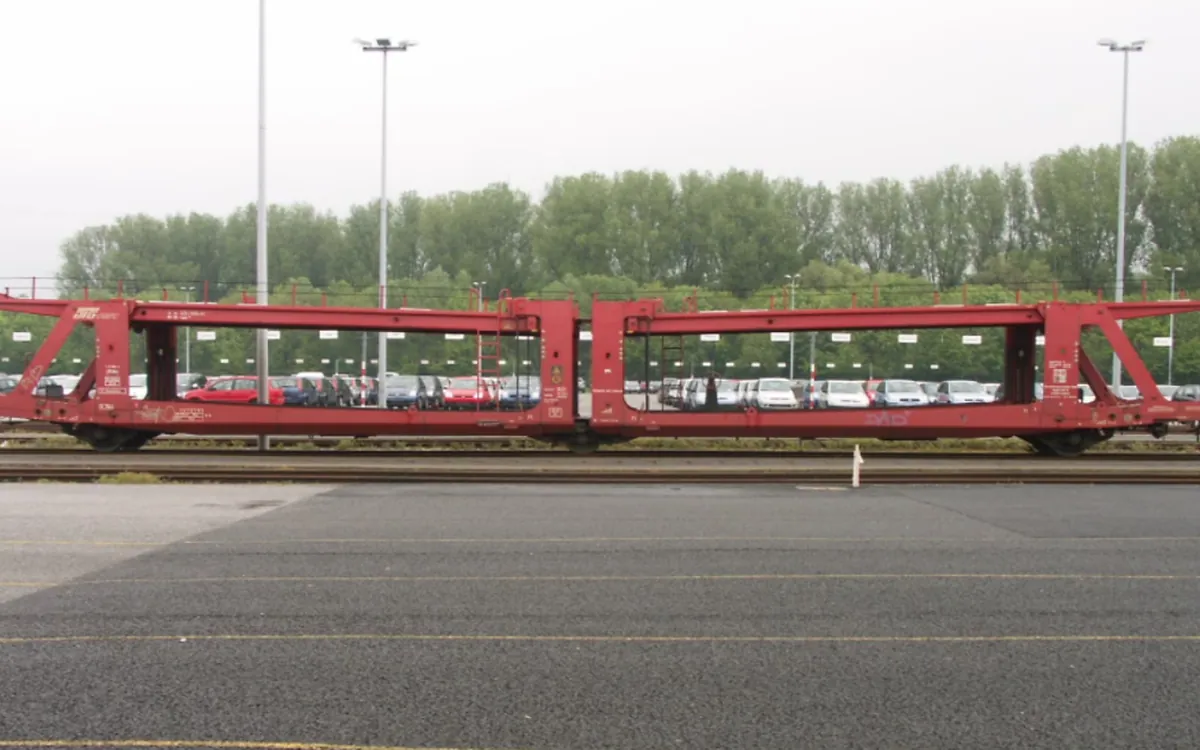
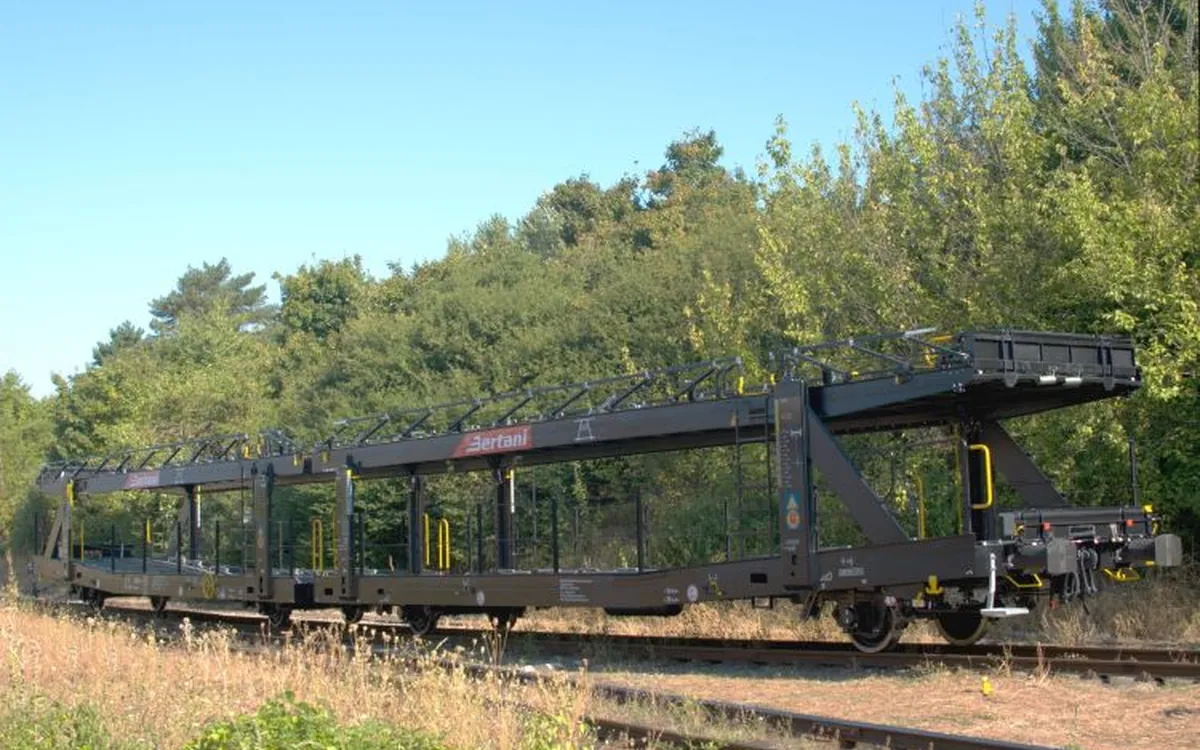
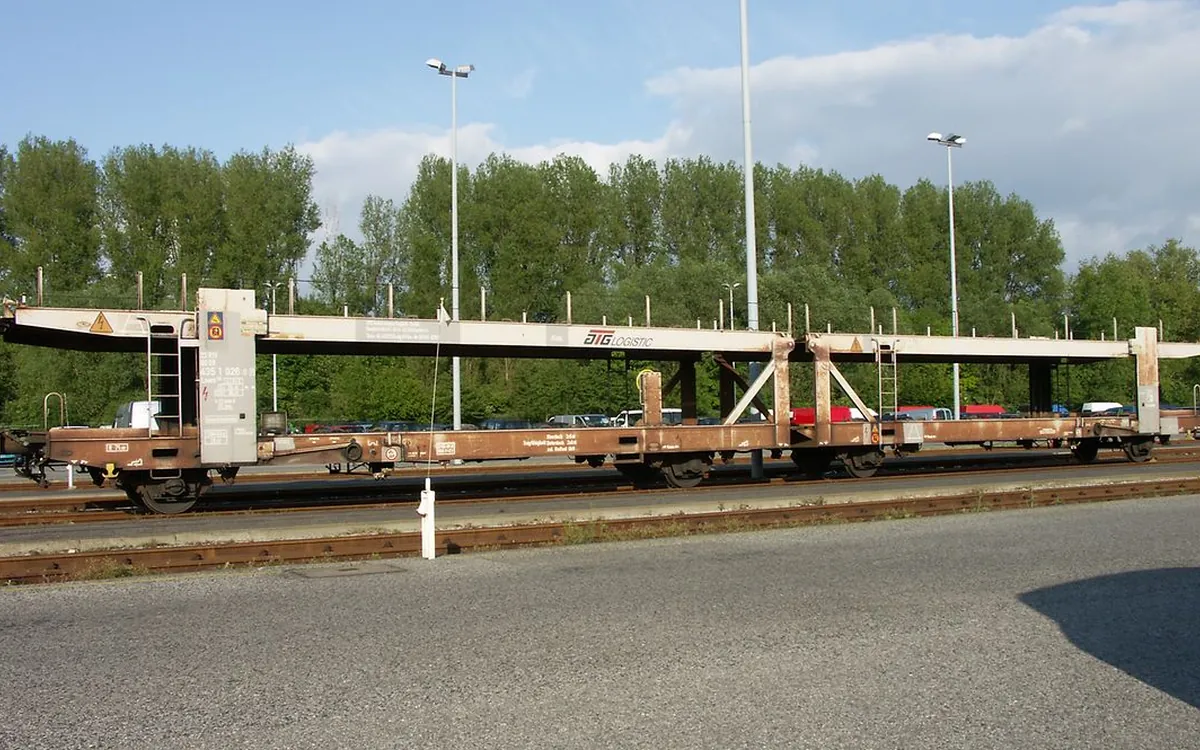
Double-deck car transporter wagons (index e) for new cars: Laaes is a pair of coupled wagons, Laes an articulated pair. Cars drive on and off over the deck ends.
What a car transporter wagon is
Car transporter wagons mainly deliver new cars and small vans to their buyers. Because cars are light, European transporters have two loading decks and need only three or four single axles despite their length. They are usually two-part units and count as special flat wagons with single axles (class L).
Laaes is a pair of coupled wagons (double wagon), Laes an articulated pair. On three-axle articulated wagons the middle axle sits in a turntable under the joint, and cars can stand over the joint.
European car transporters are open as a rule, so they are classified as class L flat wagons. Because cars are light freight, they have two decks and, despite their length, need at most three axles. With three axles, the centre axle sits under an articulated joint and cars can drive over the joint. The car-carrier wagons used in motorail trains are not counted as goods wagons, although their design is similar.
How cars are loaded
Cars drive on and off over the deck ends, through a whole rake of wagons. On many transporters the upper deck can be lowered, so no two-level end ramps or special ramp wagons are needed. With the upper deck fully lowered, larger vehicles such as small vans can be carried.
Most of these wagons are open. Enclosed versions exist as special covered wagons: multi-part units of short-coupled two-axle vehicles with bellows between them, folding end doors, height-adjustable upper decks and roofs that lift during loading. They protect cars from weather, brake dust and vandalism.
Dimensions
Both UIC standard types measure 27.0 m over buffers and offer a minimum loading length of 26.5 m plus 26.1 m on the two decks. The Laaes (double wagon) has wheelbases of 2 × 9.0 m and a maximum tare of 30.0 t. The Laes (articulated) has wheelbases of 2 × 10.4 m and a maximum tare of 27.0 t.
History and where they run
Before purpose-built wagons, railways fitted two-axle open wagons with a second deck, removed the end walls and coupled them in pairs. In the 1950s, rail capacity for the Volkswagen Beetle in West Germany ran short, so Volkswagen engineers worked with the Bundesbahn on an extra-long wagon that took ten cars and from 1958 carried them from the plants to export ports.
Today car transporters run across Europe; cars operated by DB Cargo and Autolink are among the examples. In Germany enclosed wagons run to both the international G1 and the national G2 profiles.
The class letters
L is a special flat wagon with single axles. aa means a double wagon with four axles, a an articulated wagon with three. e means a double-deck wagon for motor vehicles, d a single-deck one. s permits 100 km/h. Wagons used in passenger car-carrier trains count as luggage vans, not goods wagons.
Planning car shipments
Give the operator vehicle length, height and weight. Tall models may only fit with the upper deck lowered, which reduces the number of cars per wagon. For high-value cars ask for enclosed wagons, and check that loading ramps at both ends of the trip match the deck heights.
Variants
Questions shippers ask
What is the difference between Laaes and Laes?
Laaes is a pair of coupled wagons on four axles. Laes is an articulated pair on three axles with the middle axle under the joint.
How are cars loaded onto a Laaes?
They drive on over the deck ends. On many wagons the upper deck can be lowered, so no two-level ramps are needed.
Can vans travel on a car transporter?
Small vans can travel when the upper deck is fully lowered.