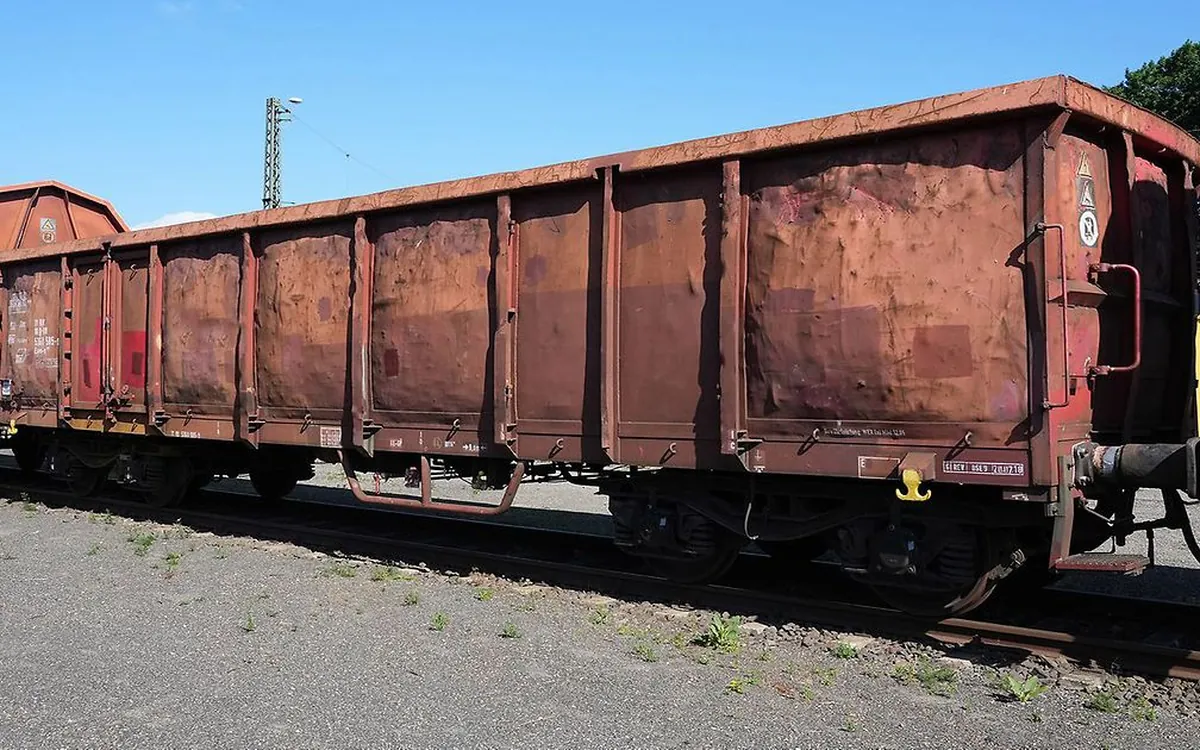
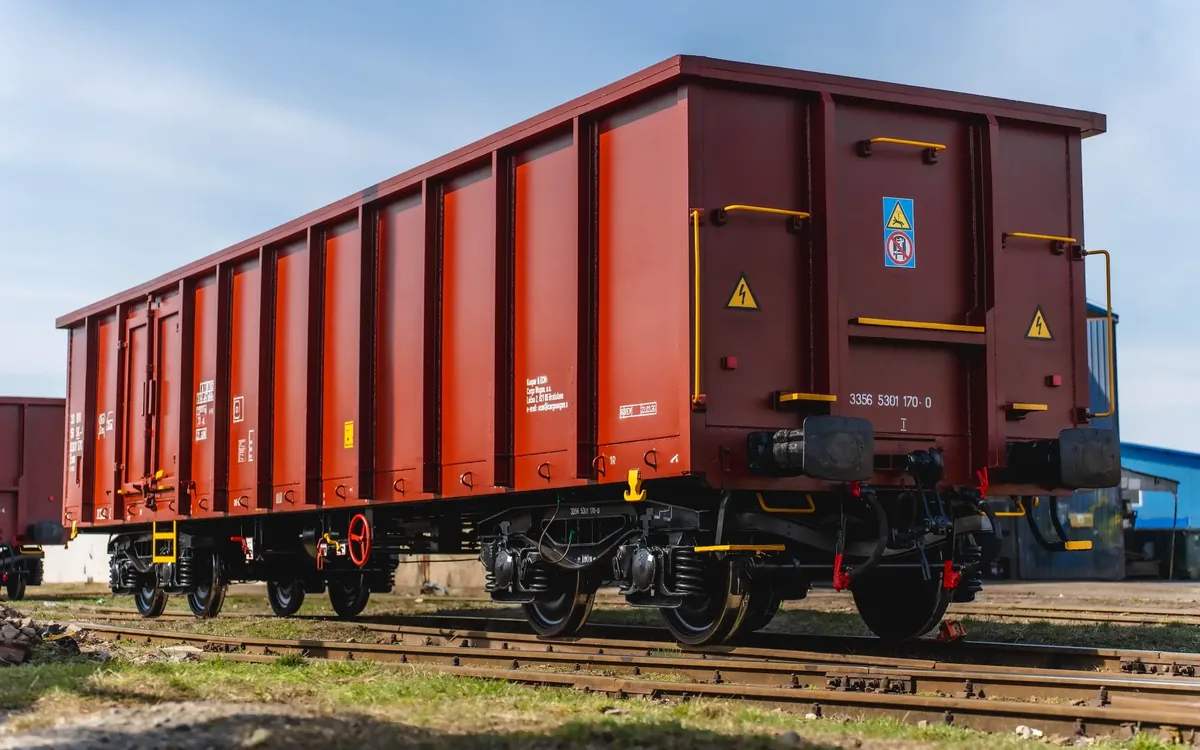
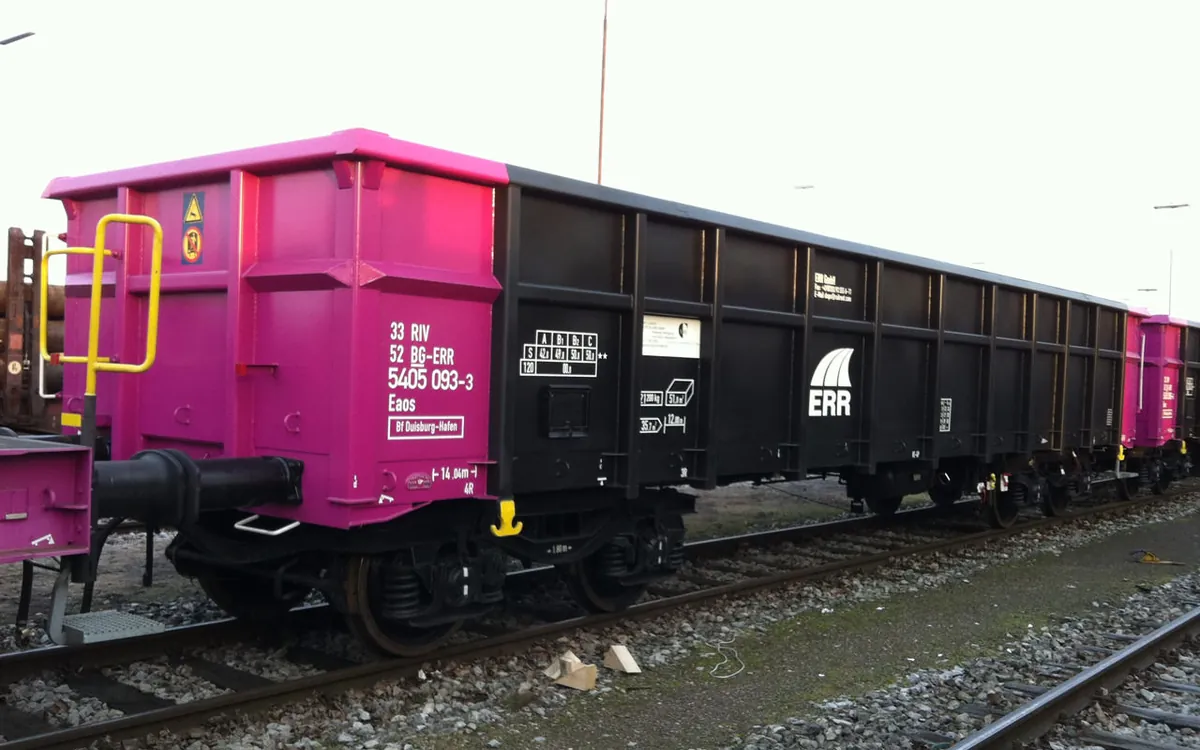
The standard four-axle open high-sided wagon, used across Europe for coal, ore, scrap, timber and bulk that can get wet. Loaded from above, unloaded by grab, by hand through the side doors or by tipping. Eanos is the heavier version (n: more than 60 t).
What the Eaos wagon is
Eaos is a UIC class code for a four-axle open wagon of the ordinary type. It has a flat floor, fixed side walls and side doors, but no roof. Many European railway companies run it, and Deutsche Bundesbahn started buying it in 1978.
The design goes back to a UIC standard from the early 1970s. The first German series was the Eaos 106. These wagons later received a steel floor and were renumbered Eaos-x 051, and new builds came out directly under that name. The Eaos 106 wagons still left in 2003 were rebuilt and fully overhauled as Eaos-x 075, a programme finished in 2014.
How it loads and unloads
The wagon is loaded from above by excavator, grab, conveyor or crane. All Eaos wagons have double doors in the sides, and most have two double doors per side, so goods can also be unloaded by hand or by forklift.
Most ordinary open wagons can be tipped sideways and over the end. End-tipping wagons have flaps at one or both ends. The letter o in Eaos means the wagon is not end-tipping. Some open wagons are strong enough for rotary dumpers, which lift and turn the wagon around its long axis. Eyes along the long sides take straps, ropes, nets or tarpaulins to secure the load, and some wagons have a handbrake that can be worked from the ground.
Dimensions and capacity
A typical Eaos measures 14.04 m over buffers, 3.04 m wide and 3.255 m high. The inside of the box is 12.79 m long, 2.76 m wide and 2.02 m high, which gives 35.3 m² of floor and 71.3 m³ of volume. The example wagon weighs 21.5 t empty and carries 58 t.
The UIC standard Ea(o)s sets a minimum loading length of 12.71 m, a floor of about 35 m², a volume of about 71 m³ and a maximum tare of 22.0 t, with two doors per side 1.80 m wide. The wagon runs at 120 km/h empty and 100 km/h loaded, rides on Y25 bogies with 920 mm wheels set 9.0 m apart, and takes curves down to 35 m radius.
Cargo and where it runs
Open wagons of class E are suited to bulk, scrap, steel, timber and paper. The Eaos in particular carries coal, ores, stone, scrap and wood. Because the box has no roof, the cargo must tolerate rain, or be covered with a tarpaulin.
Deutsche Bahn had about 16,000 four-axle E wagons in 1998, and Eaos wagons also run with other operators such as PKP Cargo in Poland. The two-axle Es types have been withdrawn since the 1990s and are now rare, so the Eaos family is the normal choice for open-wagon traffic.
Variants and what the letters mean
E stands for an ordinary open high-sided wagon. The index a means four wheelsets, o means not end-tipping and s means the wagon may run in trains up to 100 km/h. The German national suffix x marks a steel floor. The fifth digit of the 12-digit wagon number is 5 for every E wagon.
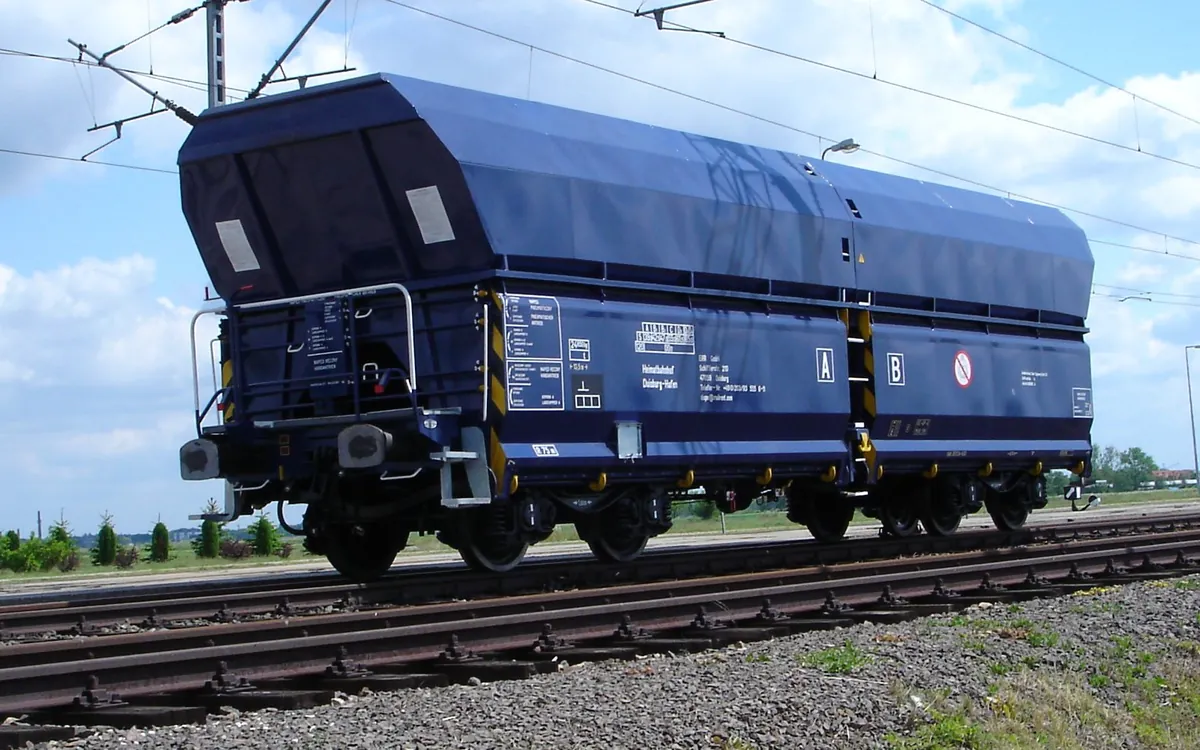
Eanos is the heavier variant: the letter n shows a load limit above 60 t on a class C line. Self-discharging open wagons with hoppers belong to the special class F instead, for example the Falns.
How to choose and book an Eaos
Check whether your cargo can be unloaded through the doors or needs a tippler or grab at destination. Ask whether the offered wagon has a steel floor (Eaos-x), which matters for heavy scrap and stone. For loads that must stay dry, ask about tarpaulins or switch to an opening-roof wagon of class T.
Confirm the load limit for the actual line class on your route, because the load table on the wagon changes by line category. Bulk shippers usually book full train sets, while single wagons travel in wagonload networks.
Variants
Questions shippers ask
What does Eaos stand for?
E is an ordinary open wagon, a means four axles, o means it cannot be tipped over the end and s allows 100 km/h. The letters describe the wagon, not a single model.
How much can an Eaos carry?
The example wagon carries 58 t in a box of 71.3 m³. The exact limit depends on the line class shown in the load table on the wagon.
How is an Eaos unloaded?
By grab or excavator from above, by hand or forklift through the side double doors, or by tipping where the wagon and the site allow it.
What is the difference between Eaos and Eanos?
The n marks a higher load limit, above 60 t on a class C line. Dimensions are similar.