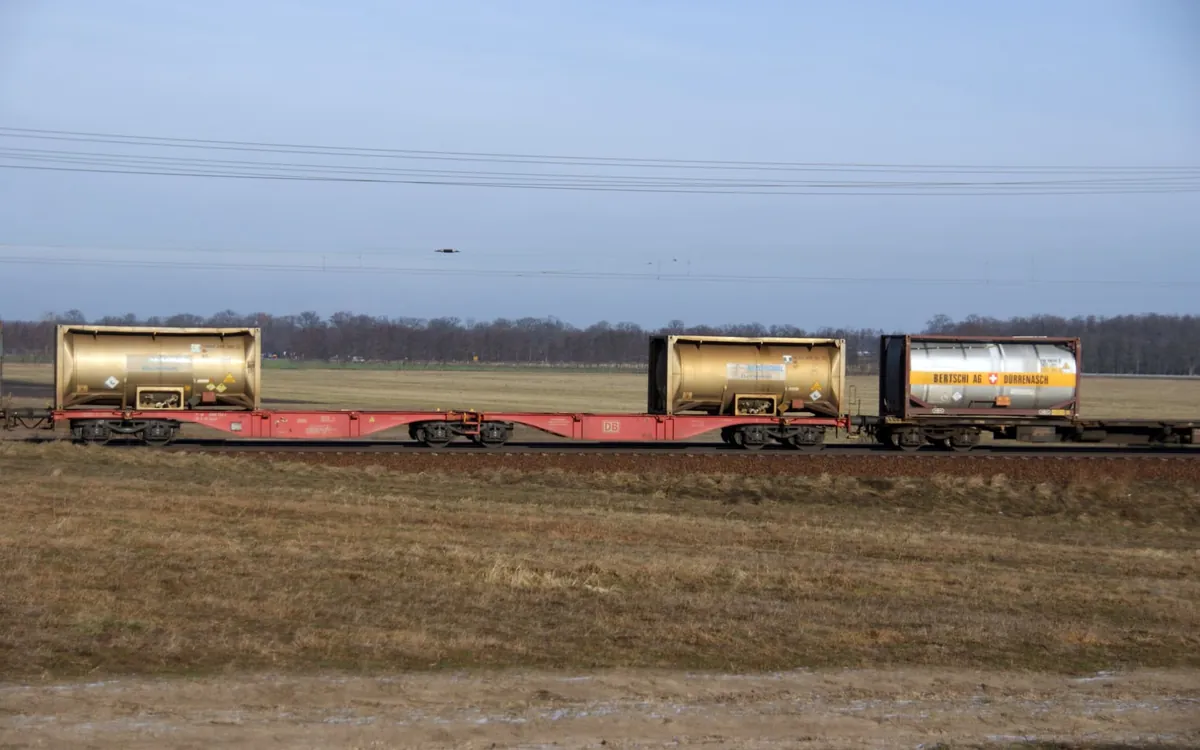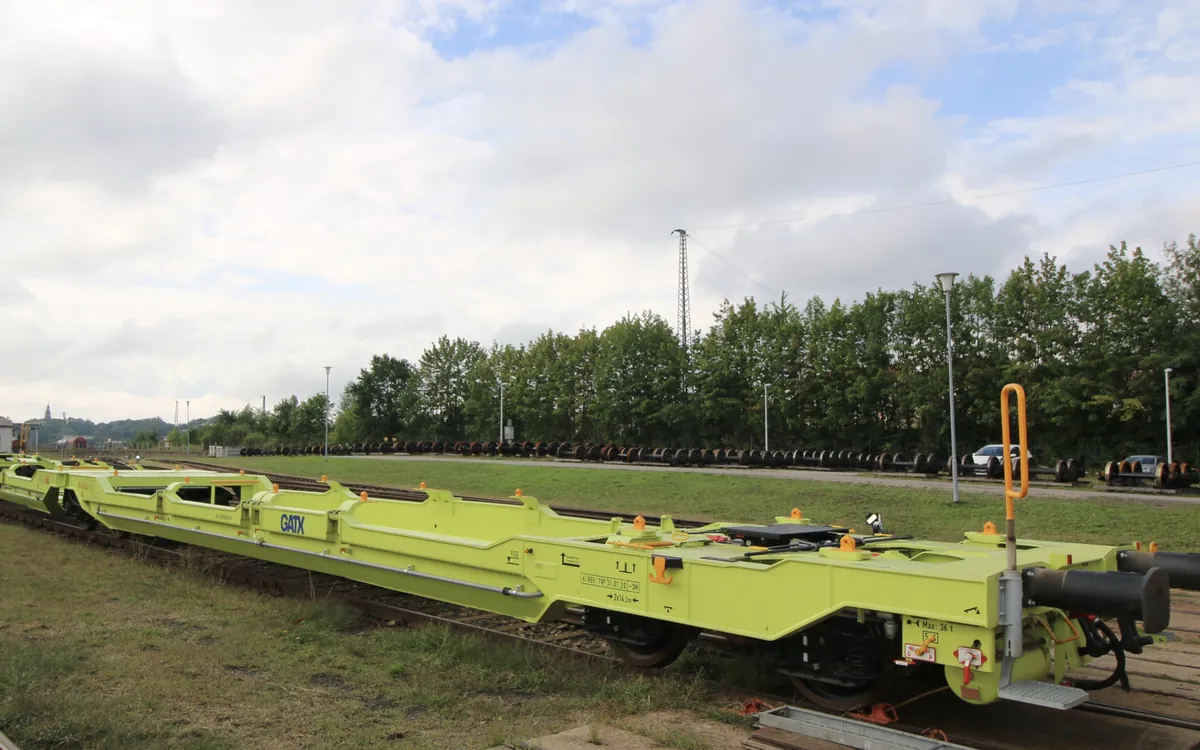





















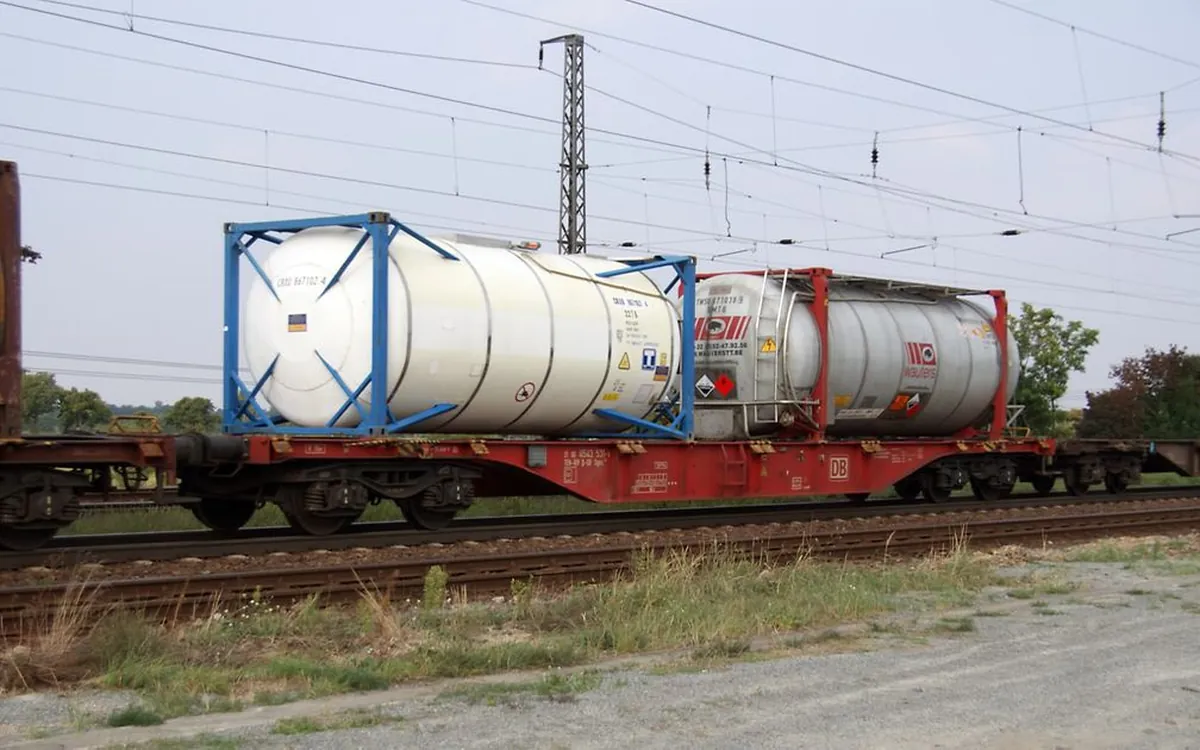
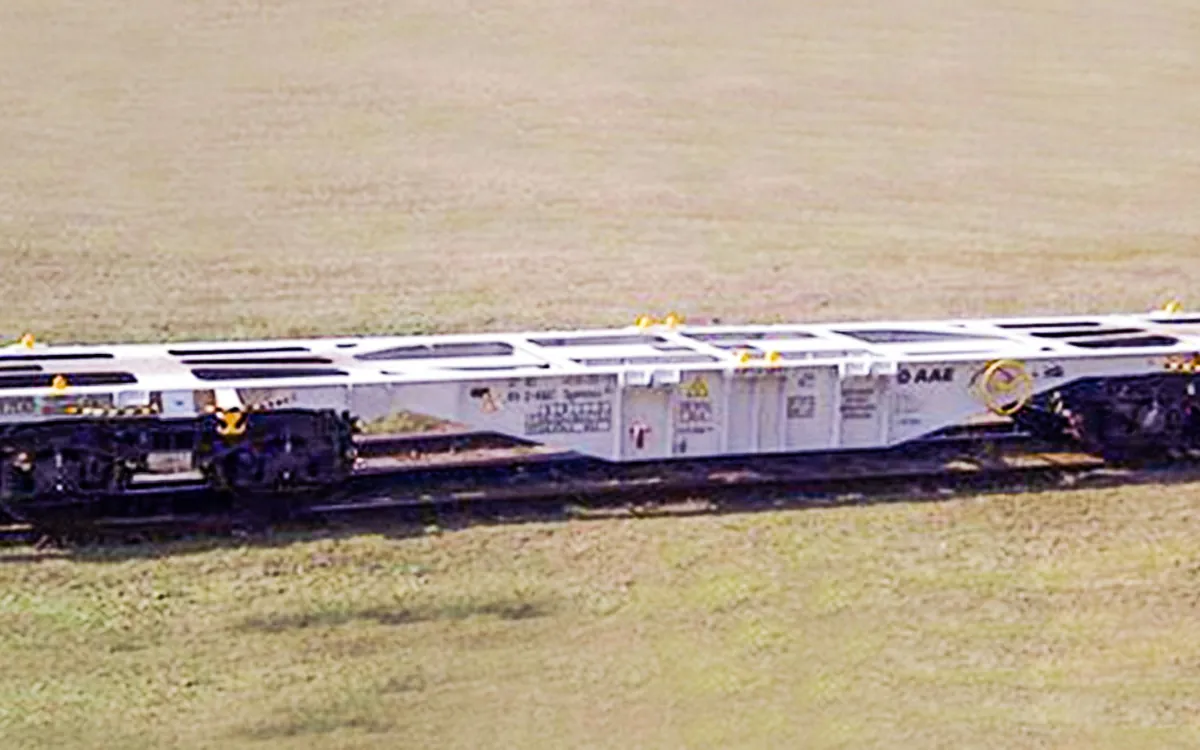
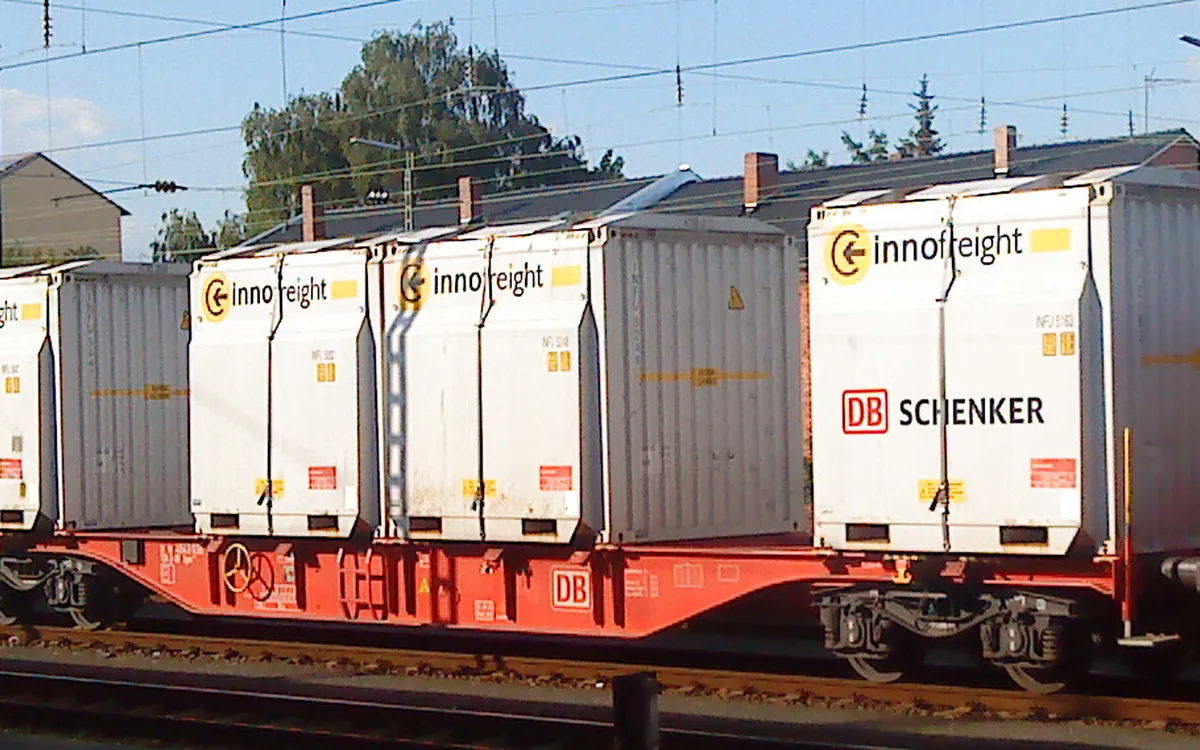
Four-axle container flat with folding spigots, the most common wagon in European combined transport. A loading length of at least 18.4 m takes ISO containers up to 60 ft in total, mostly swap bodies as well. Deutsche Bahn bought 615 Sgns from 2007.
What an Sgns wagon is
Container wagons are flat wagons fitted to carry containers. The Sg… types belong to the special flat wagons with bogies (class S) and are the most numerous wagons in combined transport. Wagons used only for containers have an open underframe, and the container rests on the beams and spigots.
Deutsche Bahn added 615 Sgns from 2007, delivered by March 2009, with an option for 600 more by 2010.
How containers are secured
Folding spigots on the frame lock into the corner castings of containers and swap bodies. Because the spigots fold away, the same wagon can take different lengths and combinations. Some wagons have long-stroke shock absorbers as extra load protection (index j).
Containers and swap bodies are lifted on and off by gantry crane or reach stacker at the terminal. The wagon itself has no ramps or walls.
Dimensions and capacity
Wagons with a loading length of at least 18.4 m (UIC 571-4 type 2) take ISO containers up to 60 ft in total, and most can also carry swap bodies. The UIC standard versions measure 19.64 m over buffers (Sgss, bogie centres 14.60 m) and 21.00 m (Sgjss, bogie centres 15.80 m).
In practice that means three 20 ft containers, a 40 ft plus a 20 ft, or a set of swap bodies. The shorter type 1 wagons with 14.5 m take one class A swap body, up to two class C swap bodies, or one ISO container of matching length.
Wagons with a loading length of at least 14.50 m (Type 1 under UIC 571-4) take an A swap body, up to two C swap bodies, or ISO containers of matching total length. Since the 1990s there have also been wagons with especially low decks and a 15.89 m loading length, for high-cube swap bodies and ISO containers with an inside height of 3 m.
Where it is used
Sgns wagons run in container and combined transport trains across Europe, linking seaports with inland terminals and carrying continental swap bodies between logistics hubs. For high-cube swap bodies and ISO containers with 3 m inside height there are also wagons with a very low floor and a 15.89 m loading length.
The class letters
S is a special flat wagon with bogies. g means fitted for containers up to 60 ft in total; gg would mean over 60 ft, up to 80 ft. n means a load limit above 60 t on a class C line. s permits 100 km/h and ss 120 km/h. j marks long-stroke shock absorbers, k and kk lower load limits, and mm a very short loading length.
Choosing a container wagon
Plan the loading pattern in units of 20 ft. A 60 ft wagon fits 40 + 20 ft; for two 40 ft boxes on one unit you need an articulated 80 ft wagon such as the Sggrss. Check the combined weight of the boxes against the wagon's load limit for the line class, and tell the operator if you ship high-cube units, which may need a low-floor wagon on routes with tight clearances.
Variants
Questions shippers ask
How many containers fit on an Sgns?
Containers up to 60 ft in total: for example three 20 ft, or one 40 ft plus one 20 ft.
Can an Sgns carry swap bodies?
Most wagons with 18.4 m loading length can carry swap bodies as well as ISO containers.
What does the g in Sgns mean?
For S wagons, g means fitted for containers up to 60 ft. gg is for up to 80 ft.