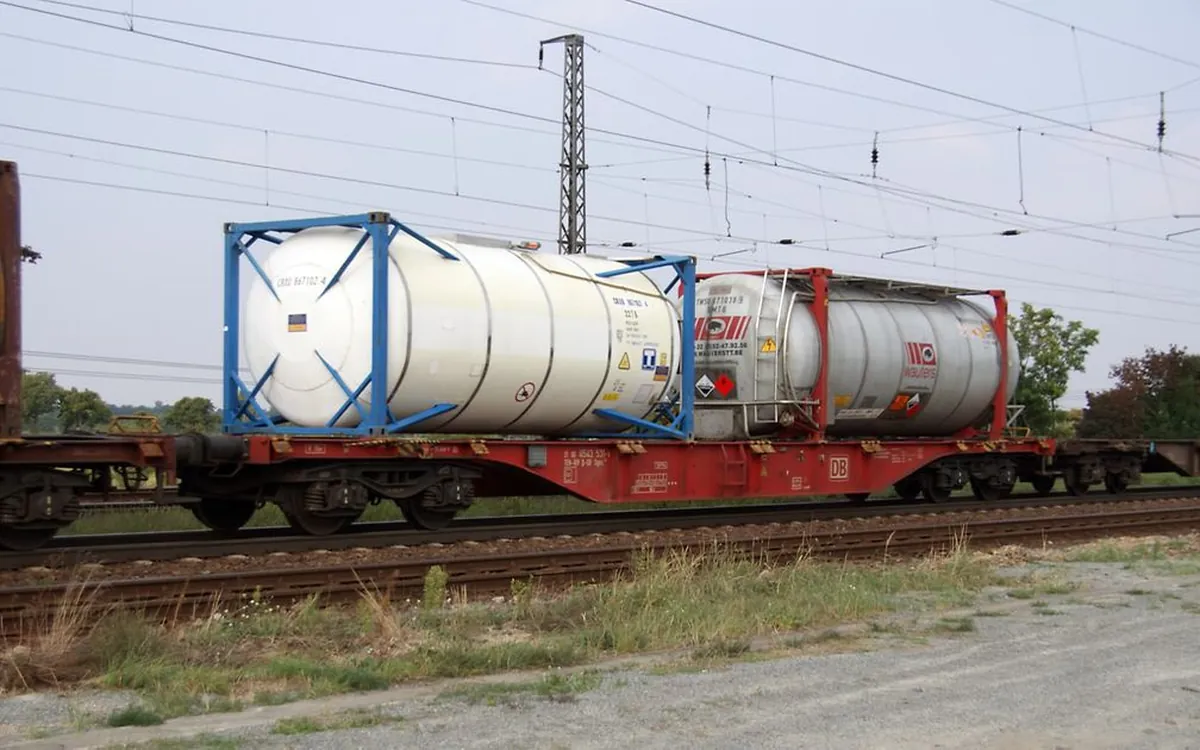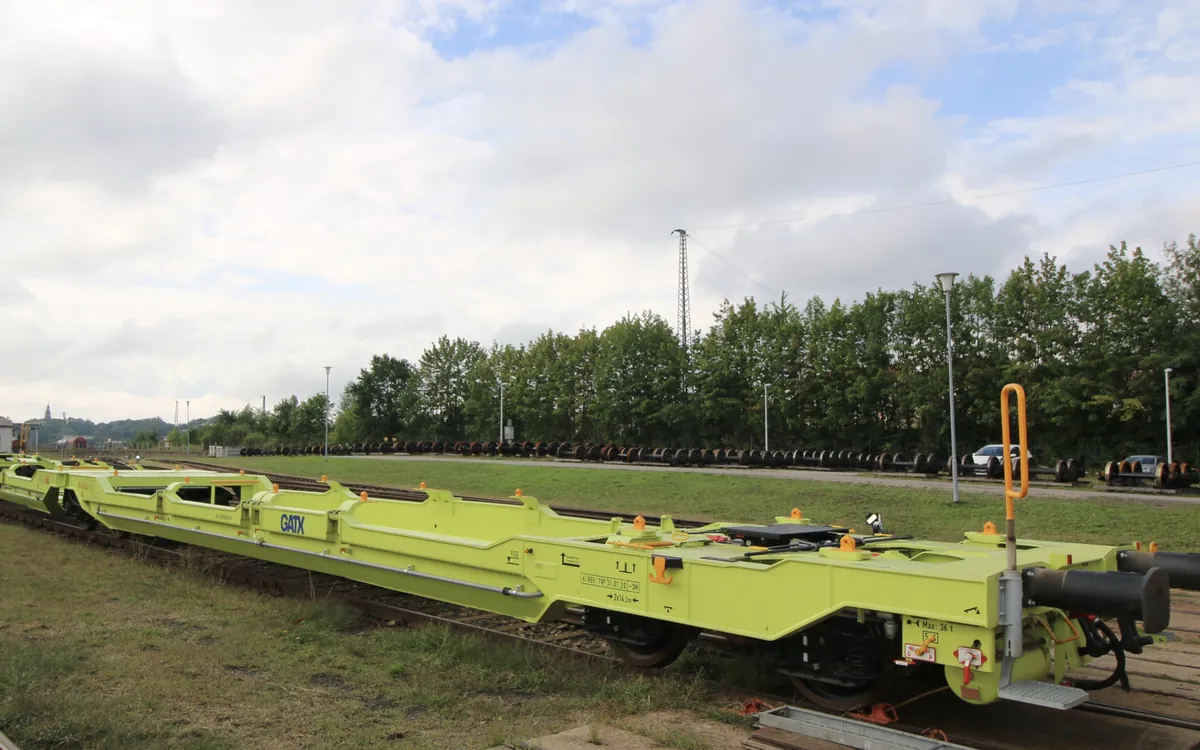





















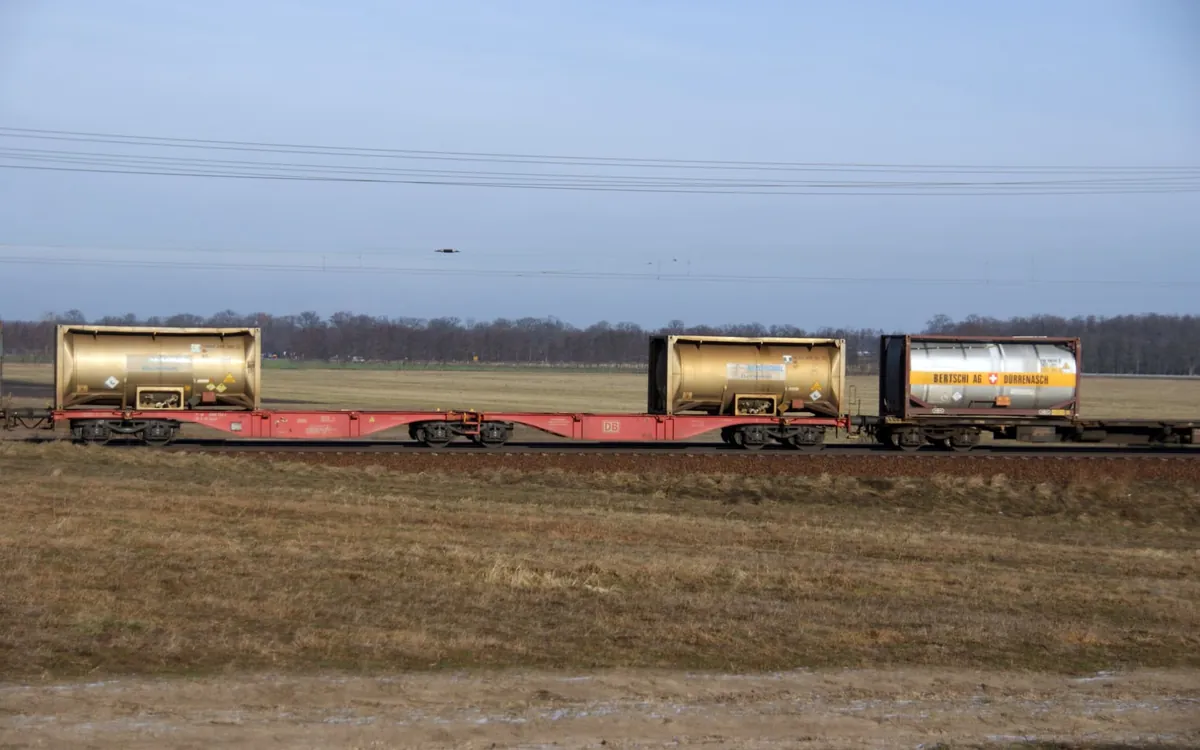
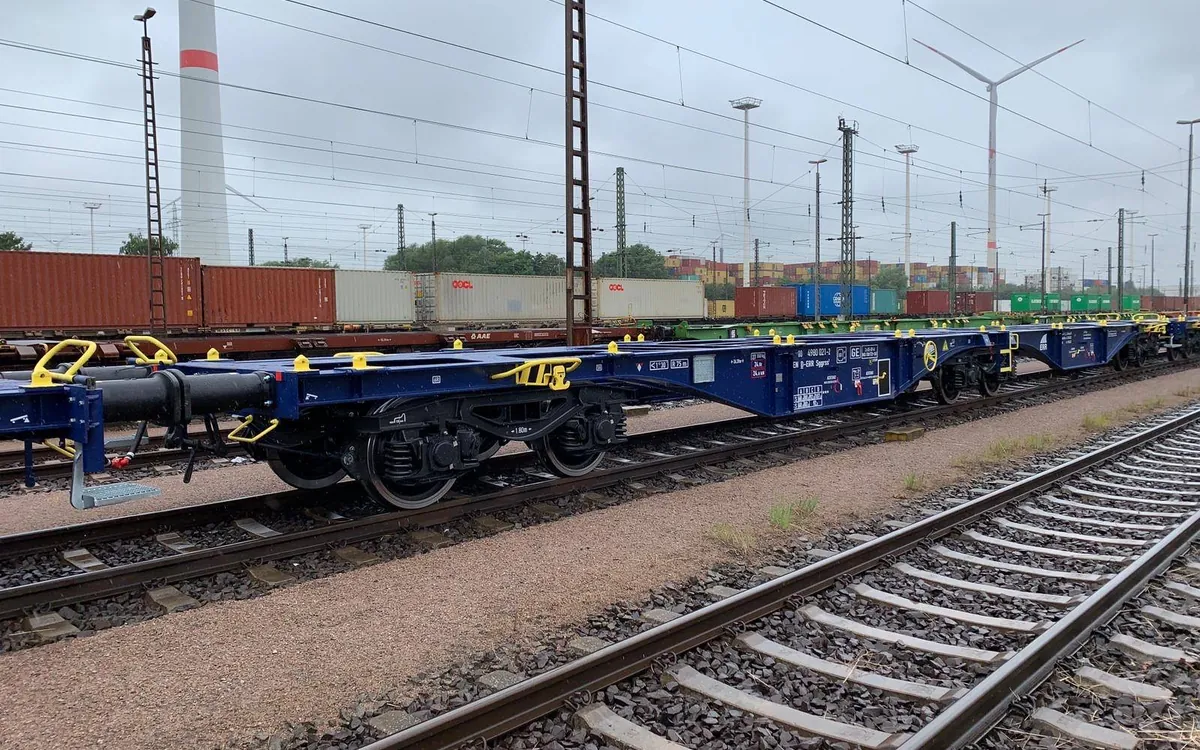
Two-unit articulated container wagon on three bogies. Two loading lengths of 16.1 m take containers or swap bodies up to 80 ft in total (index gg; r marks the articulated wagon). Shorter UIC standard version: Saggrss, 27.10 m over buffers.
What an articulated container wagon is
The Sggrss consists of two wagon units that share a bogie under the joint, so the whole wagon runs on three two-axle bogies (six axles). It is a special flat wagon with bogies (class S) built only for containers and swap bodies.
The UIC standardised a shorter six-axle articulated container wagon, the Saggrss, in leaflet 571-4. The longer Sggrss with two 16.1 m units became common later.
How it carries containers
Each unit has folding spigots that lock into container corner castings. With two loading lengths of 16.1 m, the wagon takes swap bodies or ISO containers up to 80 ft in total, for example two 40 ft containers or combinations of 20 ft and 30 ft units.
Loading and unloading is by gantry crane at the terminal. Because the units are joined over a shared bogie, the wagon behaves as one vehicle in the train and cannot be split in normal service.
Dimensions
The Sggrss offers 2 × 16.1 m of loading length. The UIC standard Saggrss measures 27.10 m over buffers, with bogie centres 10.70 m apart and a loading length of 2 × 12.27 m.
For comparison, a single four-axle container wagon with 18.4 m loading length takes only 60 ft in total, so two 40 ft boxes need two such wagons.
Class S is the largest group of flat wagons by both variety and numbers. In 1998 Deutsche Bahn had about 22,000 class S wagons. Container wagons are the most common type in combined transport, and their folding spigots let them carry different systems of containers and swap bodies.
Where it is used
Articulated container wagons run in container and combined transport trains between seaports and inland terminals. Some combination types mix a container unit and a pocket unit, such as the 270 wagons Talbot built for Kombiwaggon in 1991 and 1992, first listed by DB as Sdggnos 744.
Most container flats are built for standard 20 and 40 ft ISO containers. A single four-axle wagon usually takes three 20 ft boxes or one 40 ft plus one 20 ft. The articulated Sggrss raises this to 80 ft of containers on one wagon, carried on only three bogies.
Reading Sggrss
S is a special flat wagon with bogies. gg means fitted for containers with a total length over 60 ft, up to 80 ft. r means an articulated wagon. ss permits 120 km/h. In Saggrss the extra a means six axles; m and mm mark shorter loading lengths.
When to choose an Sggrss
Pick an articulated 80 ft wagon when most of your volume is 40 ft or 45 ft containers or long swap bodies, because two units fit per wagon. If your boxes are mainly 20 ft and heavy, check the load limit per unit, since weight may run out before length does. Ask the terminal whether it can handle the full wagon length on its crane tracks.
Variants
Questions shippers ask
How many containers fit on an Sggrss?
Up to 80 ft in total, for example two 40 ft containers, over two loading lengths of 16.1 m.
What does r mean in Sggrss?
For S wagons, r marks an articulated wagon whose units share a bogie.
What is the difference between Sggrss and Sgns?
The Sgns is a single four-axle wagon for up to 60 ft. The Sggrss has two articulated units on three bogies and takes up to 80 ft.