



















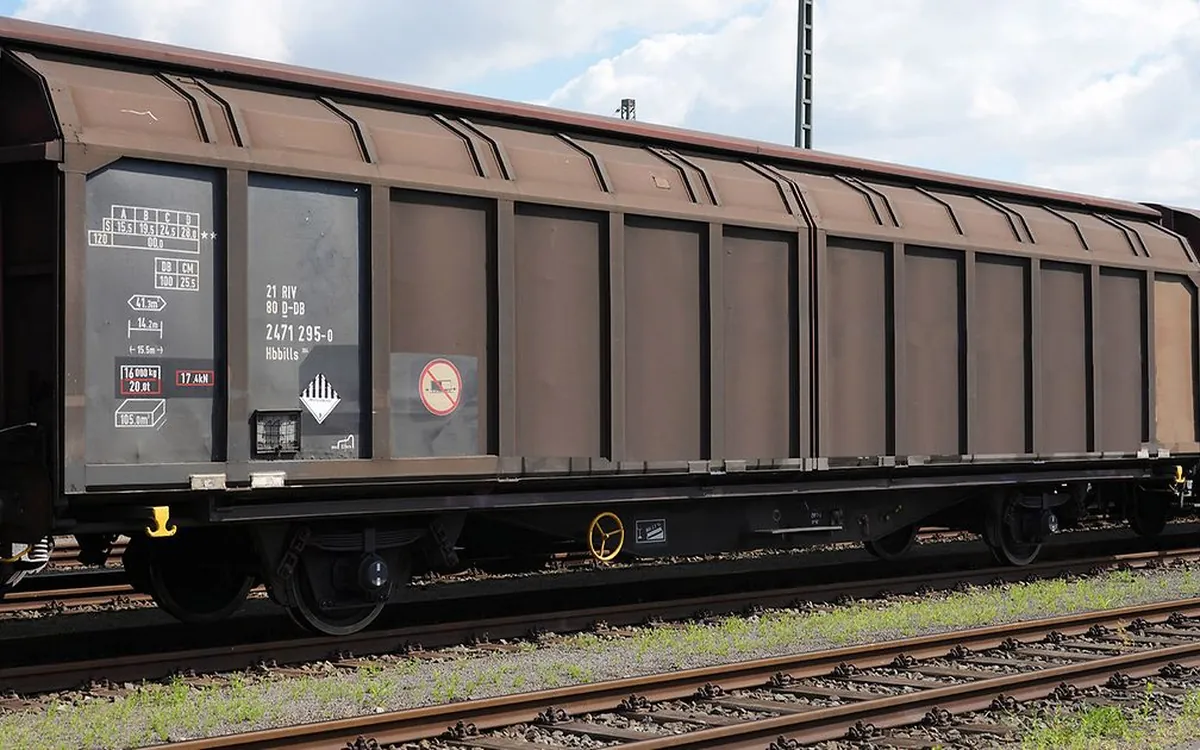
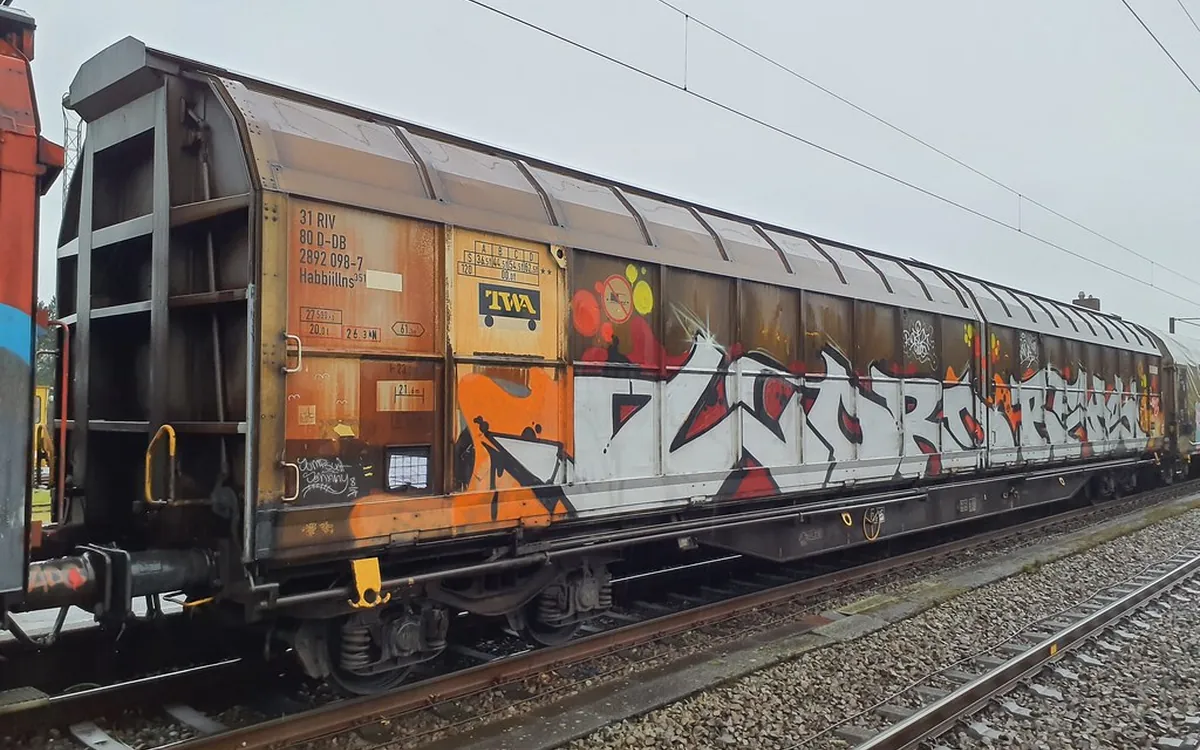
Special covered wagon whose side walls slide open, so half the side is open at once and pallets go in by forklift along the full length. Movable or lockable partitions hold part loads. The class name is the whole spec: H special covered, a 4 axles, bb loading length 22 m or more, ii high-strength sliding walls, ll lockable partitions, n heavy.
What a sliding-wall wagon is
Sliding-wall wagons have no fixed side walls. Instead, the walls slide along the wagon so that one half of the side is open at a time and the whole floor can be loaded from the side. They belong to the special covered class H, with the index i for sliding walls.
They are not a development of the old covered wagon. They grew out of wagons with sliding roof and sliding walls in the 1950s, which is why they were first placed in the German class K. Deutsche Bahn has about 15,000 sliding-wall wagons.
Loading, partitions and load security
Forklifts load whole pallets through the open side, much faster than through the single door of an ordinary covered wagon. Many wagons have partition walls that stop the load from shifting lengthwise (index l), and some can be locked in place (index ll). This holds a part load firmly when the wagon is not full. Partitions do take some floor space.
The older German index t marked the Daberkow load protection system with movable walls, used until 30 April 1994. The international l and ll indices for movable and lockable partitions apply from 1 May 1994.
Dimensions and capacity
Wagons built up to the early 1980s have 34.1 m² of floor without partitions and take up to 30 Euro pallets (index b). Newer designs have 41.0 m² and take up to 40 Euro pallets (index bb). For an H bogie wagon, bb means a loading length of 22 m or more.
The UIC standard four-axle sliding-wall wagon Habiss measures 21.70 m over buffers with bogie centres 16.66 m apart and two loading lengths of 8.67 m each. It has about 50 m² of floor, about 131 m³ of volume and a maximum tare of 29.0 t.
Cargo and networks
These are the usual wagons for palletised goods that are sensitive to moisture. Because loading gauges differ by country, operators keep special versions. Wagons cleared for Great Britain have a very small profile and carry f, ff or fff. Smaller profiles also apply in transit through Switzerland to Italy, and Deutsche Bahn keeps wagons for that traffic.
Insulated sliding-wall wagons with a refrigeration unit, such as the Hbbills-u of Rail Cargo Austria and the Hbbills-uy of SBB Cargo, cover 0 to +20 °C.
Reading the class code
H means special covered wagon. a means four axles. bb means a bogie wagon with a loading length of 22 m or more. ii means high-strength sliding walls. ll means lockable partitions. n means a load limit above 60 t on a class C line, and s permits 100 km/h. The fifth digit of the wagon number is 2 for H wagons.
Choosing and booking
Count your pallets against 30 (b) or 40 (bb) Euro pallet places. If you ship part loads, ask for lockable partitions (ll). For traffic to Britain or through Switzerland to Italy, confirm that the wagon fits the loading gauge on the route. Make sure both terminals have forklifts and a hard standing alongside the track.
Variants
Questions shippers ask
How many pallets fit in a sliding-wall wagon?
Older wagons take up to 30 Euro pallets on 34.1 m². Newer bb wagons take up to 40 on 41.0 m², without partitions.
What does ll mean in Habbiillns?
For H wagons, ll means lockable partitions, which hold part loads in place. A single l means movable partitions.
Can a sliding-wall wagon go to Great Britain?
Only versions built to the smaller British gauge, marked f, ff or fff.