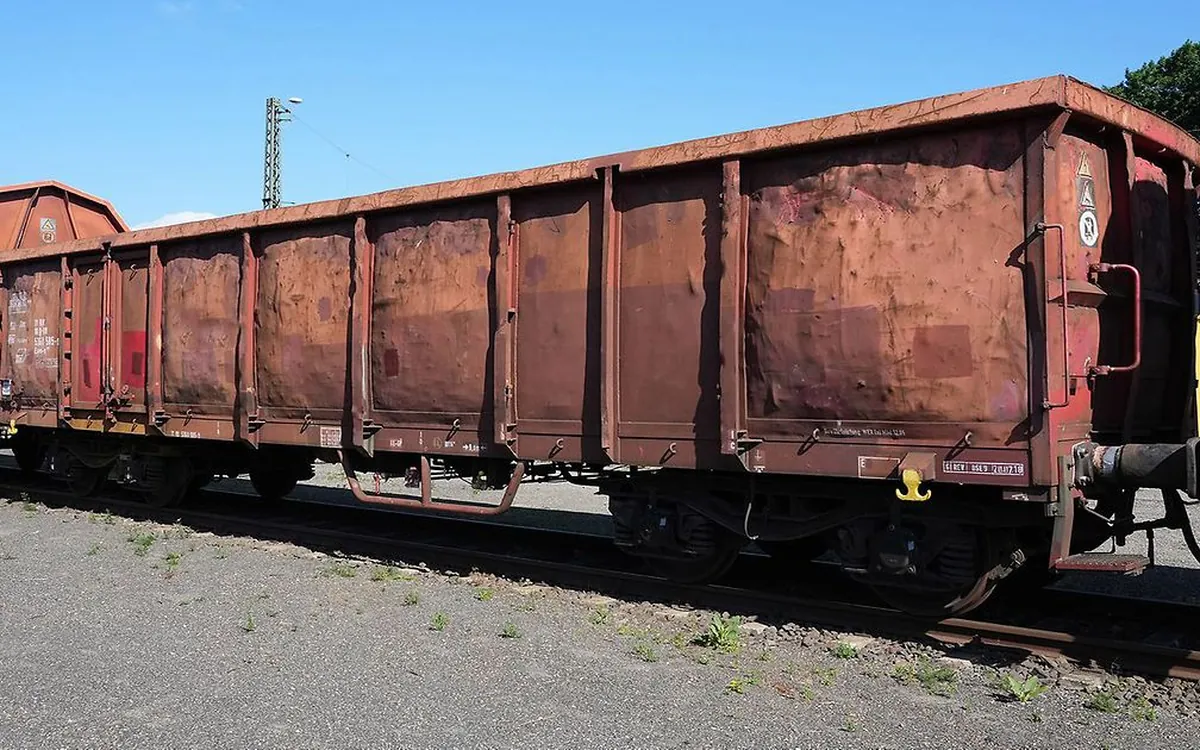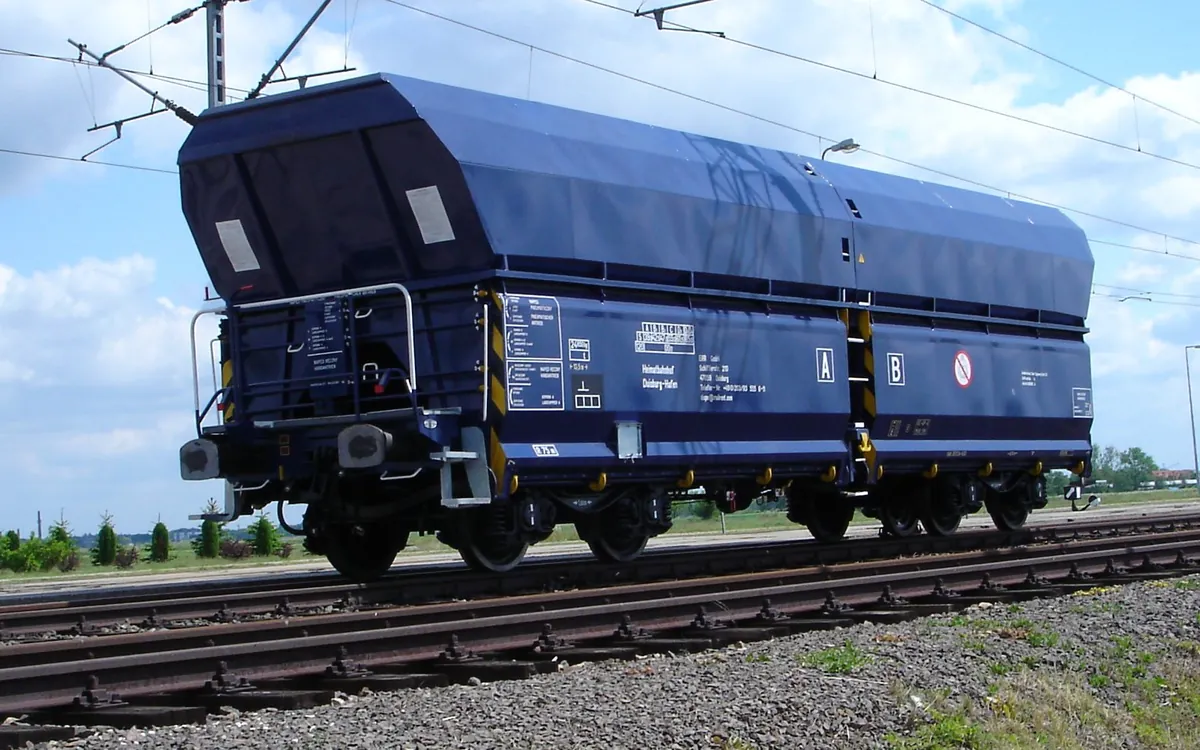
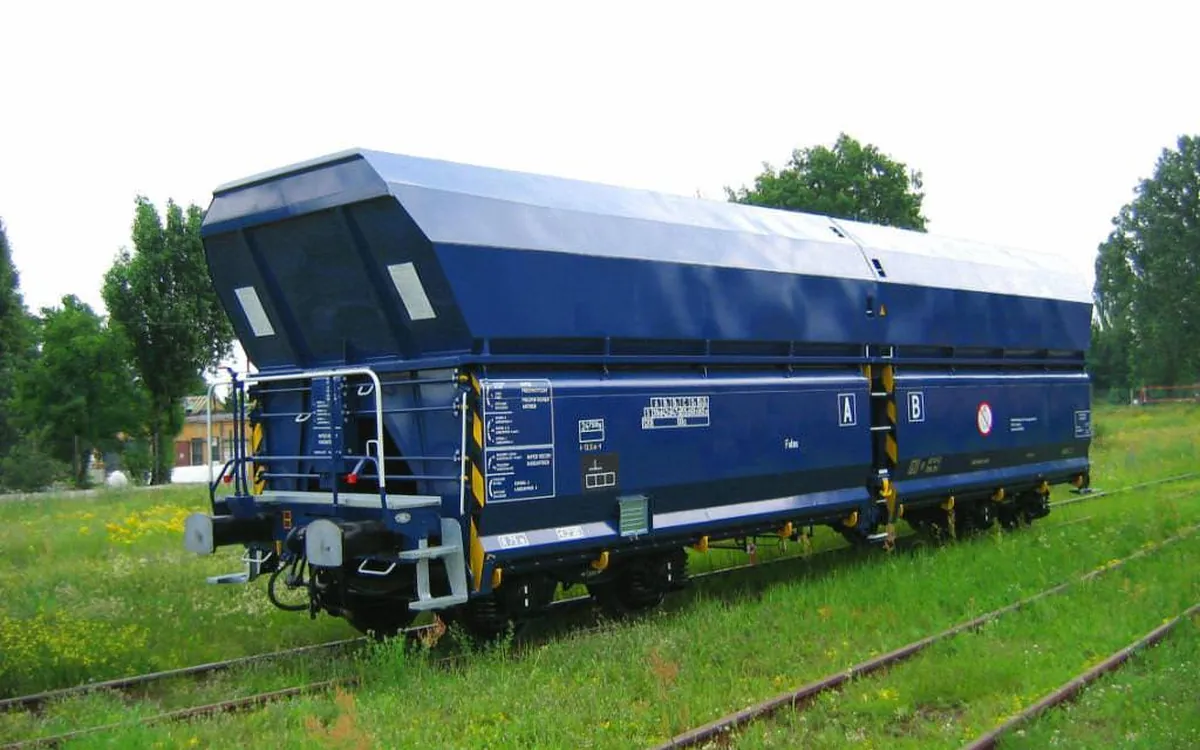
Four-axle open hopper wagon for bulk that may get wet (coal, ore, gravel). Two flaps on each side open and the load falls out by gravity, so no crane or tippler is needed. The flaps work by hand wheel, by compressed air from the locomotive, or by hydraulics driven by an axle pump. Bought by the Deutsche Bundesbahn from 1987 and used across Europe.
What the Falns wagon is
Falns is a special open wagon (class F) with a saddle-shaped floor. The floor slopes down to both sides like a pitched roof, and large flaps along the sides let the load fall out. German literature calls this type a Sattelwagen or large-capacity self-discharging wagon.
Many European railway companies run Falns wagons. Deutsche Bundesbahn bought them from 1987, and the type is used mainly for bulk goods that are not sensitive to moisture.
How it discharges
Each side has two flaps. When they open, the bulk load drops out by gravity into a pit or bunker under the track. Discharge is sudden rather than controlled: the whole wagon empties at once, on both sides at the same time. The discharge edge sits at least 70 cm above the rail, which is the meaning of the letter l.
The flaps can be worked mechanically with a hand wheel, pneumatically with cylinders fed from the locomotive or a fixed compressed-air supply, or hydraulically with cylinders whose pressure comes from an axle-driven pump while the wagon runs. Hydraulic systems can be controlled from the side, from the platform, by magnets fixed at the bunker or by radio. Wagons that store their own energy can be unloaded at any suitable site.
Dimensions and capacity
The UIC standard Fals measures 12.54 m over buffers with bogie centres 7.50 m apart, holds about 75 m³ and weighs at most 25.0 t empty. The standard captures the 1980s state of a design that has kept growing longer.
The Falns 121 of Deutsche Bahn, built in several series from 1992, holds 90 m³. Its latest wagons weigh no more than 24.5 t empty, which gives a load limit of 65.5 t at 22.5 t axle load (line class D). Parts of the hopper are stainless steel and the whole hopper has a thick epoxy coating against the salts in coal, which allowed thinner plate and less tare.
Cargo and where it runs
Typical loads are coal, ore, sand and gravel. Saddle wagons run mostly in block trains that carry one cargo from a mine or port straight to a steelworks or power station. The receiving bunker must be large enough to take a wagon's load in one go.
In 1998 Deutsche Bahn had about 10,000 saddle wagons and about 12,000 hopper wagons with controlled discharge. A registered Falns also runs with Netherlands Railways, and the type is in service across Europe.
Variants and the class letters
F means a special open wagon. a means four axles, l means uncontrolled gravity discharge with a high discharge edge, n a load limit above 60 t, and s a speed of 100 km/h. Wagons with controlled discharge carry c instead and are usually hopper wagons such as the two-axle Fcs.
Talns is the same saddle design with an opening roof for bulk that must stay dry. Since the 2020s the RockTainer ORE system, two 45 m³ tipping boxes on an eight-axle InnoWaggon, has appeared as an alternative for dense ore.
Choosing a Falns
Check that the receiving site has a bunker or pit sized for sudden discharge, and which flap drive the wagon uses, because the site must supply compressed air, a magnet system or staff. If your product must be metered onto a conveyor, a hopper wagon with c discharge suits better. For goods that cannot get wet, ask for a Talns with an opening roof.
Variants
Questions shippers ask
How is a Falns unloaded?
Two flaps on each side open and the bulk falls out by gravity into a pit or bunker. The flaps are worked by hand wheel, compressed air or hydraulics.
What is the difference between Falns and a hopper wagon with c?
The Falns empties all at once (index l). Wagons with index c allow controlled, metered discharge, often onto conveyors.
How much does a Falns hold?
The UIC Fals holds about 75 m³. The newer Falns 121 holds 90 m³ with a load limit of 65.5 t at 22.5 t axle load.